
Activity
Fruit Fly Life Cycle
Have you ever noticed the tiny fruit flies flitting around your fruit bowl in the summertime? Did you know that they have been used for genetic research for nearly a hundred years? Genetics is the study of how traits are passed from one generation to the next. The types of living things that work best for genetic studies are those that are easy to keep in a lab, have lots of offspring, and most importantly, have short generations. A generation is the average time between the birth of the parents and the birth of the parents’ offspring. A human generation is twenty five years or more. A fruit fly generation is two weeks.
Fruit flies have other characteristics helpful for research. Fruit flies have many genetically derived traits, like red, white, and brown eye color, that are easy to identify. It is also helpful for research that it’s fairly easy to tell the sexes apart. Male fruit flies are smaller, and their abdomens are less pointy than females’ abdomens, with a distinctive black patch.

Some of the most important information discovered about fruit flies involves chromosomes. Chromosomes contain DNA in cells that gives instructions for how organisms function and develop. Humans have 23 pairs of chromosomes. Fruit flies have only 4. One of the four pairs of chromosomes is called the sex chromosomes. How the sex chromosomes are paired determines whether the fly is male or female. Male fruit flies, and male humans, have an X and Y chromosome. Female fruit flies, and female humans, have two X chromosomes. In the early 1900s, fruit fly geneticist Thomas Hunt Morgan used his extensive data on multiple fruit fly generations to determine how chromosomes were related to genes in all organisms.
Problem
What is the life cycle of a fruit fly?
Materials
- Overripe banana
- One quart jar
- Large rubber band
- Magnifying glass or dissecting microscope
- Wingless fruit fly cultures (optional, can be bought from a pet store)
Procedure
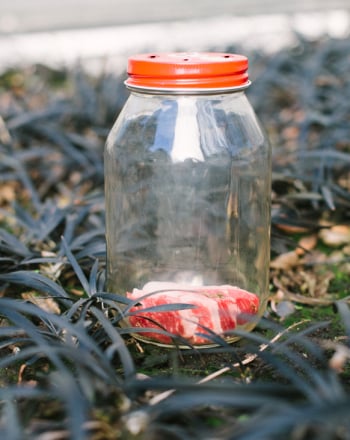
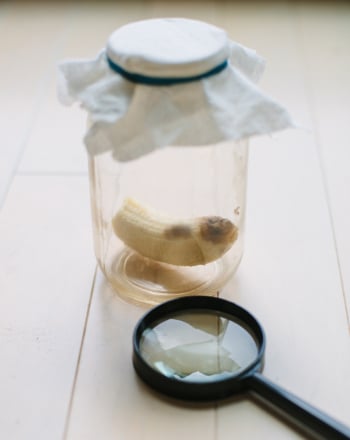
- Peel the banana and place it in an uncapped jar outside.
- In a couple hours, you should find tiny fruit flies crawling around the banana. You need to capture a number of fruit flies for this experiment to work. If no fruit flies have arrived on your banana, try waiting a couple more hours, or if you’re doing your experiment in the winter, you can order wingless fruit flies through a pet store.
- Cover the jar with a paper towel.
- Secure the paper towel with a rubber band.
- Using the magnifying glass, try to observe fruit flies and see if you can identify the males and females.
- Keeping the paper towel secure, observe the fruit flies every day for at least ten days using the magnifying glass.
Results
At first, you might notice tiny white wet specks on the banana surface. These are the eggs that the fruit flies laid. After a couple days, you should notice little white wormlike creatures on the surface of the banana. Since fruit flies are still flies, these cute little white worms are called maggots.

These maggots keep themselves busy eating tunnels through the banana all day and night. Four or five days later, the maggots will attach themselves to the inside wall of the jar, forming structures that look like large rice grains, which darken after a couple days. About ten days later, tiny flies should emerge from the banana. If the decomposing banana is not grossing your family out, you can observe how this generation of flies mates and lays eggs, repeating the life cycle.

Why?
Fruit flies are insects, and like all insects, they go through distinct live stages. The fruit flies you captured laid eggs, and those white wiggly maggots you observed are the second stage of fruit fly development, called larvae, just like caterpillars are the larval stage of butterflies and moths. Those little specks were the third stage in the fruit fly life cycle, called pupae. The specks darkened as the flies’ legs, wings, and heads developed.
Going Further
Repeat the experiment putting jars at different temperatures. How does this affect the fruit fly behavior? Research some genetics experiments done with flies. You can even order fruit fly kits at some online science stores.
Education.com provides the Science Fair Project Ideas for informational purposes only. Education.com does not make any guarantee or representation regarding the Science Fair Project Ideas and is not responsible or liable for any loss or damage, directly or indirectly, caused by your use of such information. By accessing the Science Fair Project Ideas, you waive and renounce any claims against Education.com that arise thereof. In addition, your access to Education.com's website and Science Fair Project Ideas is covered by Education.com's Privacy Policy and site Terms of Use, which include limitations on Education.com's liability.
Warning is hereby given that not all Project Ideas are appropriate for all individuals or in all circumstances. Implementation of any Science Project Idea should be undertaken only in appropriate settings and with appropriate parental or other supervision. Reading and following the safety precautions of all materials used in a project is the sole responsibility of each individual. For further information, consult your state's handbook of Science Safety.
Related learning resources