
Activity
Dinosaur Tracks: How Are Fossilized Imprints Formed?

How did dinosaurs leave their footprints behind so many years ago? Stomp, clomp, and squish your way to learn how to make fossils and create your very own fossil imprints!
Problem
How did dinosaur footprints get fossilized?
Materials
- 1 cup damp, used coffee grounds
- ½ cup of cold coffee
- 1 cup of flour
- ½ cup of salt
- Wax paper
- Bowl
- Wooden spoon
- Rolling pin
Procedure
- Get out a large mixing bowl.
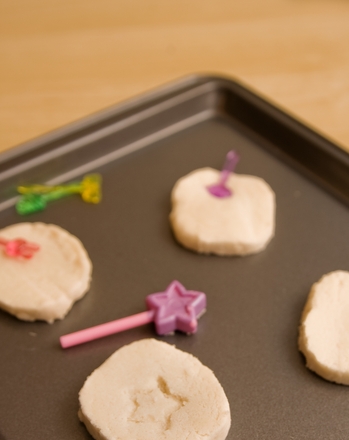
- Place the damp coffee grounds, cold coffee, flour, and salt into the bowl. Stir them together using the spoon. You can use your hands to make sure that the mixture is mixed thoroughly and completely damp. The result will look like muddy clay.
- Now, roll out a sheet of wax paper. Put a handful of “clay” on the paper and use your hand or the rolling pin to form it into a ½ inch thick blob.
- Press your fingers into the blob. What happens?
- If you’d like, you can also collect items from outdoors and try squishing them into the clay as well. What items make the best prints?
- Once you’ve made your masterpiece, let the clay dry in a room temperature location over the next few days. Then, check out your completed print!
Results
Your hand will make a print in the damp coffee ground clay and this print will stay as the clay dries.
Why?
Dinosaurs lived millions of years ago, but they left behind many clues that we can use to learn more about them. Of course, they left behind fossilized bones, but they also left behind traces of their lives, including eggs and dinosaur dung. They also left behind their footprints! We can track these ancient animals and learn more about their behavior using these prints. There are many more trace fossils than there are body fossils, since one animal can make a lot of prints and eggs, but only leaves behind one body to fossilize.
Footprint fossils are called imprint fossils, which means that something got squished into wet soil, mud, or sand and then turned into a fossil. How does this work? If you squish your foot into some damp mud, it’s likely that it will wash away during the next rain. However, if sediment covers that mud after it dries, then the sediment itself can turn into a hardened layer of rock with the footprints safely tucked inside. Over many millions of years, many layers of rock can stack on top of each other as water places sediment on top of existing sediment or as successive landslides cover each other. Many millions of years later, these rocks can erode and break apart, revealing the footprints inside.
Can you hide your fossil footprint inside something else? Experiment with clay, sand, and other materials like cornmeal to see if you can create a place for your fossil to hide.
Education.com provides the Science Fair Project Ideas for informational purposes only. Education.com does not make any guarantee or representation regarding the Science Fair Project Ideas and is not responsible or liable for any loss or damage, directly or indirectly, caused by your use of such information. By accessing the Science Fair Project Ideas, you waive and renounce any claims against Education.com that arise thereof. In addition, your access to Education.com's website and Science Fair Project Ideas is covered by Education.com's Privacy Policy and site Terms of Use, which include limitations on Education.com's liability.
Warning is hereby given that not all Project Ideas are appropriate for all individuals or in all circumstances. Implementation of any Science Project Idea should be undertaken only in appropriate settings and with appropriate parental or other supervision. Reading and following the safety precautions of all materials used in a project is the sole responsibility of each individual. For further information, consult your state's handbook of Science Safety.
Related learning resources