
Activity
Cleaning With Lemon Experiment

Many people use lemon juice to keep household items smelling fresh and looking clean. Does lemon really have any cleaning powers?
Problem
Can lemons be a cleaning agent?
Materials
- Strainer
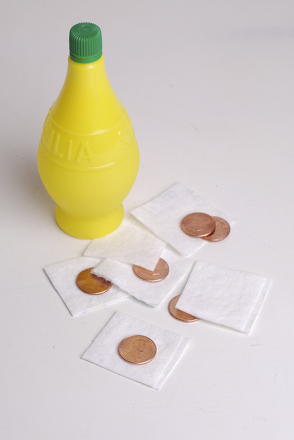
- 3 ripe lemons
- Lemon juicer
- Knife
- 3 pennies made before 1982
- Cup
- Faucet
- Greasy pan
- Sink with metal plug
- Paintbrush
- Bathtub
- 1/8 cup measuring cup
- 4 dry cleaning rags
Procedure
- Take a ripe lemon and cut it in half.
- Squeeze out the juice, and then put the juice through the strainer to make sure that there is no pulp left. Do the same with the other lemons. Make sure that you have about half a cup of lemon juice.
- Divide the lemon juice into four parts, about 1/8 of a cup each.
- Now, place three pennies into a cup with 1/8 cup of lemon juice. Set this aside.
- Plug your sink and place another 1/8 of a cup of lemon juice into the sink.
- Dip the brush into another 1/8 cup of lemon juice and paint it onto part of a dirty bathtub.
- Get a small greasy pan and place another 1/8 of a cup of lemon juice into the pan.
- After 10 minutes, use a cloth to rub at each of these materials. What happens to each of these materials when they’re exposed to lemon juice?
Results
The lemon juice will clean the pennies and soap scum and will not work as well on the grease.
Why?
Lemon juice is acidic. This is why you put so much sugar into the mix when you make lemonade! Since lemon juice is high in citric acid, it also makes a good natural cleaner.
Different materials get dirty in different ways. Your sink and bathtub gets covered in soap and toothpaste scum. Your pans get deposits of fatty grease. As metals react with the air, they form dull-looking oxides. Different cleaners work for these different types of "dirt." When you’re choosing a cleaner, it’s good to know whether the substance you’re trying to remove is acidic or alkaline. Choose a cleaner that’s the opposite, and it will react with the “dirt” on your object and will remove it most effectively.
Acids like lemon juice work best on alkaline types of stains. Since soap is alkaline, lemon juice and vinegar are both great at removing soap scum. They are less effective at removing grease. Alkaline cleaners like soap are better at removing grease by emulsifying it, or spreading it out into the dishwater. Solvents actually dissolve the grease. By understanding the chemistry behind cleaning, you can choose the best cleaners for the job.
When lemon juice interacts with oxidized metal, it reacts with the dark oxides and the penny looks shiny and new again. This is especially noticeable with copper pennies. Since most pennies made after 1982 are made out of zinc with a thin copper coating, you used real copper pennies to get the true effect. If you’re cleaning metals like copper or brass with lemon juice over the long term, this can react with the metals and can cause corrosion, damaging the metal.
Do you think that the lemon juice would work in the same way if it were diluted with water? Try adding 1/8 of a cup of lemon juice to a cup and filling the cup to the halfway point with water, and do the experiments again. What changes? Add salt to your lemon juice mixture and try cleaning additional items. Does this work better, the same, or not as well as plain lemon juice?
Education.com provides the Science Fair Project Ideas for informational purposes only. Education.com does not make any guarantee or representation regarding the Science Fair Project Ideas and is not responsible or liable for any loss or damage, directly or indirectly, caused by your use of such information. By accessing the Science Fair Project Ideas, you waive and renounce any claims against Education.com that arise thereof. In addition, your access to Education.com's website and Science Fair Project Ideas is covered by Education.com's Privacy Policy and site Terms of Use, which include limitations on Education.com's liability.
Warning is hereby given that not all Project Ideas are appropriate for all individuals or in all circumstances. Implementation of any Science Project Idea should be undertaken only in appropriate settings and with appropriate parental or other supervision. Reading and following the safety precautions of all materials used in a project is the sole responsibility of each individual. For further information, consult your state's handbook of Science Safety.
Related learning resources