
Activity
Break a Ruler Using Newspaper and Atmospheric Pressure

In those rare moments when we actually think about the air around us, we typically think of the oxygen that allows us to breathe. But did you know that oxygen makes up only 21% of the Earth’s atmosphere? The rest is composed of nitrogen, argon, carbon dioxide, varying amounts of water vapor, and trace amounts of many other gases. These gasses form our atmosphere, a layer of air that is 80 miles thick. Like any type of matter, the gases in air have mass, and since Earth’s gravity causes the atmosphere to press down on the Earth’s surface, we call this force atmospheric pressure. Pressures are expressed in force per unit area. At sea level, the 80-mile column of air exerts a pressure of 15 lbs per square inch (psi). We don’t usually notice the earth’s atmosphere pressing down on us, because we’ve lived with it our entire lives! However, this cool science experiment can help us appreciate just how powerful air pressure is.
Problem
How can we see and feel the power of air pressure?
Materials
- Smooth table in a clear area
- Safety goggles
- Flimsy wooden ruler, yardstick, or meter stick (about 1/8 inch thick)
- Newspaper
Procedure
- First, set your ruler or meter stick on the table. If you’re using a wooden ruler, allow about five inches of the ruler to protrude over the edge of the table. If you are using a yardstick or meter stick, make sure it is thin enough, and allow 12 to 16 inches of it to hang off the edge of the table.
- Place a piece of double-folded newspaper over part of the meter stick that is on the table.
- What do you think will happen when strike the stick with a karate chop?
- Locate a spot on the meter stick a couple inches beyond where it protrudes off the table.
- Using the side of your palm, try to chop the stick in two using a knifehand (“karate chop”) strike. Don’t use your hand to brace the meter stick!
- Next, unfold the newspaper and cover the stick with one or two sheets of newspaper. Smooth the paper over the stick so that there are no air pockets. Again, make sure the appropriate length of stick extends over the edge of the table.
- Predict what you think will happen this time when you strike the meter stick.
- Give the meter stick your best strike (again, no bracing allowed!).
Results
During the first chop, the ruler probably flew off the table and didn’t break. During the second chop, you may have managed to chop the stick in two! (If you didn’t get this result for the second chop, try again, making sure that your newspaper lies perfectly smooth and that you strike cleanly.)
Why?
You were able to chop the stick in two because of air pressure. When you spread out the newspaper on top of the stick, you basically created a large suction cup because you’re preventing air from flowing underneath. When you strike the ruler, it tries to lift up against the newspaper, but because the air can’t flow very quickly into the space between the table and the newspaper, most of it simply pushes down on the newspaper (and the ruler).
Suppose you had 8 inches of ruler covered by the newspaper. If the ruler were one inch wide, that would mean that the area is 8 square inches. Remember that the 80 mile column of air above us presses down at 15 pounds per square inch. That means your stick had 120 pounds of pressure holding it down while you chopped (This isn’t a perfect explanation, but it should give you a rough idea of what’s going on). The point is that when the ruler tries to lift off of the table, it has to push against all 120 of those pounds.
If you live at a higher altitude, the air pressure is a bit less. For instance, citizens of the mile high city of Denver, Colorado have a shorter column of air (about 79 miles) pressing down on them—but it’s still more than enough pressure to hold the stick down.
Going Further
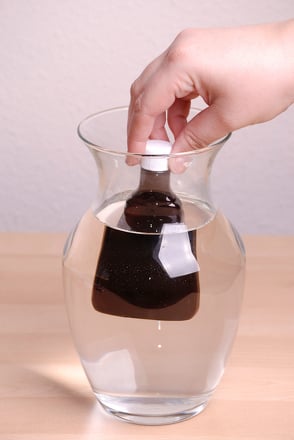
There are lots more experiments showing the power of air pressure. Air pressure can push an egg into a bottle orr crush a can.
Education.com provides the Science Fair Project Ideas for informational purposes only. Education.com does not make any guarantee or representation regarding the Science Fair Project Ideas and is not responsible or liable for any loss or damage, directly or indirectly, caused by your use of such information. By accessing the Science Fair Project Ideas, you waive and renounce any claims against Education.com that arise thereof. In addition, your access to Education.com's website and Science Fair Project Ideas is covered by Education.com's Privacy Policy and site Terms of Use, which include limitations on Education.com's liability.
Warning is hereby given that not all Project Ideas are appropriate for all individuals or in all circumstances. Implementation of any Science Project Idea should be undertaken only in appropriate settings and with appropriate parental or other supervision. Reading and following the safety precautions of all materials used in a project is the sole responsibility of each individual. For further information, consult your state's handbook of Science Safety.
Related learning resources