Activity
Rock Candy Science
The next time you've got a restless young earth scientist on your hands and a rainy day outside, try this exciting experiment. You can use it to demonstrate what a crystal is and in the process, create that enchantingly sweet, fully edible, traditional kid favorite: rock candy. Here's how.
Grades:
Subjects:
What You Need:
- 4 cups sugar (two pounds)
- 2 cups water
- Small cooking pot with tall sides, to avoid spatters
- Large cooking spoon for stirring
- Candy thermometer (optional)
- Tall, clean glass jar
- Cotton string
- Something to hold the string down in liquid (such as a clean, heavy screw)
- Parchment paper, foil, or waxed paper
- Plain pencil, which will hold the string over the jar
What You Do:
- Rock candy is made by creating a "supersaturated" solution: one with much more sugar dissolved in the water than you could possible do at room temperature. Have your child start the experiment by pouring just the water into the saucepan, and then heating it to a boil. If you have a candy thermometer on hand, place it in the pot for a mini experiment in temperature. (Caution, parents: do be sure you supervise these hot stages!)
- Once the water is boiling, pour the sugar into it. Notice that at first the mixture is chalky, since the sugar isn't melted at all. But as the sugar melts, there will be a distinct change: the entire solution will become clear. Do be sure that you and your child stir constantly throughout this phase—if the sugar sticks to the bottom of the pot, it will burn and that will not be so fun! If you're using a thermometer, don't forget to monitor the temperature during this stage to see how hot the solution gets.
- Keep stirring and melting until the solution is completely clear and gets to a full rolling boil (that's a boil with lots and lots of bubbles, but not a boil that's overflowing the pot).
- Pull the pan off the burner, and then gently pour it into the jar. Use a piece of waxed paper to cover the jar.
- Now tie the string around the screw-weight and dip it into the sugar solution, about 2/3 to the bottom of the jar. Let it get nice and wet, and then lay it on another piece of waxed paper or a piece of parchment paper, to dry for several days. In the meantime, let the jar of sugar solution sit on a countertop.
- In about 2-3 days, you'll notice that the string is dry, and if you use a magnifying glass, you will start to see little crystals formed all along it. That’s just what you want! These are the little edges on which the big crystals of rock candy will start to cling and form.
- CAREFULLY place the string back into the jar of supersaturated sugar water, suspended from the pencil and weighted down on the other end by the screw and leave it be for a few days. DO NOT jiggle the jar at any point during that time, and do NOT check the string—there is delicate work underway! The sugar molecules, which were previously suspended in the liquid, are now re-forming, and if you move the solution, you interrupt their progress.
- By 4-5 days later, you'll see a delightful thing: the crystals on your string should be visible, with points and angles and very cool “faces,” which have been created as unique sugar molecules found their way to one another. This process of crystallization happens in nature as well, giving us uniquely beautiful crystal formations from all parts of the globe.
This is a great time to open a geology book and study more…but don't be surprised if your child considers that a distant second step to a pressing matter at hand: EATING this way cool experiment!
Related learning resources
Candy Science: A Halloween Experiment
Activity
Candy Science: A Halloween Experiment
With Halloween right around the corner, find a way to use your brain and reward your tummy with a new type of science -- candy science!
1st Grade
Science
Activity
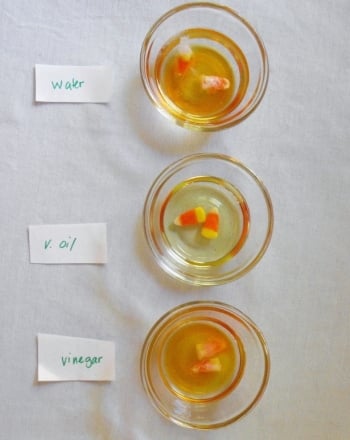
Candy Corn Science
Activity
Candy Corn Science
Young scientists develop a hypothesis, conduct an experiment, and then revise their hypothesis to find out which common household liquids dissolve candy corn.
3rd Grade
Activity
Candy pH
Activity
Candy pH
Take a dive into the candy jar with this yummy science experiment.
4th Grade
Science
Activity
Making A Rock In A Cup
Activity
Making A Rock In A Cup
This science fair project idea creates a sedimentary rock and to investigate what takes place during the rock cycle.
4th Grade
Science
Activity
The Rock Cycle: Energy Flow
Worksheet
The Rock Cycle: Energy Flow
Students demonstrate their understanding of the rock cycle in this engaging science worksheet!
6th Grade
Science
Worksheet
Rock Formations
Worksheet
Rock Formations
Check out this science worksheet to learn all about rock formations.
4th Grade
Science
Worksheet
The Rock Cycle: Vocabulary
Interactive Worksheet
The Rock Cycle: Vocabulary
Students match 12 rock cycle vocabulary words to their definitions in this middle school science worksheet.
6th Grade
Science
Interactive Worksheet
Guess My Rock!
Activity
Guess My Rock!
There are hundreds of properties in rocks which you can describe, so get your geology goggles on and get ready to rock your child's science skills.
5th Grade
Science
Activity
Candy Corn Candy Holder
Activity
Candy Corn Candy Holder
Big bags hold a lot of candy, but they're hard to tote around. Have your kid construct a candy corn candy holder perfect for carrying a few lightweight treats.
1st Grade
Math
Activity
Candy Valentine
Worksheet
Candy Valentine
A candy valentine is always a nice gift on Valentine's Day. Make a candy valentine out of lollipops with this candy valentine worksheet.
2nd Grade
Worksheet
Rock Climbing Coloring Page
Worksheet
Rock Climbing Coloring Page
This rock climbing coloring page gets your child to learn about a new sport. Teach your child about rock climbing with this rock climbing worksheet.
1st Grade
Worksheet
Candy Ring
Activity
Candy Ring
A candy ring is perfect for the kid with a sweet tooth and style. Make a sweet candy ring with your child this Valentine's Day.
Kindergarten
Activity
See this activity in a set:
Sizzling Science Crafts