

RL.3.1 Worksheets, Workbooks, Lesson Plans, and Games
CCSS.ELA-LITERACY.RL.3.1
:"Ask and answer questions to demonstrate understanding of a text, referring explicitly to the text as the basis for the answers."
These worksheets, workbooks, and lesson plans can help students practice this Common Core State Standards skill.
Worksheets
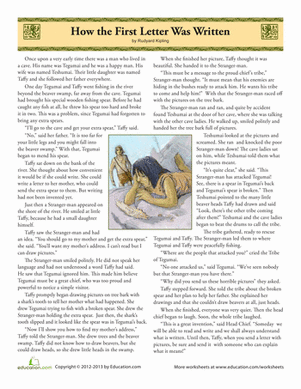
How the First Letter was Written
Worksheet
How the First Letter was Written
How was writing first invented? Find out by reading this delightful story by Rudyard Kipling, "How the First Letter was Written."
3rd Grade
Worksheet

Wh Questions
Worksheet
Wh Questions
Help your child learn the "Wh words," who, what, where, why and when, with this charming story about a day at the dog park.
3rd Grade
Worksheet

The Butterfly That Stamped
Worksheet
The Butterfly That Stamped
Help your student with reading comprehension, and enjoy a favorite short story by Rudyard Kipling, about a King, a Queen and two quarreling butterflies.
3rd Grade
Worksheet

The Cat That Walked by Himself
Worksheet
The Cat That Walked by Himself
Beginning readers will love this short story by Rudyard Kipling, all about how the animals were first domesticated.
3rd Grade
Worksheet

Conflict
Worksheet
Conflict
Help your child understand how conflicts factor into plots with this inventive reading worksheet.
3rd Grade
Worksheet
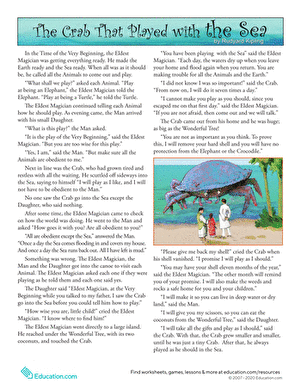
The Crab that Played with the Sea
Worksheet
The Crab that Played with the Sea
Introduce your little reader to some classic childhood literature, with Rudyard Kipling's charming story "The Crab That Played with the Sea."
4th Grade
Worksheet
Lesson Plans
Close Reading: Introduction
Lesson plan
Close Reading: Introduction
Help your students absorb the details of a text and make inferences about what they read with the strategy of close reading. By reading closely, students will become better able to understand complex themes and nuances in a text.
Lesson plan

Characters Change Just Like We Do
Lesson plan
Characters Change Just Like We Do
Change is inevitable, even for story characters! In this lesson, your students will determine how a character changes throughout a story by focusing on the character’s dialogue and actions.
3rd Grade
Lesson plan

Traditional Literature: Story Mapping
Lesson plan
Traditional Literature: Story Mapping
Students will learn how to identify story elements and create a short and sweet summary. They will fill out a graphic organizer and solidify their understanding by creating illustrations to show major plot points that they find themselves!
2nd Grade
Lesson plan

Fairy Tales: Character Traits
Lesson plan
Fairy Tales: Character Traits
In this literary lesson, students use fairy tales to practice identifying character traits. Students are challenged to justify their reasoning using text based support.
2nd Grade
Lesson plan

Asking and Answering Questions
Lesson plan
Asking and Answering Questions
This lesson helps students learn about asking and answering questions about a text. It also exposes them to valuable lessons about trying to figure out their dreams and not giving up along the way.
2nd Grade
Lesson plan
Red Light, Green Light Questions
Lesson plan
Red Light, Green Light Questions
Teach your students to ask and differentiate between recall questions and inferential questions. This lesson will help build a classroom culture around asking deep, inferential questions.
3rd Grade
Lesson plan
Workbooks

My Vacation
Workbook
My Vacation
In this three-part series, a child anticipates a family getaway. Practice summarizing works of fiction, identifying chronology, interpreting pictures, and identifying homophones and homographs through this series of reading and comprehension activities.
3rd Grade
Workbook
Games
No games found for this common core code.
Exercises
No exercises found for this common core code.
Teacher Editions
No teacher editions found for this common core code.
