SKIP TO CONTENT
Worksheet Generator
Subjects
Grades
Worksheets
Games
Build a Worksheet
More Resources
Roly Recommends
Subjects
Grades
Worksheets
Games
Build a Worksheet
More Resources
Roly Recommends
Writing Resources for 'types of...' : Page 3
Filters
English Language Arts
Writing
69 results
Search for: types, of...
✕
English Language Arts
✕
Clear all
69 results
Subtopics:
Writing Types
Writing Process
Writing Organization
Writing Strategies
Show Less
Filters
Search for: types, of...
✕
English Language Arts
✕
Subjects
Math
English Language Arts
Science
Social Studies
Foreign Language
Technology
Grade Level
Pre-K
K
1st
2nd
3rd
4th
5th
6th
7th
8th
Early Childhood
Elementary School
Middle School
Resource Type
Worksheets
Games
Lesson Plans
Activities
Offline Games
Occasion
Back to School
Christmas
Halloween
Holidays
Labor Day
Summer
Valentine's Day
Winter
Women's History Month
Common Core
Yes
Game Type
Outdoor Games
Arts & Crafts
Arts & Crafts
Paper & Glue Crafts
Painting & Drawing
English Language Support
Yes
Clear all
View 69 results
Writing Resources for 'types of...' : Page 3
Filters
69 results
Search for: types, of...
✕
English Language Arts
✕
Clear all
69 results
Don't Get Soap in Your Eye!
Activity
Don't Get Soap in Your Eye!
Writing
Look for correlation between pH values of commercial soaps and detergents and manufacturer claims about eye irritation hazards.
Activity
Don't Get Soap in Your Eye!
Activity
Don't Get Soap in Your Eye!
Look for correlation between pH values of commercial soaps and detergents and manufacturer claims about eye irritation hazards.
Writing
Activity
The Five W's of Notetaking
Lesson Plan
The Five W's of Notetaking
Second Grade
Writing
Thinking about who, what, when, where, and why isn’t just for detectives! Students will practice gleaning important information from texts using these questions and a few other tools.
Lesson Plan
The Five W's of Notetaking
Lesson Plan
The Five W's of Notetaking
Thinking about who, what, when, where, and why isn’t just for detectives! Students will practice gleaning important information from texts using these questions and a few other tools.
Second Grade
Writing
Lesson Plan
EL
Parts of a Drama
Lesson Plan
Parts of a Drama
Third Grade
Writing
Expose your students to the wonderful genre of drama, but be sure to teach them the important key terms so they understand the structure. Use this as a stand alone lesson or a pre-lesson for the
Putting a Play Together!
lesson.
Lesson Plan
EL
Parts of a Drama
Lesson Plan
Parts of a Drama
Expose your students to the wonderful genre of drama, but be sure to teach them the important key terms so they understand the structure. Use this as a stand alone lesson or a pre-lesson for the
Putting a Play Together!
lesson.
Third Grade
Writing
Lesson Plan
Nonfiction Genres
Lesson Plan
Nonfiction Genres
Fourth Grade
Writing
In this lesson, your students will explore the library in search of various genres of nonfiction texts. Teach this lesson at the beginning of the year to familiarize your students with the structure and organization of the library.
Lesson Plan
Nonfiction Genres
Lesson Plan
Nonfiction Genres
In this lesson, your students will explore the library in search of various genres of nonfiction texts. Teach this lesson at the beginning of the year to familiarize your students with the structure and organization of the library.
Fourth Grade
Writing
Lesson Plan
Informational Essay: Creating an Outline for a Draft
Lesson Plan
Informational Essay: Creating an Outline for a Draft
Sixth Grade
Writing
Students will continue their informational writing project by creating an essay outline prior to drafting.
Lesson Plan
Informational Essay: Creating an Outline for a Draft
Lesson Plan
Informational Essay: Creating an Outline for a Draft
Students will continue their informational writing project by creating an essay outline prior to drafting.
Sixth Grade
Writing
Lesson Plan
EL
Working with Idioms
Lesson Plan
Working with Idioms
Third Grade
Writing
Figurative language can be difficult, especially for ELs. With the help of context clues and exposure to common idioms, it can be a piece of cake! Use this as a stand-alone lesson or as a pre-lesson for the
Take a Walk with Idioms
lesson.
Lesson Plan
EL
Working with Idioms
Lesson Plan
Working with Idioms
Figurative language can be difficult, especially for ELs. With the help of context clues and exposure to common idioms, it can be a piece of cake! Use this as a stand-alone lesson or as a pre-lesson for the
Take a Walk with Idioms
lesson.
Third Grade
Writing
Lesson Plan
EL
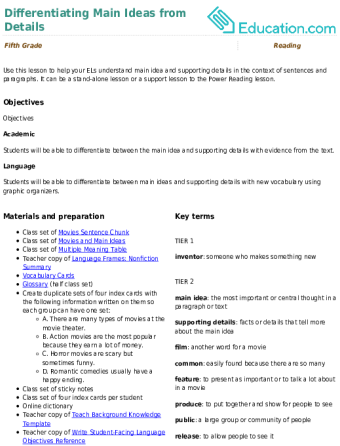
Differentiating Main Ideas from Details
Lesson Plan
Differentiating Main Ideas from Details
Fifth Grade
Writing
Use this lesson to help your ELs understand main idea and supporting details in the context of sentences and paragraphs. It can be a stand-alone lesson or a support lesson to the Power Reading lesson.
Lesson Plan
EL
Differentiating Main Ideas from Details
Lesson Plan
Differentiating Main Ideas from Details
Use this lesson to help your ELs understand main idea and supporting details in the context of sentences and paragraphs. It can be a stand-alone lesson or a support lesson to the Power Reading lesson.
Fifth Grade
Writing
Lesson Plan
EL
Understanding Line Plots
Lesson Plan
Understanding Line Plots
Second Grade
Writing
This lesson provides students with the opportunity to critically think about data. Use this lesson alongside Line Plots: Representing the Length of Classroom Items or as a stand alone lesson.
Lesson Plan
EL
Understanding Line Plots
Lesson Plan
Understanding Line Plots
This lesson provides students with the opportunity to critically think about data. Use this lesson alongside Line Plots: Representing the Length of Classroom Items or as a stand alone lesson.
Second Grade
Writing
Lesson Plan
Power Reading
Lesson Plan
Power Reading
Fifth Grade
Writing
Help students learn how to read passages with multiple main ideas and differentiate between main ideas and supporting details by creating a graphic organizer with proof from the text.
Lesson Plan
Power Reading
Lesson Plan
Power Reading
Help students learn how to read passages with multiple main ideas and differentiate between main ideas and supporting details by creating a graphic organizer with proof from the text.
Fifth Grade
Writing
Lesson Plan
1
2
3