Offline Educational 1st Grade Mazes Number Patterns Games

Subtopics:
Offline Educational 1st Grade Mazes Number Patterns Games
2 results
Math
✕1st Grade
✕Offline Games
✕Mazes
✕2 results


About Offline Educational 1st Grade Mazes Number Patterns Games
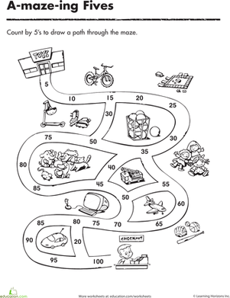
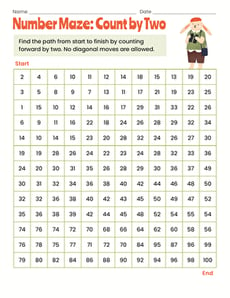
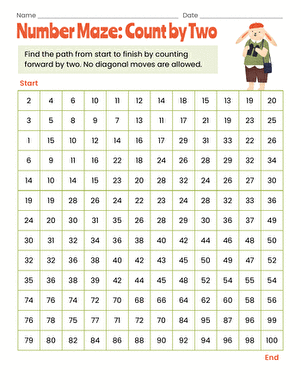
On Education.com, 1st grade offline math mazes are printable puzzles that help children practice number sense by guiding them through pathways that promote sequencing, recognition of odd and even numbers, and skip-counting. These engaging activities make learning to count and recognize patterns both interactive and enjoyable. Educators and parents can use these worksheets to reinforce early arithmetic skills through hands-on, path-finding challenges that encourage critical thinking and problem-solving.
The site offers a variety of worksheets that focus on counting from 1 to 20, identifying numerical patterns, and practicing skip-counting by fives and tens. These resources support foundational math concepts while providing structured and fun ways to enhance number recognition, sequencing, and pattern identification. Each activity allows children to build confidence in their ability to recognize, remember, and apply early mathematical rules.
Using these printable maze worksheets in classrooms or at home saves planning time and provides structured, engaging practice for first-grade students. Teachers can assign worksheets for practice or homework, while parents can use them as educational activities to reinforce classroom learning. These materials support both independent exploration and guided instruction, strengthening students’ problem-solving skills and mathematical understanding.
The site offers a variety of worksheets that focus on counting from 1 to 20, identifying numerical patterns, and practicing skip-counting by fives and tens. These resources support foundational math concepts while providing structured and fun ways to enhance number recognition, sequencing, and pattern identification. Each activity allows children to build confidence in their ability to recognize, remember, and apply early mathematical rules.
Using these printable maze worksheets in classrooms or at home saves planning time and provides structured, engaging practice for first-grade students. Teachers can assign worksheets for practice or homework, while parents can use them as educational activities to reinforce classroom learning. These materials support both independent exploration and guided instruction, strengthening students’ problem-solving skills and mathematical understanding.