SKIP TO CONTENT
Worksheet Generator
Subjects
Grades
Worksheets
Games
Build a Worksheet
More Resources
Roly Recommends
Subjects
Grades
Worksheets
Games
Build a Worksheet
More Resources
Roly Recommends
Filters
Search for: slideshow, lemonade, stand
✕
2nd - 5th Grade
✕
Subjects
Math
English Language Arts
Science
Social Studies
Grade Level
Pre-K
K
1st
2nd
3rd
4th
5th
6th
7th
8th
Early Childhood
Elementary School
Middle School
Resource Type
Worksheets
Lesson Plans
Interactive Worksheets
Activities
Offline Games
Guided Lessons
Occasion
St. Patrick's Day
Passover
Spring
Easter
Earth Day
Mother's Day
Summer
Father's Day
Independence Day
Back to School
Fall
Halloween
Winter
Holidays
Thanksgiving
Christmas
Hanukkah
New Year
Martin Luther King Jr. Day
Valentine's Day
Black History Month
See more
Common Core
Yes
Roly Recommends
Social Emotional Learning
Game Type
Ball Games
Fitness & Exercise
Group Games
Outdoor Games
Travel Games
Word Puzzles
Arts & Crafts
Arts & Crafts
Fabric Projects
Beads & Jewelry
Paper & Glue Crafts
Construction & Sculpture
Painting & Drawing
Recycled Crafts
Coloring
Yes
Recipes
Snacks
Mains
Sides
English Language Support
Yes
See More
Clear All
View 586 results
Showing Results for slideshow lemonade stand : Page 4
586 results
Search for: slideshow, lemonade, stand
✕
2nd - 5th Grade
✕
Clear All
Sort by:
Relevance
Most recent
Most popular
Alphabetical A-Z
Alphabetical Z-A
All filters
586 results
Sort by:
Relevance
Most recent
Most popular
Alphabetical A-Z
Alphabetical Z-A
EL
Text Features and Their Purposes
Lesson Plan
Text Features and Their Purposes
Fourth Grade
This lesson helps your ELs identify nonfiction text features and explain how they enhance comprehension of the text. Use it as a stand-alone lesson or a support lesson for the Searching for Text Features lesson plan.
Lesson Plan
EL
Text Features and Their Purposes
Lesson Plan
Text Features and Their Purposes
This lesson helps your ELs identify nonfiction text features and explain how they enhance comprehension of the text. Use it as a stand-alone lesson or a support lesson for the Searching for Text Features lesson plan.
Fourth Grade
Lesson Plan
EL
Discussing Fraction Representations
Lesson Plan
Discussing Fraction Representations
Third Grade
Support your students as they utilize key academy language to speak about visual and numerical representations of fractions. Use this as a stand alone lesson or as a pre-lesson for
Fractions in Action
.
Lesson Plan
EL
Discussing Fraction Representations
Lesson Plan
Discussing Fraction Representations
Support your students as they utilize key academy language to speak about visual and numerical representations of fractions. Use this as a stand alone lesson or as a pre-lesson for
Fractions in Action
.
Third Grade
Lesson Plan
EL
A Script with Adverbs
Lesson Plan
A Script with Adverbs
Fourth Grade
Reading
Describe what's happening in the script! Use this lesson to help your ELs describe events in a drama. It can be a stand-alone lesson or used as support to the lesson Summer Drama.
Lesson Plan
EL
A Script with Adverbs
Lesson Plan
A Script with Adverbs
Describe what's happening in the script! Use this lesson to help your ELs describe events in a drama. It can be a stand-alone lesson or used as support to the lesson Summer Drama.
Fourth Grade
Reading
Lesson Plan
EL
What Are Equivalent Fractions?
Lesson Plan
What Are Equivalent Fractions?
Third Grade
Get your students to think deeply about fractions as they discuss which pictures show equivalence. Use this as a stand alone lesson or a pre-lesson for the
Equivalent Fractions: Are They Equal?
lesson.
Lesson Plan
EL
What Are Equivalent Fractions?
Lesson Plan
What Are Equivalent Fractions?
Get your students to think deeply about fractions as they discuss which pictures show equivalence. Use this as a stand alone lesson or a pre-lesson for the
Equivalent Fractions: Are They Equal?
lesson.
Third Grade
Lesson Plan
EL
Fairy Tale Character Traits
Lesson Plan
Fairy Tale Character Traits
Second Grade
Students will be able to answer questions to show understanding of character traits. This can be a stand-alone lesson or a support lesson to be used prior to The Paper Bag Princess lesson plan.
Lesson Plan
EL
Fairy Tale Character Traits
Lesson Plan
Fairy Tale Character Traits
Students will be able to answer questions to show understanding of character traits. This can be a stand-alone lesson or a support lesson to be used prior to The Paper Bag Princess lesson plan.
Second Grade
Lesson Plan
EL
Match Author's Point with Evidence
Lesson Plan
Match Author's Point with Evidence
Fifth Grade
Writing
Use this lesson to help your ELs identify and discuss the author's point and the information that supports it. It can be a stand-alone lesson or used as support for the What’s the Point? lesson.
Lesson Plan
EL
Match Author's Point with Evidence
Lesson Plan
Match Author's Point with Evidence
Use this lesson to help your ELs identify and discuss the author's point and the information that supports it. It can be a stand-alone lesson or used as support for the What’s the Point? lesson.
Fifth Grade
Writing
Lesson Plan
EL
Character Actions and Emotions
Lesson Plan
Character Actions and Emotions
Fourth Grade
Use this lesson to help your ELs describe a character’s emotion based on actions. It can be a stand-alone lesson or used as support to the lesson Close Reading: Reading Through Character Emotion.
Lesson Plan
EL
Character Actions and Emotions
Lesson Plan
Character Actions and Emotions
Use this lesson to help your ELs describe a character’s emotion based on actions. It can be a stand-alone lesson or used as support to the lesson Close Reading: Reading Through Character Emotion.
Fourth Grade
Lesson Plan
EL
Multiple-Meaning Words
Lesson Plan
Multiple-Meaning Words
Second Grade
Grammar and Mechanics
This lesson will help students understand multiple-meaning words through the use of artistic and theatrical representation! Use as a stand-alone activity or a support lesson for Let's Compare and Contrast Nonfiction Texts!
Lesson Plan
EL
Multiple-Meaning Words
Lesson Plan
Multiple-Meaning Words
This lesson will help students understand multiple-meaning words through the use of artistic and theatrical representation! Use as a stand-alone activity or a support lesson for Let's Compare and Contrast Nonfiction Texts!
Second Grade
Grammar and Mechanics
Lesson Plan
EL
Identify and Develop an Opinion
Lesson Plan
Identify and Develop an Opinion
Third Grade
Grammar and Mechanics
Use this lesson to teach your students how to express opinions about nonfiction topics. This lesson can stand alone or be used as a pre-lesson for the
What Does the Author Think?
lesson.
Lesson Plan
EL
Identify and Develop an Opinion
Lesson Plan
Identify and Develop an Opinion
Use this lesson to teach your students how to express opinions about nonfiction topics. This lesson can stand alone or be used as a pre-lesson for the
What Does the Author Think?
lesson.
Third Grade
Grammar and Mechanics
Lesson Plan
EL
Word Problem Comprehension
Lesson Plan
Word Problem Comprehension
Third Grade
Make sure your students understand the word problem before they begin to solve it! Use this as a stand alone lesson or a pre-lesson for
Two-Step Word Problems with Mixed-Operations - Gamified!
Lesson Plan
EL
Word Problem Comprehension
Lesson Plan
Word Problem Comprehension
Make sure your students understand the word problem before they begin to solve it! Use this as a stand alone lesson or a pre-lesson for
Two-Step Word Problems with Mixed-Operations - Gamified!
Third Grade
Lesson Plan
EL
Cause or Effect?
Lesson Plan
Cause or Effect?
Third Grade
Use this lesson to help your ELs understand the relationship between cause and the effect sentences. It can be a stand-alone lesson or a support lesson to the Fiction Comprehension: Cause and Effect lesson.
Lesson Plan
EL
Cause or Effect?
Lesson Plan
Cause or Effect?
Use this lesson to help your ELs understand the relationship between cause and the effect sentences. It can be a stand-alone lesson or a support lesson to the Fiction Comprehension: Cause and Effect lesson.
Third Grade
Lesson Plan
EL
Elections and Conditions
Lesson Plan
Elections and Conditions
Fifth Grade
Reading
Use this lesson to help your ELs understand details in a sentence by identifying conditional phrases. It can be a stand-alone lesson or used as support to the lesson Comparing Primary and Secondary Sources.
Lesson Plan
EL
Elections and Conditions
Lesson Plan
Elections and Conditions
Use this lesson to help your ELs understand details in a sentence by identifying conditional phrases. It can be a stand-alone lesson or used as support to the lesson Comparing Primary and Secondary Sources.
Fifth Grade
Reading
Lesson Plan
EL
Using a Dictionary to Clarify the Meaning of Unknown Words
Lesson Plan
Using a Dictionary to Clarify the Meaning of Unknown Words
Second Grade
Vocabulary
This lesson will help students explore using a dictionary to figure out tricky words with suffixes. Use as a stand-alone activity or a support for the Understanding Academic Vocabulary in a Nonfiction Text lesson.
Lesson Plan
EL
Using a Dictionary to Clarify the Meaning of Unknown Words
Lesson Plan
Using a Dictionary to Clarify the Meaning of Unknown Words
This lesson will help students explore using a dictionary to figure out tricky words with suffixes. Use as a stand-alone activity or a support for the Understanding Academic Vocabulary in a Nonfiction Text lesson.
Second Grade
Vocabulary
Lesson Plan
EL
What's the Moral?
Lesson Plan
What's the Moral?
Second Grade
This lesson focuses on the comprehension of fables and folktales in order to identify a moral or lesson. Use this lesson as a stand-alone activity or a support lesson for the Finding the Moral lesson plan.
Lesson Plan
EL
What's the Moral?
Lesson Plan
What's the Moral?
This lesson focuses on the comprehension of fables and folktales in order to identify a moral or lesson. Use this lesson as a stand-alone activity or a support lesson for the Finding the Moral lesson plan.
Second Grade
Lesson Plan
EL
Vocabulary in Context
Lesson Plan
Vocabulary in Context
Fourth Grade
In this lesson, students will improve their skills in using context clues to determine the meaning of difficult words. Use it as a stand-alone lesson or as support to the lesson Journey on the Underground Railroad.
Lesson Plan
EL
Vocabulary in Context
Lesson Plan
Vocabulary in Context
In this lesson, students will improve their skills in using context clues to determine the meaning of difficult words. Use it as a stand-alone lesson or as support to the lesson Journey on the Underground Railroad.
Fourth Grade
Lesson Plan
EL
Adding Within 20
Lesson Plan
Adding Within 20
Second Grade
This scaffolded EL lesson will help your students fluently add within 20, while reinforcing parts of a whole. Use as a pre-lesson for Addition: Over in a Flash, or as a stand alone activity.
Lesson Plan
EL
Adding Within 20
Lesson Plan
Adding Within 20
This scaffolded EL lesson will help your students fluently add within 20, while reinforcing parts of a whole. Use as a pre-lesson for Addition: Over in a Flash, or as a stand alone activity.
Second Grade
Lesson Plan
EL
Building Fluency with Punctuation
Lesson Plan
Building Fluency with Punctuation
Second Grade
Reading
This lesson focuses on how punctuation affects reading fluency and comprehension using graphic organizers and sentence stems. Use this lesson as a stand-alone activity or a support for the Punctuation and Prosody lesson plan.
Lesson Plan
EL
Building Fluency with Punctuation
Lesson Plan
Building Fluency with Punctuation
This lesson focuses on how punctuation affects reading fluency and comprehension using graphic organizers and sentence stems. Use this lesson as a stand-alone activity or a support for the Punctuation and Prosody lesson plan.
Second Grade
Reading
Lesson Plan
EL
Pick Out the Parts of a Story
Lesson Plan
Pick Out the Parts of a Story
Third Grade
Reading
Use this lesson to teach your students to identify story elements and compare them to another text's story elements. This lesson can stand alone or be used as a pre-lesson for the
Comparing Texts by the Same Author
lesson.
Lesson Plan
EL
Pick Out the Parts of a Story
Lesson Plan
Pick Out the Parts of a Story
Use this lesson to teach your students to identify story elements and compare them to another text's story elements. This lesson can stand alone or be used as a pre-lesson for the
Comparing Texts by the Same Author
lesson.
Third Grade
Reading
Lesson Plan
EL
Thinking Deeply About Word Problems
Lesson Plan
Thinking Deeply About Word Problems
Third Grade
Subtraction
Word problems can be overwhelming to students, but if they have a tool to help them, they can handle it! Use this as a stand alone lesson or alongside
Stepping Through Addition and Subtraction Word Problems
.
Lesson Plan
EL
Thinking Deeply About Word Problems
Lesson Plan
Thinking Deeply About Word Problems
Word problems can be overwhelming to students, but if they have a tool to help them, they can handle it! Use this as a stand alone lesson or alongside
Stepping Through Addition and Subtraction Word Problems
.
Third Grade
Subtraction
Lesson Plan
EL
Differentiating Main Ideas from Details
Lesson Plan
Differentiating Main Ideas from Details
Fifth Grade
Writing
Use this lesson to help your ELs understand main idea and supporting details in the context of sentences and paragraphs. It can be a stand-alone lesson or a support lesson to the Power Reading lesson.
Lesson Plan
EL
Differentiating Main Ideas from Details
Lesson Plan
Differentiating Main Ideas from Details
Use this lesson to help your ELs understand main idea and supporting details in the context of sentences and paragraphs. It can be a stand-alone lesson or a support lesson to the Power Reading lesson.
Fifth Grade
Writing
Lesson Plan
EL
Problem and Solution Summaries
Lesson Plan
Problem and Solution Summaries
Third Grade
Use this lesson to guide your ELs towards identifying and discussing the problem and solution in a story. Teach this lesson as a stand-alone lesson or as support to the lesson Traditional Literature: Story Mapping.
Lesson Plan
EL
Problem and Solution Summaries
Lesson Plan
Problem and Solution Summaries
Use this lesson to guide your ELs towards identifying and discussing the problem and solution in a story. Teach this lesson as a stand-alone lesson or as support to the lesson Traditional Literature: Story Mapping.
Third Grade
Lesson Plan
EL
Sentence Structures for Summarizing
Lesson Plan
Sentence Structures for Summarizing
Fifth Grade
Vocabulary
In this support lesson, your ELs will use key vocabulary and sentence structures to summarize a story. It can be a stand-alone lesson or used as support for the lesson Comparing and Contrasting Book Series.
Lesson Plan
EL
Sentence Structures for Summarizing
Lesson Plan
Sentence Structures for Summarizing
In this support lesson, your ELs will use key vocabulary and sentence structures to summarize a story. It can be a stand-alone lesson or used as support for the lesson Comparing and Contrasting Book Series.
Fifth Grade
Vocabulary
Lesson Plan
EL
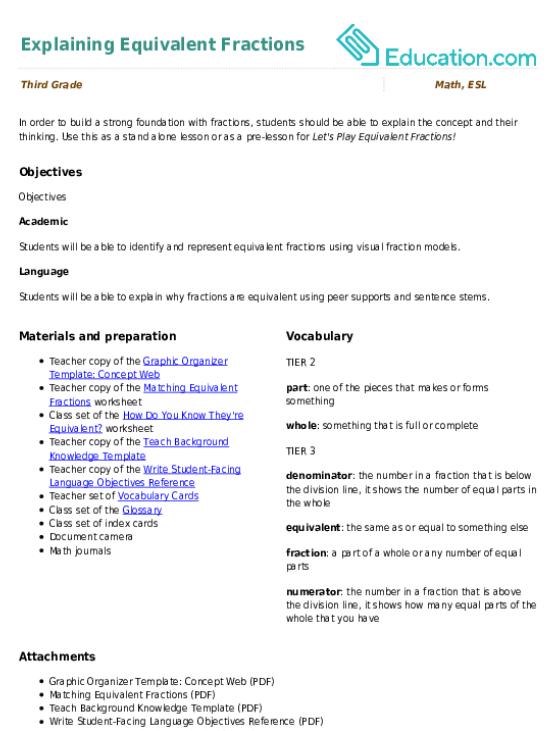
Explaining Equivalent Fractions
Lesson Plan
Explaining Equivalent Fractions
Third Grade
In order to build a strong foundation with fractions, students should be able to explain the concept and their thinking. Use this as a stand alone lesson or as a pre-lesson for
Let's Play Equivalent Fractions!
Lesson Plan
EL
Explaining Equivalent Fractions
Lesson Plan
Explaining Equivalent Fractions
In order to build a strong foundation with fractions, students should be able to explain the concept and their thinking. Use this as a stand alone lesson or as a pre-lesson for
Let's Play Equivalent Fractions!
Third Grade
Lesson Plan
EL
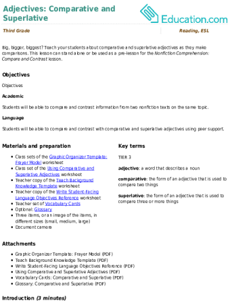
Adjectives: Comparative and Superlative
Lesson Plan
Adjectives: Comparative and Superlative
Third Grade
Big, bigger, biggest? Teach your students about comparative and superlative adjectives as they make comparisons. This lesson can stand alone or be used as a pre-lesson for the
Nonfiction Comprehension: Compare and Contrast
lesson.
Lesson Plan
EL
Adjectives: Comparative and Superlative
Lesson Plan
Adjectives: Comparative and Superlative
Big, bigger, biggest? Teach your students about comparative and superlative adjectives as they make comparisons. This lesson can stand alone or be used as a pre-lesson for the
Nonfiction Comprehension: Compare and Contrast
lesson.
Third Grade
Lesson Plan
EL
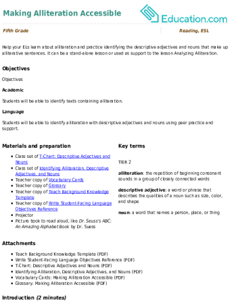
Making Alliteration Accessible
Lesson Plan
Making Alliteration Accessible
Fifth Grade
Grammar and Mechanics
Help your ELs learn about alliteration and practice identifying the descriptive adjectives and nouns that make up alliterative sentences. It can be a stand-alone lesson or used as support to the lesson Analyzing Alliteration.
Lesson Plan
EL
Making Alliteration Accessible
Lesson Plan
Making Alliteration Accessible
Help your ELs learn about alliteration and practice identifying the descriptive adjectives and nouns that make up alliterative sentences. It can be a stand-alone lesson or used as support to the lesson Analyzing Alliteration.
Fifth Grade
Grammar and Mechanics
Lesson Plan
EL
Shifting Points of View
Lesson Plan
Shifting Points of View
Fourth Grade
Reading
This lesson gives students practice identifying first person and third person narration in fiction and nonfiction texts. It could be taught as a stand-alone lesson or as a precursor to the lesson Fiction vs. Nonfiction.
Lesson Plan
EL
Shifting Points of View
Lesson Plan
Shifting Points of View
This lesson gives students practice identifying first person and third person narration in fiction and nonfiction texts. It could be taught as a stand-alone lesson or as a precursor to the lesson Fiction vs. Nonfiction.
Fourth Grade
Reading
Lesson Plan
EL
Realism and Fantasy
Lesson Plan
Realism and Fantasy
Third Grade
Use this lesson to help your ELs learn about the differences between realism and fantasy. This lesson can stand alone or be used as a pre-lesson for the
Making Sense of Realism and Fantasy
lesson.
Lesson Plan
EL
Realism and Fantasy
Lesson Plan
Realism and Fantasy
Use this lesson to help your ELs learn about the differences between realism and fantasy. This lesson can stand alone or be used as a pre-lesson for the
Making Sense of Realism and Fantasy
lesson.
Third Grade
Lesson Plan
EL
Explore the Associative Property of Multiplication
Lesson Plan
Explore the Associative Property of Multiplication
Third Grade
Use this lesson with your students to allow them to explore the associative property of multiplication by having deep discussions in small groups. Use this as a stand alone lesson or alongside
Associative Property of Multiplication
.
Lesson Plan
EL
Explore the Associative Property of Multiplication
Lesson Plan
Explore the Associative Property of Multiplication
Use this lesson with your students to allow them to explore the associative property of multiplication by having deep discussions in small groups. Use this as a stand alone lesson or alongside
Associative Property of Multiplication
.
Third Grade
Lesson Plan
EL
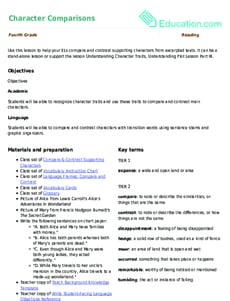
Character Comparisons
Lesson Plan
Character Comparisons
Fourth Grade
Reading
Use this lesson to help your ELs compare and contrast supporting characters from excerpted texts. It can be a stand-alone lesson or support the lesson Understanding Character Traits, Understanding Plot Lesson Part III.
Lesson Plan
EL
Character Comparisons
Lesson Plan
Character Comparisons
Use this lesson to help your ELs compare and contrast supporting characters from excerpted texts. It can be a stand-alone lesson or support the lesson Understanding Character Traits, Understanding Plot Lesson Part III.
Fourth Grade
Reading
Lesson Plan
EL
Showing Numbers in Different Ways
Lesson Plan
Showing Numbers in Different Ways
Second Grade
Place Value
Use this hands-on lesson to encourage collaboration amongst students as they review base-ten numerals, number names, and expanded form. This lesson can be used as a pre-lesson to Base Ten Block Party or as a stand-alone activity.
Lesson Plan
EL
Showing Numbers in Different Ways
Lesson Plan
Showing Numbers in Different Ways
Use this hands-on lesson to encourage collaboration amongst students as they review base-ten numerals, number names, and expanded form. This lesson can be used as a pre-lesson to Base Ten Block Party or as a stand-alone activity.
Second Grade
Place Value
Lesson Plan
1
2
3
4
5
…
20