English Language Support Three-Dimensional Shapes Lesson Plans

1 result
Math
✕Lesson Plans
✕English Language Support
✕1 result
Subtopics:
English Language Support Three-Dimensional Shapes Lesson Plans
1 result
Math
✕Lesson Plans
✕English Language Support
✕1 result
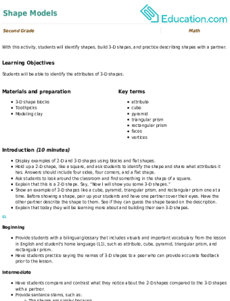

About English Language Support Three-dimensional Shapes Lesson Plans
On Education.com, this page provides lesson plans and resources for teaching young learners about three-dimensional shapes using English language support. These materials incorporate visual aids, real-world examples, manipulative activities, and repetition to help students identify and describe cubes, spheres, cones, and other 3D objects. Educators can access guided activities that promote architectural shape concepts and build foundational vocabulary in an engaging way.
This page features printable worksheets, interactive games, manipulatives, and hands-on exercises designed to reinforce understanding of 3D shapes. Each resource supports classroom or homeschooling environments by combining creative learning strategies with concrete examples. Materials also include shape hunts, sorting activities, and building exercises that make geometry accessible and actionable for early learners.
Educators and parents can explore these resources to enhance early geometry instruction, making shape recognition fun, interactive, and educational. Using structured lesson plans, learners connect abstract concepts to tangible objects and learn foundational spatial language. This approach promotes confidence and curiosity in mathematics while supporting literacy and observation skills.
This page features printable worksheets, interactive games, manipulatives, and hands-on exercises designed to reinforce understanding of 3D shapes. Each resource supports classroom or homeschooling environments by combining creative learning strategies with concrete examples. Materials also include shape hunts, sorting activities, and building exercises that make geometry accessible and actionable for early learners.
Educators and parents can explore these resources to enhance early geometry instruction, making shape recognition fun, interactive, and educational. Using structured lesson plans, learners connect abstract concepts to tangible objects and learn foundational spatial language. This approach promotes confidence and curiosity in mathematics while supporting literacy and observation skills.