Mazes Properties of Exponents Resources

3 results
Math
✕Mazes
✕3 results
Subtopics:
Mazes Properties of Exponents Resources
3 results
Math
✕Mazes
✕3 results



About Maze Properties Of Exponents Resources
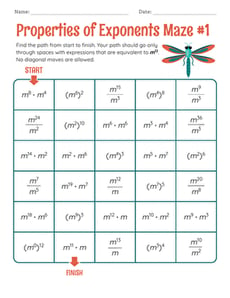
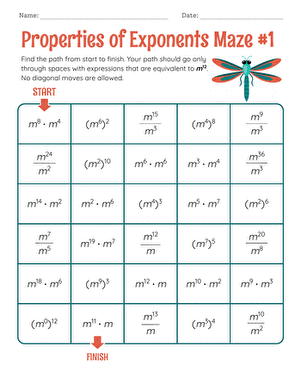
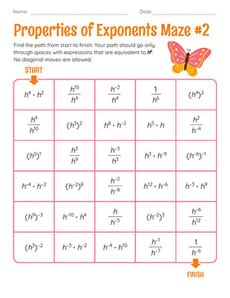
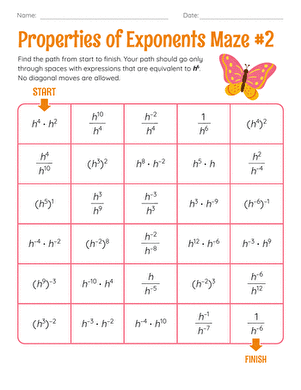
On Education.com, maze properties of exponents resources include inspirational worksheets, online games, and interactive lesson plans designed to help students in grades 7-12 practice simplifying expressions using exponent rules. These resources cover key concepts such as the product rule, quotient rule, power to a power, zero exponents, and negative exponents, enabling learners to strengthen their understanding of exponentiation in an engaging way.
Students can explore printable worksheets and digital practice activities that incorporate mazes into solving problems involving the properties of exponents. These materials provide self-checking exercises, step-by-step guidance, and real-world examples that make learning mathematical rules both accessible and fun. Educators and parents can use these resources to support classroom instruction or at-home practice, saving time while providing structured, interactive practice.
By using maze properties of exponents resources on Education.com, students and teachers gain access to a collection of hands-on learning tools that gamify the mastery of exponent rules. This helps reinforce learning, builds confidence, and enables students to apply algebraic concepts in various settings while making math practice more interactive and enjoyable.
Students can explore printable worksheets and digital practice activities that incorporate mazes into solving problems involving the properties of exponents. These materials provide self-checking exercises, step-by-step guidance, and real-world examples that make learning mathematical rules both accessible and fun. Educators and parents can use these resources to support classroom instruction or at-home practice, saving time while providing structured, interactive practice.
By using maze properties of exponents resources on Education.com, students and teachers gain access to a collection of hands-on learning tools that gamify the mastery of exponent rules. This helps reinforce learning, builds confidence, and enables students to apply algebraic concepts in various settings while making math practice more interactive and enjoyable.