
Activity
Electromagnetic Ring Launcher
Electromagnetism is a cool (and useful) natural phenomenon. Electric current, which is the flow of electrons, creates its own magnetic field when in a closed loop. In conjunction with other magnets or other current-induced magnetic fields, you can use electromagnetism to power electric motors or launch a non-magnetic ring into the sky!
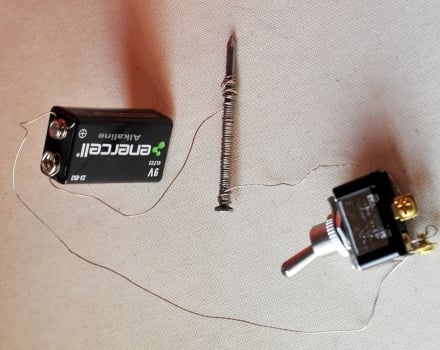
An Elihu Thomson apparatus, also known as a ring launcher, is named for the engineer and inventor Elihu Thomson who studied alternating current. A ring launcher has a coil wound around an iron center. The coil is charged with current until it launches the ring into the air.
Problem
What material will a ring launcher toss highest?
Materials
- Elihu Thomson apparatus (aka ring launcher)
- Copper ring
- Aluminum ring
- Split aluminum ring
- Lead ring
- Copper collar
- Freezer
- Liquid nitrogen (optional)
- Tongs (needed if you use liquid nitrogen)
Safety: Wear eye goggles. Make sure no one and nothing will be hit by flying rings. Take caution when dealing with the ring launcher and rings, as they may get hot. Also be sure to be careful when dealing with freezing rings.
Procedure
- Pick a ring to test.
- Slide the ring onto the ring launcher over the coil.
- Apply current to the ring by switching the launcher on.

- Record your observations.
- Freeze the rings overnight. Repeat steps 1-4. Be sure the ceilings have high clearances. Better yet, get an extension cord and perform this part of the experiment outside.
- Using the tongs, submerge the rings in liquid nitrogen.
- Using the tongs to handle the rings, repeat steps 1-4. Do not use your bare hands to handle rings frozen with liquid nitrogen.
Results
The copper ring will be tossed the highest, followed by the aluminum ring. The copper collar will lift slightly, but will not be launched. The split rings will not move.
Frozen rings will be thrown much farther than room-temperature rings.
Why?
Closed loops that carry current produce their own magnetic fields. The alternating (direction-changing) electric current from the power outlet in the wall charges the core, which then creates a magnetic field. The magnetic field then induces a current in the closed rings, which then create their own magnetic fields. When the magnet fields repel each other, the ring is launched. The split rings do not carry enough current to and do not create a magnetic field that is equally distributed around the ring.
Cooper launches the highest because it is the best conductor of electricity. The larger the change in the magnetic flux, the greater is the force that tosses the ring. Aluminum is the next best conductor, followed by lead.
Similarly, frozen rings experience a very large change in magnetic flux when they are suddenly heated with induced current, causing them to fly much higher than they typically do at room temperature.
Education.com provides the Science Fair Project Ideas for informational purposes only. Education.com does not make any guarantee or representation regarding the Science Fair Project Ideas and is not responsible or liable for any loss or damage, directly or indirectly, caused by your use of such information. By accessing the Science Fair Project Ideas, you waive and renounce any claims against Education.com that arise thereof. In addition, your access to Education.com's website and Science Fair Project Ideas is covered by Education.com's Privacy Policy and site Terms of Use, which include limitations on Education.com's liability.
Warning is hereby given that not all Project Ideas are appropriate for all individuals or in all circumstances. Implementation of any Science Project Idea should be undertaken only in appropriate settings and with appropriate parental or other supervision. Reading and following the safety precautions of all materials used in a project is the sole responsibility of each individual. For further information, consult your state's handbook of Science Safety.
Related learning resources