
Activity
Fruit Battery

In this science fair project, construct batteries from various fruits and test them to see which one will produce the most electric current. Then, determine if it would be practical to use fruit as a natural source for generating electricity.
An electric current is a flow of electrons and is measured in units called amperes or "amps." Voltage is the force that pushes the electrons through a circuit (like the pressure on water in a pipe) and is measured in volts.
When two dissimilar metals are placed in a common conducting solution, electricity will be produced. This is the basis of the electro-chemical cell, or wet cell. In the early nineteenth-century, Alessandro Volta used this fact of physics to invent the voltaic pile and discovered the first practical method of generating electricity. Constructed of alternating discs of zinc and copper metals with pieces of cardboard soaked in a salt solution between the metals, his voltaic pile produced an electrical current. Alessandro Volta's voltaic pile was the first "wet cell battery" that produced electricity.
A wet cell consists of a negative electrode, a positive electrode and an electrolyte, which conducts ions (atoms with an electric charge). In this science fair project, copper and zinc metals will be used as the electrodes and the citric acid found in fresh fruit is the electrolyte. The chemistry behind the fruit cell is that zinc is more reactive than copper which means zinc loses electrons more easily than copper. As a result, oxidation occurs in the zinc metal strip and zinc metal loses electrons which then become zinc ions. The electrons then flow from the zinc strip to the copper strip through an external circuit. In the copper strip, reduction occurs and the hydrogen ions in the fruit's critic acid juice accept these electrons to form hydrogen gas; this explains why the investigator may observe bubbling of gas produced at the copper strip when the two metals are connected by a wire.
In this project an LED is used to indicate if the fruit-cell is generating an electric current. A Light Emitting Diode (LED) is a semiconductor device which converts electricity into light. An electric current can flow only in one direction through LEDs, which means that they have a positive and negative terminal (also referred to as the anode and cathode). The cathode should be connected to the negative zinc metal strip, and the anode to the positive copper strip.
Safety: The fruits used in this project should not be eaten. Care should be taken when handling the metal electrodes, LED and alligator clip leads.
Materials
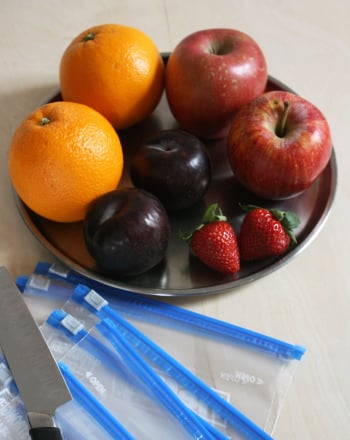
- Various fruits (such as a lemon, grapefruit, orange, tomato, and kiwi)
- Multi-meter
- LED
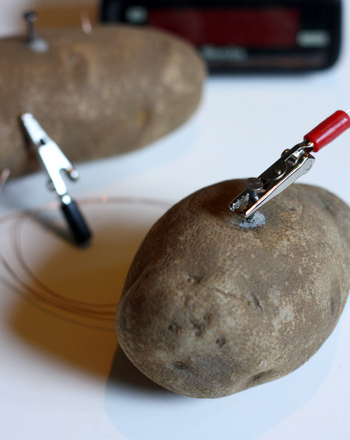
- Alligator clip leads
- Tri-fold cardboard display board
- Copper and zinc electrodes
- (optional) Small 1.5 volt electric hobby motor.
Research Questions
- What is a wet cell battery?
- Why do placing two dissimilar metals into a fruit produce an electric current?
- Which fruit-cell produced the most electricity? Which fruit-cell produced the least?
- Did changing how far in the electrodes were make the current increase or decrease?
- Did putting the electrodes closer together make the current increase or decrease?
- Did putting the electrodes farther apart make the current increase or decrease, or stay the same?
- Did the size of fruit make a difference? If so, did the size make the current increase or decrease?
- How long did the fruit-cell provide electricity to light the LED?
- Citrus fruits are acidic, which helps their juice to conduct electricity. What other fruits and vegetables might work as batteries?
- Would fruit juice minus the fruit work as an electrolyte?
Procedure
- Prepare the fruits for this project by squeezing them on all sides with the hands. Make sure not to squeeze too tightly and break the skin!
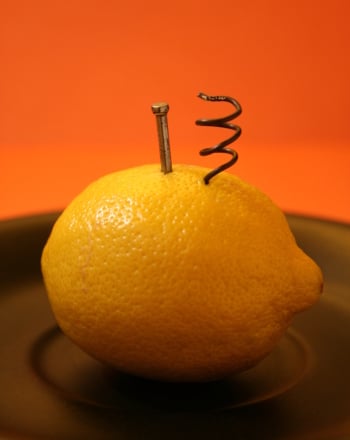
- Stick the zinc electrode all the way into the first fruit to be tested.
- Place the copper electrode on the opposite side.
- Connect the longer of the two LED leads to the copper strip and the shorter lead to the metal strip using a pair of alligator clips.
- Observe and record what happens.
- If the LED lights up, also record how long the LED stays lit.
- Measure the current using the multi-meter.
- Remove the zinc and copper electrodes and wipe off any excess juice.
- Repeat the same procedure using a different fruit. Record the results for each time.
- For a more scientifically-accurate investigation, the entire process should be repeated twice more.
- Calculate the average current produced by adding the values from the three independent results and dividing the sum by three for each fruit.
- Record the data in a table similar to the one shown.
|
Current (milliamps) |
Lemon
|
Grapefruit
|
Orange
|
Tomato
|
Kiwi
|
|
Trial 1 |
|
|
|
|
|
|
Trial 2 |
|
|
|
|
|
|
Trial 3 |
|
|
|
|
|
|
Average
|
|
|
|
|
|
- Using the data in the table, plot a bar graph with name of fruit along the x-axis and current along the y-axis.
If the LED does not light up, connect several fruit cells together attaching copper to zinc on each fruit. Also if a small motor is used instead of an LED and it doesn't automatically start when attached to the fruit cell, twist the armature.
Education.com provides the Science Fair Project Ideas for informational purposes only. Education.com does not make any guarantee or representation regarding the Science Fair Project Ideas and is not responsible or liable for any loss or damage, directly or indirectly, caused by your use of such information. By accessing the Science Fair Project Ideas, you waive and renounce any claims against Education.com that arise thereof. In addition, your access to Education.com's website and Science Fair Project Ideas is covered by Education.com's Privacy Policy and site Terms of Use, which include limitations on Education.com's liability.
Warning is hereby given that not all Project Ideas are appropriate for all individuals or in all circumstances. Implementation of any Science Project Idea should be undertaken only in appropriate settings and with appropriate parental or other supervision. Reading and following the safety precautions of all materials used in a project is the sole responsibility of each individual. For further information, consult your state's handbook of Science Safety.
Related learning resources