
Activity
Cloud Meteorologist: Predict the Weather by Learning the Clouds!
Grade Level: 4th - 6th; Type: Meteorology, Earth Science
Objective:
The objective of this project is learning to identify clouds as a means of predicting the weather. By learning the types of clouds and identifying what they mean the student will become more acutely aware of the world around them and gain experience making consistent observations and predictions.
Research Questions:
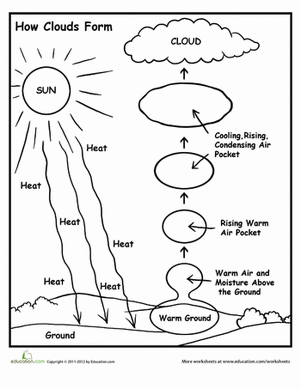
- What causes clouds to form?
- What are the names of the different shapes of clouds?
- What are the names to describe the position of clouds in the sky?
- How do warm fronts and cold fronts affect the weather?
- What is barometric pressure? How does this affect weather?
- What are the different types of storms we experience? What conditions cause these types of storms?
- How do different weather patterns cause different cloud formations to occur?
- What tools do professional meteorologists use to predict the weather?
As we no longer spend our days outside in search of sustenance, or travel by foot from place to place we have lost touch with the signs that nature gives us about impending weather. With a little time and effort students can learn to predict the weather by making observations of clouds rather than depending on a weather report. Not only does this build useful science skills but also can increase safety on hiking and camping trips. We categorize clouds by their shape and height in the sky. Clouds can be high, low, in the middle of the sky or have vertical growth. There are many shapes of clouds, cumulus (heaped), cirrus (wispy), nimbus (dark, rainy) etc. We combine the position in the sky with the shape of the clouds to classify the cloud. For example: alto=middle, cumulus=heaped, therefore a heaped cloud found in the middle of the sky would be classified as an altocumulus cloud. The shape and placement of the cloud in the sky is determined by temperature, moisture content, wind, and warm and cold air masses. As these are the elements that also cause the different types of weather, the clouds are a good indicator of the weather we will experience.
Materials:
- Cloud chart
- Camera (optional)
- Drawing pad
- Internet
- Local Newspaper
Experimental Procedure:
- Study the different types of clouds and how they are named.
- Use a cloud chart or field guide to create flash cards for you to use to memorize the names of different types of clouds.
- Begin making cloud observations once a day. Sketch the clouds you see. You may also want to take photographs of the clouds.
- Cut out the weather section of the local daily newspaper. Compare the weather predictions with the cloud observations you make. Use your cloud chart or field guide to learn what the different clouds mean.
- Once you are comfortable with the cloud types begin to officially observe clouds and predict the weather. Everyday make an observation, record your results and make a weather prediction. Keep track of your data in a table like Table 1 below. Continue to sketch and photograph the clouds so that you have a visual to accompany your written descriptions.
- Each day after you have made your prediction, find the weather prediction in the newspaper or online and put a copy of it with your prediction. The next day note what the weather is like so that you can keep track of how accurate your predictions are.
- Continue to observe the clouds for a month.
- At the end of the month you will have a lot of data! Did your predictions become more accurate as the month continued? What other weather elements did you begin to notice? (wind direction, humidity, temperature rise and fall, precipitation, etc.)
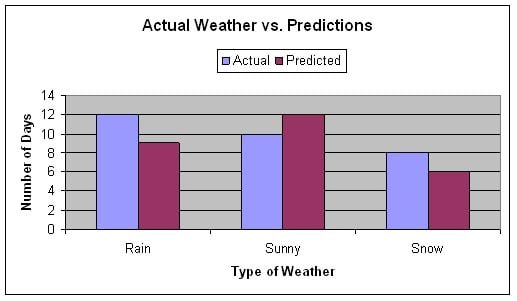
- Display your data in a bar graph. See example below. (Figure 1)
|
Date
|
Time
|
Cloud Shape
|
Cloud Position
|
Cloud Classification
|
Other Observations
|
Weather Prediction
|
|
7/28/2010
|
10:00 AM
|
Cumulus
|
Middle
|
Altocumulus
|
Wind from the NW. 50 F
|
Possible thunderstorms
|
|
|
|
|
|
|
|
|
|
|
|
|
|
|
|
|
|
|
|
|
|
|
|
|
Terms/Concepts: Cloud; Cloud Classification and identification; Water Cycle; Global Winds; Warm Front; Cold Front; Barometric Pressure; Storms; Observation; Prediction; Meteorology
References:
- Rubin, Louis D. Sr., Jim Duncan, Hiram J. Herbert. The Weather Wizard’s Cloud Book: A Unique Way to Predict the Weather.Algonquin Books, New York. 1989
- Schaeffer, Vincent and Jay Pasachoff. Peterson First Guide to Clouds and Weather. Houghton Mifflin Harcourt, Boston. 1998
- CERES S’COOL (Student’s Cloud Observations Online) Project: NASA http://science-edu.larc.nasa.gov/SCOOL/index.php
- S’COOL (Student’s Cloud Observations Online) Cloud Types Tutorial http://asd-www.larc.nasa.gov/SCOOL/tutorial/clouds/cloudtypes.html
- Weather Whiz Kids: Clouds http://www.weatherwizkids.com/weather-clouds.htm
Education.com provides the Science Fair Project Ideas for informational purposes only. Education.com does not make any guarantee or representation regarding the Science Fair Project Ideas and is not responsible or liable for any loss or damage, directly or indirectly, caused by your use of such information. By accessing the Science Fair Project Ideas, you waive and renounce any claims against Education.com that arise thereof. In addition, your access to Education.com's website and Science Fair Project Ideas is covered by Education.com's Privacy Policy and site Terms of Use, which include limitations on Education.com's liability.
Warning is hereby given that not all Project Ideas are appropriate for all individuals or in all circumstances. Implementation of any Science Project Idea should be undertaken only in appropriate settings and with appropriate parental or other supervision. Reading and following the safety precautions of all materials used in a project is the sole responsibility of each individual. For further information, consult your state's handbook of Science Safety.
Related learning resources