SKIP TO CONTENT
Worksheet Generator
Subjects
Grades
Worksheets
Games
Build a Worksheet
More Resources
Roly Recommends
Back to School
Subjects
Grades
Worksheets
Games
Build a Worksheet
More Resources
Roly Recommends
Back to School
Showing Results for dictionary
Filters
16 results
Search for: dictionary
✕
3rd Grade
✕
English Language Support
✕
Clear all
16 results
Filters
Search for: dictionary
✕
3rd Grade
✕
English Language Support
✕
Subjects
Math
English Language Arts
Grade Level
Pre-K
K
1st
2nd
3rd
4th
5th
6th
7th
8th
Early Childhood
Elementary School
Middle School
Resource Type
Lesson Plans
Common Core
Yes
English Language Support
Yes
Clear all
View 16 results
Showing Results for dictionary
Filters
16 results
Search for: dictionary
✕
3rd Grade
✕
English Language Support
✕
Clear all
16 results
Vocabulary Flash Cards
Lesson Plan
Vocabulary Flash Cards
Second Grade
Vocabulary
Making flash cards is something done by students of all ages. Help your kids develop good study habits with this lesson plan, which will teach them how to use flash cards and a dictionary to learn new vocabulary.
Lesson Plan
Vocabulary Flash Cards
Lesson Plan
Vocabulary Flash Cards
Making flash cards is something done by students of all ages. Help your kids develop good study habits with this lesson plan, which will teach them how to use flash cards and a dictionary to learn new vocabulary.
Second Grade
Vocabulary
Lesson Plan
Get Clued In to Context Clues
Lesson Plan
Get Clued In to Context Clues
Third Grade
Vocabulary
Context clues are a powerful tool for all readers! Use this lesson to teach your students how to utilize context clues to determine the meanings of unknown words.
Lesson Plan
Get Clued In to Context Clues
Lesson Plan
Get Clued In to Context Clues
Context clues are a powerful tool for all readers! Use this lesson to teach your students how to utilize context clues to determine the meanings of unknown words.
Third Grade
Vocabulary
Lesson Plan
Fact or Opinion: Part 1
Lesson Plan
Fact or Opinion: Part 1
Second Grade
Reading
Cats are the best! Pizza is better! My teacher rules! In Fact or Opinion: Part 1, your students will combine reading and writing to learn about the differences between facts and opinions and how those differences are communicated.
Lesson Plan
Fact or Opinion: Part 1
Lesson Plan
Fact or Opinion: Part 1
Cats are the best! Pizza is better! My teacher rules! In Fact or Opinion: Part 1, your students will combine reading and writing to learn about the differences between facts and opinions and how those differences are communicated.
Second Grade
Reading
Lesson Plan
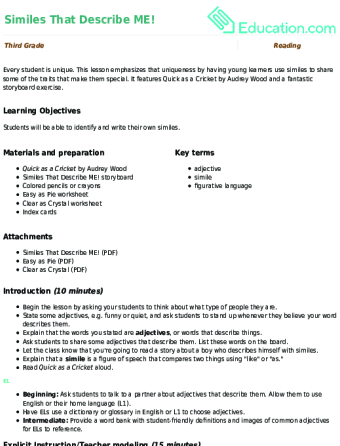
Similes That Describe ME!
Lesson Plan
Similes That Describe ME!
Third Grade
Vocabulary
Every student is unique. This lesson emphasizes that uniqueness by having young learners use similes to share some of the traits that make them special. It features Quick as a Cricket by Audrey Wood and a fantastic storyboard exercise.
Lesson Plan
Similes That Describe ME!
Lesson Plan
Similes That Describe ME!
Every student is unique. This lesson emphasizes that uniqueness by having young learners use similes to share some of the traits that make them special. It features Quick as a Cricket by Audrey Wood and a fantastic storyboard exercise.
Third Grade
Vocabulary
Lesson Plan
Making Sense of Realism and Fantasy
Lesson Plan
Making Sense of Realism and Fantasy
Third Grade
Vocabulary
Is it real or is it fantasy? This lesson introduces students to the literary concepts of realism and fantasy. Readers will practice this skill by using details in texts to distinguish the two genre elements.
Lesson Plan
Making Sense of Realism and Fantasy
Lesson Plan
Making Sense of Realism and Fantasy
Is it real or is it fantasy? This lesson introduces students to the literary concepts of realism and fantasy. Readers will practice this skill by using details in texts to distinguish the two genre elements.
Third Grade
Vocabulary
Lesson Plan
Traditional Literature: Story Mapping
Lesson Plan
Traditional Literature: Story Mapping
Second Grade
Reading
Students will learn how to identify story elements and create a short and sweet summary. They will fill out a graphic organizer and solidify their understanding by creating illustrations to show major plot points that they find themselves!
Lesson Plan
Traditional Literature: Story Mapping
Lesson Plan
Traditional Literature: Story Mapping
Students will learn how to identify story elements and create a short and sweet summary. They will fill out a graphic organizer and solidify their understanding by creating illustrations to show major plot points that they find themselves!
Second Grade
Reading
Lesson Plan
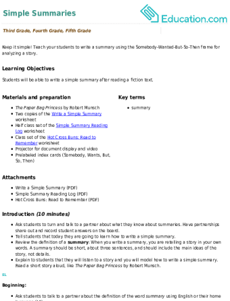
Simple Summaries
Lesson Plan
Simple Summaries
Third Grade
Reading
Keep it simple! Teach your students to write a summary using the Somebody-Wanted-But-So-Then frame for analyzing a story.
Lesson Plan
Simple Summaries
Lesson Plan
Simple Summaries
Keep it simple! Teach your students to write a summary using the Somebody-Wanted-But-So-Then frame for analyzing a story.
Third Grade
Reading
Lesson Plan
Reading Comprehension and Evidence-Based Terms
Lesson Plan
Reading Comprehension and Evidence-Based Terms
Third Grade
Vocabulary
The proof is in the pudding! Use this lesson to teach your students how to use text evidence as proof when answering questions after reading. They will use evidence-based terms as they answer basic comprehension questions.
Lesson Plan
Reading Comprehension and Evidence-Based Terms
Lesson Plan
Reading Comprehension and Evidence-Based Terms
The proof is in the pudding! Use this lesson to teach your students how to use text evidence as proof when answering questions after reading. They will use evidence-based terms as they answer basic comprehension questions.
Third Grade
Vocabulary
Lesson Plan
My View as an Ant
Lesson Plan
My View as an Ant
Third Grade
Vocabulary
Give students a chance to experience a different point of view! This fANTastic lesson on narrative style turns young readers into characters of Chris Van Allsburg's Two Bad Ants.
Lesson Plan
My View as an Ant
Lesson Plan
My View as an Ant
Give students a chance to experience a different point of view! This fANTastic lesson on narrative style turns young readers into characters of Chris Van Allsburg's Two Bad Ants.
Third Grade
Vocabulary
Lesson Plan
Elapseable
Lesson Plan
Elapseable
Second Grade
Vocabulary
It's time to learn about time. In this hands-on lesson, students manipulate clock hands and jump across timelines in order to calculate the "distance" between different times and events.
Lesson Plan
Elapseable
Lesson Plan
Elapseable
It's time to learn about time. In this hands-on lesson, students manipulate clock hands and jump across timelines in order to calculate the "distance" between different times and events.
Second Grade
Vocabulary
Lesson Plan
In Search of the Main Idea
Lesson Plan
In Search of the Main Idea
Third Grade
Writing
Young learners will love finding the main ideas in short informational texts. Featuring a bunch of fun worksheets, this lesson will help students learn about different topics while improving their reading skills.
Lesson Plan
In Search of the Main Idea
Lesson Plan
In Search of the Main Idea
Young learners will love finding the main ideas in short informational texts. Featuring a bunch of fun worksheets, this lesson will help students learn about different topics while improving their reading skills.
Third Grade
Writing
Lesson Plan
Questions that Gauge Comprehension
Lesson Plan
Questions that Gauge Comprehension
Third Grade
Vocabulary
Use this lesson to gauge your students’ basic comprehension of fiction text. If they can answer who, what, when, where, why, and how questions, you know they have a handle on it and it’s time to get into more critical thinking!
Lesson Plan
Questions that Gauge Comprehension
Lesson Plan
Questions that Gauge Comprehension
Use this lesson to gauge your students’ basic comprehension of fiction text. If they can answer who, what, when, where, why, and how questions, you know they have a handle on it and it’s time to get into more critical thinking!
Third Grade
Vocabulary
Lesson Plan
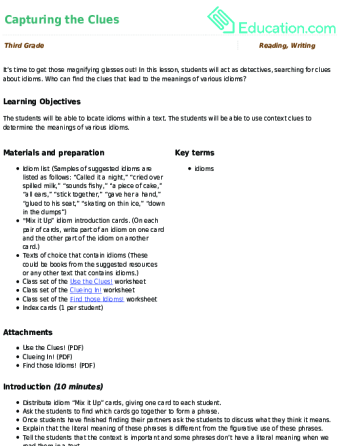
Capturing the Clues
Lesson Plan
Capturing the Clues
Third Grade
Vocabulary
It’s time to get those magnifying glasses out! In this lesson, students will act as detectives, searching for clues about idioms. Who can find the clues that lead to the meanings of various idioms?
Lesson Plan
Capturing the Clues
Lesson Plan
Capturing the Clues
It’s time to get those magnifying glasses out! In this lesson, students will act as detectives, searching for clues about idioms. Who can find the clues that lead to the meanings of various idioms?
Third Grade
Vocabulary
Lesson Plan
Characteristics of Polygons
Lesson Plan
Characteristics of Polygons
Third Grade
Vocabulary
Bring on the polygons! Your students will build their understanding of polygons and sort shapes into categories based on their attributes in this lesson.
Lesson Plan
Characteristics of Polygons
Lesson Plan
Characteristics of Polygons
Bring on the polygons! Your students will build their understanding of polygons and sort shapes into categories based on their attributes in this lesson.
Third Grade
Vocabulary
Lesson Plan
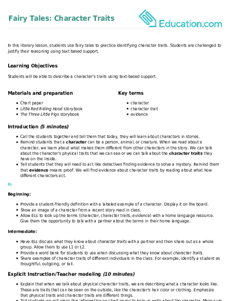
Fairy Tales: Character Traits
Lesson Plan
Fairy Tales: Character Traits
Second Grade
Reading
In this literary lesson, students use fairy tales to practice identifying character traits. Students are challenged to justify their reasoning using text based support.
Lesson Plan
Fairy Tales: Character Traits
Lesson Plan
Fairy Tales: Character Traits
In this literary lesson, students use fairy tales to practice identifying character traits. Students are challenged to justify their reasoning using text based support.
Second Grade
Reading
Lesson Plan
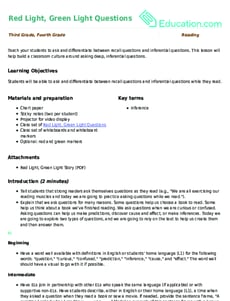
Red Light, Green Light Questions
Lesson Plan
Red Light, Green Light Questions
Third Grade
Statistics
Teach your students to ask and differentiate between recall questions and inferential questions. This lesson will help build a classroom culture around asking deep, inferential questions.
Lesson Plan
Red Light, Green Light Questions
Lesson Plan
Red Light, Green Light Questions
Teach your students to ask and differentiate between recall questions and inferential questions. This lesson will help build a classroom culture around asking deep, inferential questions.
Third Grade
Statistics
Lesson Plan
1