SKIP TO CONTENT
Worksheet Generator
Subjects
Grades
Worksheets
Games
Build a Worksheet
More Resources
Roly Recommends
Subjects
Grades
Worksheets
Games
Build a Worksheet
More Resources
Roly Recommends
Filters
Search for: technology, interactive, learning
✕
3rd Grade
✕
Subjects
Math
English Language Arts
Science
Social Studies
Foreign Language
Grade Level
Pre-K
K
1st
2nd
3rd
4th
5th
6th
7th
8th
Early Childhood
Elementary School
Middle School
Resource Type
Worksheets
Games
Lesson Plans
Interactive Worksheets
Workbooks
Activities
Exercises
Stories
Offline Games
Guided Lessons
Teacher Resources
See more
Occasion
Birthdays
Women's History Month
Spring
Easter
Earth Day
Mother's Day
Memorial Day
Summer
Independence Day
Back to School
Labor Day
Fall
Halloween
Veterans Day
Winter
Holidays
Thanksgiving
Christmas
New Year
Martin Luther King Jr. Day
Lunar New Year
Valentine's Day
Presidents' Day
Black History Month
See more
Common Core
Yes
No
Roly Recommends
Social Emotional Learning
Game Type
Mazes
Crossword
Group Games
Outdoor Games
Puzzles & Sudoku
Scavenger Hunt
Travel Games
Word Puzzles
Word Search
See more
Arts & Crafts
Arts & Crafts
Fabric Projects
Beads & Jewelry
Paper & Glue Crafts
Construction & Sculpture
Painting & Drawing
Recycled Crafts
Coloring
Yes
Recipes
Snacks
Mains
Sides
English Language Support
Yes
See More
Clear All
View 984 results
Showing Results for technology interactive learning : Page 33
984 results
Search for: technology, interactive, learning
✕
3rd Grade
✕
Clear All
Sort by:
Relevance
Most recent
Most popular
Alphabetical A-Z
Alphabetical Z-A
All filters
984 results
Sort by:
Relevance
Most recent
Most popular
Alphabetical A-Z
Alphabetical Z-A
-Er and -Est: Which is the Best?
Lesson Plan
-Er and -Est: Which is the Best?
Third Grade
Phonics
Do your students need extra practice forming words with the suffixes
-er
and* -est* depending on the context? With an abundance of words to explore, your students will learn how to determine which suffix is best for each individual context.
Lesson Plan
-Er and -Est: Which is the Best?
Lesson Plan
-Er and -Est: Which is the Best?
Do your students need extra practice forming words with the suffixes
-er
and* -est* depending on the context? With an abundance of words to explore, your students will learn how to determine which suffix is best for each individual context.
Third Grade
Phonics
Lesson Plan
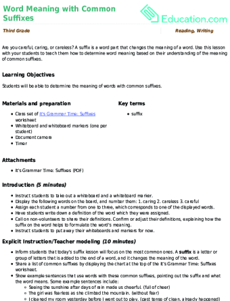
Word Meaning with Common Suffixes
Lesson Plan
Word Meaning with Common Suffixes
Third Grade
Are you careful, caring, or careless? A suffix is a word part that changes the meaning of a word. Use this lesson with your students to teach them how to determine word meaning based on their understanding of the meaning of common suffixes.
Lesson Plan
Word Meaning with Common Suffixes
Lesson Plan
Word Meaning with Common Suffixes
Are you careful, caring, or careless? A suffix is a word part that changes the meaning of a word. Use this lesson with your students to teach them how to determine word meaning based on their understanding of the meaning of common suffixes.
Third Grade
Lesson Plan
EL
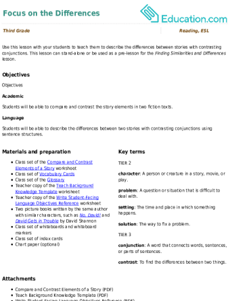
Focus on the Differences
Lesson Plan
Focus on the Differences
Third Grade
Reading
Use this lesson with your students to teach them to describe the differences between stories with contrasting conjunctions. This lesson can stand-alone or be used as a pre-lesson for the
Finding Similarities and Differences
lesson.
Lesson Plan
EL
Focus on the Differences
Lesson Plan
Focus on the Differences
Use this lesson with your students to teach them to describe the differences between stories with contrasting conjunctions. This lesson can stand-alone or be used as a pre-lesson for the
Finding Similarities and Differences
lesson.
Third Grade
Reading
Lesson Plan
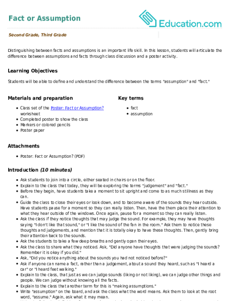
Fact or Assumption
Lesson Plan
Fact or Assumption
Second Grade
Distinguishing between facts and assumptions is an important life skill. In this lesson, students will articulate the difference between assumptions and facts through class discussion and a poster activity.
Lesson Plan
Fact or Assumption
Lesson Plan
Fact or Assumption
Distinguishing between facts and assumptions is an important life skill. In this lesson, students will articulate the difference between assumptions and facts through class discussion and a poster activity.
Second Grade
Lesson Plan
EL
Pick Out the Parts of a Story
Lesson Plan
Pick Out the Parts of a Story
Third Grade
Reading
Use this lesson to teach your students to identify story elements and compare them to another text's story elements. This lesson can stand alone or be used as a pre-lesson for the
Comparing Texts by the Same Author
lesson.
Lesson Plan
EL
Pick Out the Parts of a Story
Lesson Plan
Pick Out the Parts of a Story
Use this lesson to teach your students to identify story elements and compare them to another text's story elements. This lesson can stand alone or be used as a pre-lesson for the
Comparing Texts by the Same Author
lesson.
Third Grade
Reading
Lesson Plan
EL
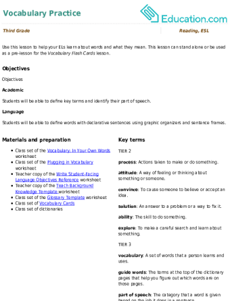
Vocabulary Practice
Lesson Plan
Vocabulary Practice
Third Grade
Vocabulary
Use this lesson to help your ELs learn about words and what they mean. This lesson can stand alone or be used as a pre-lesson for the
Vocabulary Flash Cards
lesson.
Lesson Plan
EL
Vocabulary Practice
Lesson Plan
Vocabulary Practice
Use this lesson to help your ELs learn about words and what they mean. This lesson can stand alone or be used as a pre-lesson for the
Vocabulary Flash Cards
lesson.
Third Grade
Vocabulary
Lesson Plan
Perfect Prefixes!
Lesson Plan
Perfect Prefixes!
Third Grade
This lesson introduces young learners to prefixes. It also gives them hands-on experience with building words using prefix and root word cards.
Lesson Plan
Perfect Prefixes!
Lesson Plan
Perfect Prefixes!
This lesson introduces young learners to prefixes. It also gives them hands-on experience with building words using prefix and root word cards.
Third Grade
Lesson Plan
Actions and Reactions!
Lesson Plan
Actions and Reactions!
Third Grade
Help your students tweak their narrative writing while working on the reading skill of predictions! In this integrated reading and writing lesson, students will use narratives to generate predictions about characters’ reactions.
Lesson Plan
Actions and Reactions!
Lesson Plan
Actions and Reactions!
Help your students tweak their narrative writing while working on the reading skill of predictions! In this integrated reading and writing lesson, students will use narratives to generate predictions about characters’ reactions.
Third Grade
Lesson Plan
What's Your Phase?
Lesson Plan
What's Your Phase?
Third Grade
Earth and Space Science
This lesson engages students in activity to help them understand the phases of the Moon, and why they occur. Students read literature, analyze it, and then apply it to the small group performance of one cycle of the Moon’s phases.
Lesson Plan
What's Your Phase?
Lesson Plan
What's Your Phase?
This lesson engages students in activity to help them understand the phases of the Moon, and why they occur. Students read literature, analyze it, and then apply it to the small group performance of one cycle of the Moon’s phases.
Third Grade
Earth and Space Science
Lesson Plan
The Role of Fat in Food
Activity
The Role of Fat in Food
First Grade
Engineering and Science Inquiry
This science experiment examines the role of fat in food, especially in making bread rise and whipping cream.
Activity
The Role of Fat in Food
Activity
The Role of Fat in Food
This science experiment examines the role of fat in food, especially in making bread rise and whipping cream.
First Grade
Engineering and Science Inquiry
Activity
Factors Affecting Solubility
Activity
Factors Affecting Solubility
Third Grade
Engineering and Science Inquiry
Kids discover what a homogeneous mixture is by adding sugar to distilled water and identify the various factors affecting solubility.
Activity
Factors Affecting Solubility
Activity
Factors Affecting Solubility
Kids discover what a homogeneous mixture is by adding sugar to distilled water and identify the various factors affecting solubility.
Third Grade
Engineering and Science Inquiry
Activity
Exploring Author's Purpose and Point of View
Lesson Plan
Exploring Author's Purpose and Point of View
Third Grade
Life Science
We aren’t mind readers, but we can still figure out why the author wrote a text and what an author thinks about the topic! This lesson will teach your students the main purposes for writing.
Lesson Plan
Exploring Author's Purpose and Point of View
Lesson Plan
Exploring Author's Purpose and Point of View
We aren’t mind readers, but we can still figure out why the author wrote a text and what an author thinks about the topic! This lesson will teach your students the main purposes for writing.
Third Grade
Life Science
Lesson Plan
What Does the Author Think?
Lesson Plan
What Does the Author Think?
Third Grade
Can you tell what the author thinks about this subject? What do
you
think about it? Use this resource to help your students recognize the author's point of view and establish their own.
Lesson Plan
What Does the Author Think?
Lesson Plan
What Does the Author Think?
Can you tell what the author thinks about this subject? What do
you
think about it? Use this resource to help your students recognize the author's point of view and establish their own.
Third Grade
Lesson Plan
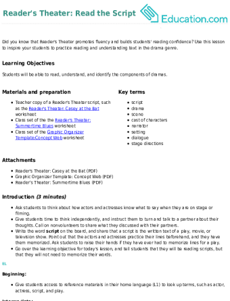
Reader's Theater: Read the Script
Lesson Plan
Reader's Theater: Read the Script
Third Grade
Reading
Did you know that Reader's Theater promotes fluency and builds students' reading confidence? Use this lesson to inspire your students to practice reading and understanding text in the drama genre.
Lesson Plan
Reader's Theater: Read the Script
Lesson Plan
Reader's Theater: Read the Script
Did you know that Reader's Theater promotes fluency and builds students' reading confidence? Use this lesson to inspire your students to practice reading and understanding text in the drama genre.
Third Grade
Reading
Lesson Plan
EL
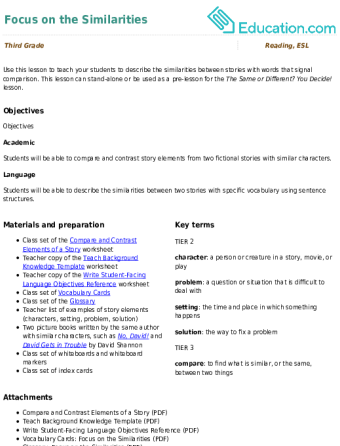
Focus on the Similarities
Lesson Plan
Focus on the Similarities
Third Grade
Reading
Use this lesson to teach your students to describe the similarities between stories with words that signal comparison. This lesson can stand-alone or be used as a pre-lesson for the
The Same or Different? You Decide!
lesson.
Lesson Plan
EL
Focus on the Similarities
Lesson Plan
Focus on the Similarities
Use this lesson to teach your students to describe the similarities between stories with words that signal comparison. This lesson can stand-alone or be used as a pre-lesson for the
The Same or Different? You Decide!
lesson.
Third Grade
Reading
Lesson Plan
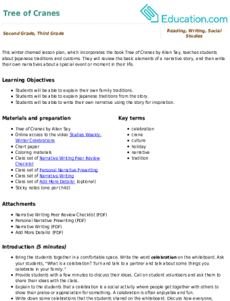
Tree of Cranes
Lesson Plan
Tree of Cranes
Second Grade
Reading
This winter-themed lesson plan, which incorporates the book
Tree of Cranes
by Allen Say, teaches students about Japanese traditions and customs. They will review the basic elements of a narrative story, and then write their own narratives about a special event or moment in their life.
Lesson Plan
Tree of Cranes
Lesson Plan
Tree of Cranes
This winter-themed lesson plan, which incorporates the book
Tree of Cranes
by Allen Say, teaches students about Japanese traditions and customs. They will review the basic elements of a narrative story, and then write their own narratives about a special event or moment in their life.
Second Grade
Reading
Lesson Plan
EL
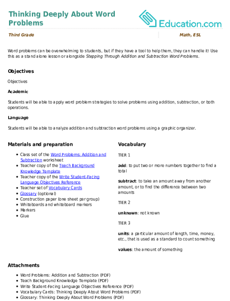
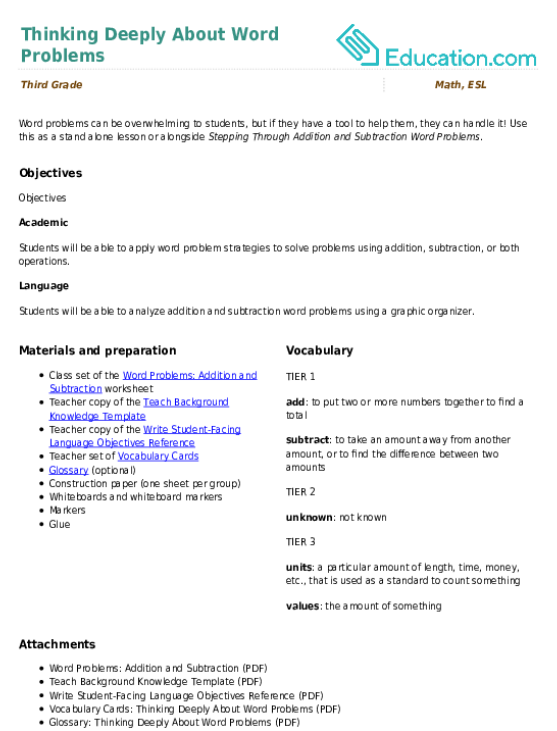
Thinking Deeply About Word Problems
Lesson Plan
Thinking Deeply About Word Problems
Third Grade
Subtraction
Word problems can be overwhelming to students, but if they have a tool to help them, they can handle it! Use this as a stand alone lesson or alongside
Stepping Through Addition and Subtraction Word Problems
.
Lesson Plan
EL
Thinking Deeply About Word Problems
Lesson Plan
Thinking Deeply About Word Problems
Word problems can be overwhelming to students, but if they have a tool to help them, they can handle it! Use this as a stand alone lesson or alongside
Stepping Through Addition and Subtraction Word Problems
.
Third Grade
Subtraction
Lesson Plan
EL
Skip Counting with Visuals
Lesson Plan
Skip Counting with Visuals
Third Grade
Give your students visuals to support their understanding of skip counting. Use this lesson on its own or as a pre-lesson for
Roll the Dice: Skip Counting by Fives
.
Lesson Plan
EL
Skip Counting with Visuals
Lesson Plan
Skip Counting with Visuals
Give your students visuals to support their understanding of skip counting. Use this lesson on its own or as a pre-lesson for
Roll the Dice: Skip Counting by Fives
.
Third Grade
Lesson Plan
EL
Distinguish Between Facts and Opinions
Lesson Plan
Distinguish Between Facts and Opinions
Third Grade
Teach your students the difference between facts and opinions, and why an author would choose to use each type of information. This can stand-alone or be used as a pre-lesson for the
Exploring Author's Purpose and Point of View
lesson.
Lesson Plan
EL
Distinguish Between Facts and Opinions
Lesson Plan
Distinguish Between Facts and Opinions
Teach your students the difference between facts and opinions, and why an author would choose to use each type of information. This can stand-alone or be used as a pre-lesson for the
Exploring Author's Purpose and Point of View
lesson.
Third Grade
Lesson Plan
EL
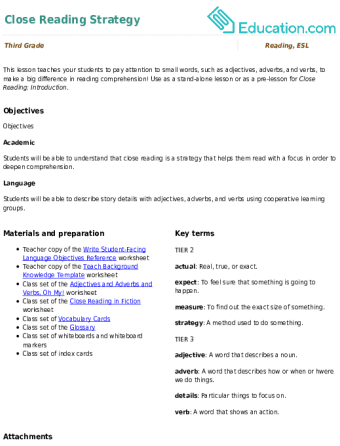
Close Reading Strategy
Lesson Plan
Close Reading Strategy
Third Grade
Grammar and Mechanics
This lesson teaches your students to pay attention to small words, such as adjectives, adverbs, and verbs, to make a big difference in reading comprehension! Use as a stand-alone lesson or as a pre-lesson for
Close Reading: Introduction
.
Lesson Plan
EL
Close Reading Strategy
Lesson Plan
Close Reading Strategy
This lesson teaches your students to pay attention to small words, such as adjectives, adverbs, and verbs, to make a big difference in reading comprehension! Use as a stand-alone lesson or as a pre-lesson for
Close Reading: Introduction
.
Third Grade
Grammar and Mechanics
Lesson Plan
EL
Working with Idioms
Lesson Plan
Working with Idioms
Third Grade
Writing
Figurative language can be difficult, especially for ELs. With the help of context clues and exposure to common idioms, it can be a piece of cake! Use this as a stand-alone lesson or as a pre-lesson for the
Take a Walk with Idioms
lesson.
Lesson Plan
EL
Working with Idioms
Lesson Plan
Working with Idioms
Figurative language can be difficult, especially for ELs. With the help of context clues and exposure to common idioms, it can be a piece of cake! Use this as a stand-alone lesson or as a pre-lesson for the
Take a Walk with Idioms
lesson.
Third Grade
Writing
Lesson Plan
EL
The Attributes of Polygons
Lesson Plan
The Attributes of Polygons
Third Grade
Get your students discussing the attributes of polygons by having them categorize statements as always, sometimes, or never true. Use this lesson independently or alongside
Characteristics of Polygons.
Lesson Plan
EL
The Attributes of Polygons
Lesson Plan
The Attributes of Polygons
Get your students discussing the attributes of polygons by having them categorize statements as always, sometimes, or never true. Use this lesson independently or alongside
Characteristics of Polygons.
Third Grade
Lesson Plan
Silent E Springing Up
Lesson Plan
Silent E Springing Up
Second Grade
Phonics
Help your students learn new vocabulary in this hands-on lesson. Your class will learn new words by adding a silent e on the end of familiar CVC words.
Lesson Plan
Silent E Springing Up
Lesson Plan
Silent E Springing Up
Help your students learn new vocabulary in this hands-on lesson. Your class will learn new words by adding a silent e on the end of familiar CVC words.
Second Grade
Phonics
Lesson Plan
EL
Reflecting on Multiplication and Division Word Problems
Lesson Plan
Reflecting on Multiplication and Division Word Problems
Third Grade
Teach your students how to reflect upon the information in multiplication and division word problems before solving them. Use this lesson on its own or as a pre-lesson to
Stepping Through Multiplication and Division Word Problems
.
Lesson Plan
EL
Reflecting on Multiplication and Division Word Problems
Lesson Plan
Reflecting on Multiplication and Division Word Problems
Teach your students how to reflect upon the information in multiplication and division word problems before solving them. Use this lesson on its own or as a pre-lesson to
Stepping Through Multiplication and Division Word Problems
.
Third Grade
Lesson Plan
1
…
30
31
32
33