SKIP TO CONTENT
Worksheet Generator
Subjects
Grades
Worksheets
Games
Build a Worksheet
More Resources
Roly Recommends
Subjects
Grades
Worksheets
Games
Build a Worksheet
More Resources
Roly Recommends
Filters
Search for: types, of...
✕
Lesson Plans
✕
Kindergarten - 4th Grade
✕
Subjects
Math
English Language Arts
Science
Social Studies
Grade Level
Pre-K
K
1st
2nd
3rd
4th
5th
6th
7th
8th
Early Childhood
Elementary School
Middle School
Resource Type
Worksheets
Games
Lesson Plans
Interactive Worksheets
Workbooks
Activities
Exercises
Stories
Offline Games
Guided Lessons
Common Core
Yes
Roly Recommends
Social Emotional Learning
English Language Support
Yes
See More
Clear All
View 237 results
Showing Results for types of... : Page 7
237 results
Search for: types, of...
✕
Lesson Plans
✕
Kindergarten - 4th Grade
✕
Clear All
Sort by:
Relevance
Most recent
Most popular
Alphabetical A-Z
Alphabetical Z-A
All filters
237 results
Sort by:
Relevance
Most recent
Most popular
Alphabetical A-Z
Alphabetical Z-A
Mindfulness: Mindful Movement
Lesson Plan
Mindfulness: Mindful Movement
Pre-K
Imagine wild animals teaching students to walk mindfully, and camoflauge teaching about stillness. This lesson takes a cue from animal adaptations as students practice walking and pausing mindfully.
Lesson Plan
Mindfulness: Mindful Movement
Lesson Plan
Mindfulness: Mindful Movement
Imagine wild animals teaching students to walk mindfully, and camoflauge teaching about stillness. This lesson takes a cue from animal adaptations as students practice walking and pausing mindfully.
Pre-K
Lesson Plan
Life-Size Maze
Lesson Plan
Life-Size Maze
First Grade
Engineering and Science Inquiry
In this lesson, students will create a set of instructions for navigating a life-size maze.
Lesson Plan
Life-Size Maze
Lesson Plan
Life-Size Maze
In this lesson, students will create a set of instructions for navigating a life-size maze.
First Grade
Engineering and Science Inquiry
Lesson Plan
Pantomime: An Adverb Game
Lesson Plan
Pantomime: An Adverb Game
Fourth Grade
Act it out! Your students will have fun guessing and acting out adverbs in this engaging grammar game. As you progress through this adverb lesson plan, your students will have the opportunity to identify and use a variety of adverbs.
Lesson Plan
Pantomime: An Adverb Game
Lesson Plan
Pantomime: An Adverb Game
Act it out! Your students will have fun guessing and acting out adverbs in this engaging grammar game. As you progress through this adverb lesson plan, your students will have the opportunity to identify and use a variety of adverbs.
Fourth Grade
Lesson Plan
EL
Let's Read It With Expression!
Lesson Plan
Let's Read It With Expression!
Third Grade
Teach your students about text clues that will help them read with expression. This lesson can stand alone or be used as a pre-lesson for the
Reader's Theater: Read the Script
lesson.
Lesson Plan
EL
Let's Read It With Expression!
Lesson Plan
Let's Read It With Expression!
Teach your students about text clues that will help them read with expression. This lesson can stand alone or be used as a pre-lesson for the
Reader's Theater: Read the Script
lesson.
Third Grade
Lesson Plan
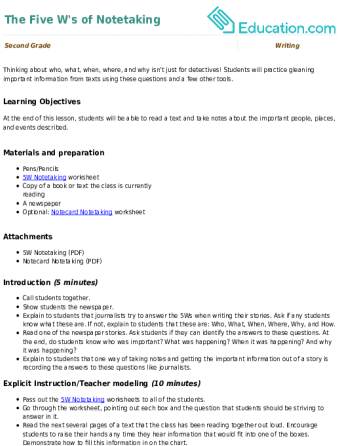
The Five W's of Notetaking
Lesson Plan
The Five W's of Notetaking
Second Grade
Writing
Thinking about who, what, when, where, and why isn’t just for detectives! Students will practice gleaning important information from texts using these questions and a few other tools.
Lesson Plan
The Five W's of Notetaking
Lesson Plan
The Five W's of Notetaking
Thinking about who, what, when, where, and why isn’t just for detectives! Students will practice gleaning important information from texts using these questions and a few other tools.
Second Grade
Writing
Lesson Plan
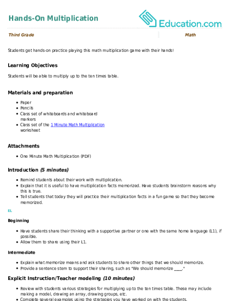
Hands-On Multiplication
Lesson Plan
Hands-On Multiplication
Third Grade
Students get hands-on practice playing this math multiplication game with their hands!
Lesson Plan
Hands-On Multiplication
Lesson Plan
Hands-On Multiplication
Students get hands-on practice playing this math multiplication game with their hands!
Third Grade
Lesson Plan
Artist Spotlight: Frida Kahlo
Lesson Plan
Artist Spotlight: Frida Kahlo
First Grade
This lesson plan teaches students about Frida Kahlo and her legacy as an activist and artist who continues to inspire people all over the world. Students will listen to a story about Frida Kahlo and reflect on what it means to be an artist.
Lesson Plan
Artist Spotlight: Frida Kahlo
Lesson Plan
Artist Spotlight: Frida Kahlo
This lesson plan teaches students about Frida Kahlo and her legacy as an activist and artist who continues to inspire people all over the world. Students will listen to a story about Frida Kahlo and reflect on what it means to be an artist.
First Grade
Lesson Plan
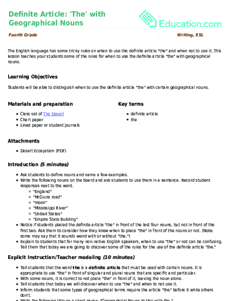
Definite Article: 'The' with Geographical Nouns
Lesson Plan
Definite Article: 'The' with Geographical Nouns
Fourth Grade
The English language has some tricky rules on when to use the definite article "the" and when not to use it. This lesson teaches your students some of the rules for when to use the definite article "the" with geographical nouns.
Lesson Plan
Definite Article: 'The' with Geographical Nouns
Lesson Plan
Definite Article: 'The' with Geographical Nouns
The English language has some tricky rules on when to use the definite article "the" and when not to use it. This lesson teaches your students some of the rules for when to use the definite article "the" with geographical nouns.
Fourth Grade
Lesson Plan
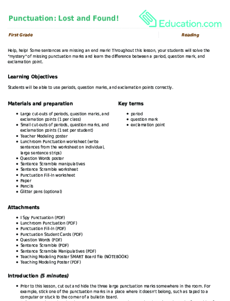
Punctuation: Lost and Found!
Lesson Plan
Punctuation: Lost and Found!
First Grade
Help, help! Some sentences are missing an end mark! Throughout this lesson, your students will solve the "mystery" of missing punctuation marks and learn the difference between a period, question mark, and exclamation point.
Lesson Plan
Punctuation: Lost and Found!
Lesson Plan
Punctuation: Lost and Found!
Help, help! Some sentences are missing an end mark! Throughout this lesson, your students will solve the "mystery" of missing punctuation marks and learn the difference between a period, question mark, and exclamation point.
First Grade
Lesson Plan
EL
Parts of a Drama
Lesson Plan
Parts of a Drama
Third Grade
Writing
Expose your students to the wonderful genre of drama, but be sure to teach them the important key terms so they understand the structure. Use this as a stand alone lesson or a pre-lesson for the
Putting a Play Together!
lesson.
Lesson Plan
EL
Parts of a Drama
Lesson Plan
Parts of a Drama
Expose your students to the wonderful genre of drama, but be sure to teach them the important key terms so they understand the structure. Use this as a stand alone lesson or a pre-lesson for the
Putting a Play Together!
lesson.
Third Grade
Writing
Lesson Plan
Shapes Inside Shapes
Lesson Plan
Shapes Inside Shapes
Kindergarten
Geometry
Look all around! We can find 2D shapes inside 3D shapes wherever we go! In this lesson, students will sort shapes and recognize the 2D components of common 3D shapes.
Lesson Plan
Shapes Inside Shapes
Lesson Plan
Shapes Inside Shapes
Look all around! We can find 2D shapes inside 3D shapes wherever we go! In this lesson, students will sort shapes and recognize the 2D components of common 3D shapes.
Kindergarten
Geometry
Lesson Plan
What is a Region?
Lesson Plan
What is a Region?
Fourth Grade
Geography
Through examples and non-examples, students will learn what qualifies as a region. Creativity and problem solving skills will be put to the test as students determine the necessary elements that make up a region.
Lesson Plan
What is a Region?
Lesson Plan
What is a Region?
Through examples and non-examples, students will learn what qualifies as a region. Creativity and problem solving skills will be put to the test as students determine the necessary elements that make up a region.
Fourth Grade
Geography
Lesson Plan
Charts and Graphs and Diagrams, Oh My!
Lesson Plan
Charts and Graphs and Diagrams, Oh My!
Fourth Grade
Reading
Students will learn about three nonfiction text features: charts, graphs, and diagrams. They will analyze and interpret the information represented in these visual forms and discover how they aid in the comprehension of nonfiction texts.
Lesson Plan
Charts and Graphs and Diagrams, Oh My!
Lesson Plan
Charts and Graphs and Diagrams, Oh My!
Students will learn about three nonfiction text features: charts, graphs, and diagrams. They will analyze and interpret the information represented in these visual forms and discover how they aid in the comprehension of nonfiction texts.
Fourth Grade
Reading
Lesson Plan
Less Than or Greater Than Alligators
Lesson Plan
Less Than or Greater Than Alligators
First Grade
Your students will learn when to use less than and greater than and how to differentiate the two symbols in this lesson. They will have fun playing the role of the Less Than and Greater Than alligators!
Lesson Plan
Less Than or Greater Than Alligators
Lesson Plan
Less Than or Greater Than Alligators
Your students will learn when to use less than and greater than and how to differentiate the two symbols in this lesson. They will have fun playing the role of the Less Than and Greater Than alligators!
First Grade
Lesson Plan
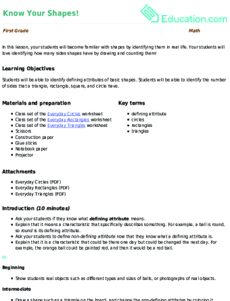
Know Your Shapes!
Lesson Plan
Know Your Shapes!
First Grade
Geometry
In this lesson, your students will become familiar with shapes by identifying them in real life. Your students will love identifying how many sides shapes have by drawing and counting them!
Lesson Plan
Know Your Shapes!
Lesson Plan
Know Your Shapes!
In this lesson, your students will become familiar with shapes by identifying them in real life. Your students will love identifying how many sides shapes have by drawing and counting them!
First Grade
Geometry
Lesson Plan
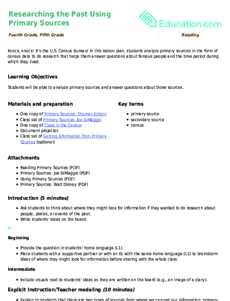
Researching the Past Using Primary Sources
Lesson Plan
Researching the Past Using Primary Sources
Fourth Grade
Reading
Knock, knock! It’s the U.S. Census Bureau! In this lesson plan, students analyze primary sources in the form of census data to do research that helps them answer questions about famous people and the time period during which they lived.
Lesson Plan
Researching the Past Using Primary Sources
Lesson Plan
Researching the Past Using Primary Sources
Knock, knock! It’s the U.S. Census Bureau! In this lesson plan, students analyze primary sources in the form of census data to do research that helps them answer questions about famous people and the time period during which they lived.
Fourth Grade
Reading
Lesson Plan
What's Your Phase?
Lesson Plan
What's Your Phase?
Third Grade
Earth and Space Science
This lesson engages students in activity to help them understand the phases of the Moon, and why they occur. Students read literature, analyze it, and then apply it to the small group performance of one cycle of the Moon’s phases.
Lesson Plan
What's Your Phase?
Lesson Plan
What's Your Phase?
This lesson engages students in activity to help them understand the phases of the Moon, and why they occur. Students read literature, analyze it, and then apply it to the small group performance of one cycle of the Moon’s phases.
Third Grade
Earth and Space Science
Lesson Plan
Multiplying by Multiples of 10
Lesson Plan
Multiplying by Multiples of 10
Third Grade
10, 20, 30, and up! In this lesson, students learn strategies for multiplying one-digit numbers by multiples of ten (10 through 90) through practice problems and playing a fun, hands-on game.
Lesson Plan
Multiplying by Multiples of 10
Lesson Plan
Multiplying by Multiples of 10
10, 20, 30, and up! In this lesson, students learn strategies for multiplying one-digit numbers by multiples of ten (10 through 90) through practice problems and playing a fun, hands-on game.
Third Grade
Lesson Plan
What’s the (Main) Topic?
Lesson Plan
What’s the (Main) Topic?
First Grade
Teach your students how to identify the main topic using story cards and an interactive read aloud in this engaging lesson.
Lesson Plan
What’s the (Main) Topic?
Lesson Plan
What’s the (Main) Topic?
Teach your students how to identify the main topic using story cards and an interactive read aloud in this engaging lesson.
First Grade
Lesson Plan
EL
Long, Longer, Longest
Lesson Plan
Long, Longer, Longest
First Grade
Measurement
Students will love working together to create a display that demonstrates understanding of relative length. Use alone or with the lesson
Order Up Measurement.
Lesson Plan
EL
Long, Longer, Longest
Lesson Plan
Long, Longer, Longest
Students will love working together to create a display that demonstrates understanding of relative length. Use alone or with the lesson
Order Up Measurement.
First Grade
Measurement
Lesson Plan
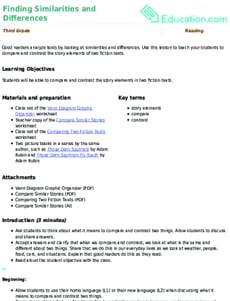
Finding Similarities and Differences
Lesson Plan
Finding Similarities and Differences
Third Grade
Reading
Good readers analyze texts by looking at similarities and differences. Use this lesson to teach your students to compare and contrast the story elements of two fiction texts.
Lesson Plan
Finding Similarities and Differences
Lesson Plan
Finding Similarities and Differences
Good readers analyze texts by looking at similarities and differences. Use this lesson to teach your students to compare and contrast the story elements of two fiction texts.
Third Grade
Reading
Lesson Plan
EL
Decomposing and Adding Place Values
Lesson Plan
Decomposing and Adding Place Values
Second Grade
Use this scaffolded EL support lesson to help students learn the strategy of decomposing three-digit numbers to add their place values. This lesson can be used alone or prior to teaching Composing and Decomposing to students.
Lesson Plan
EL
Decomposing and Adding Place Values
Lesson Plan
Decomposing and Adding Place Values
Use this scaffolded EL support lesson to help students learn the strategy of decomposing three-digit numbers to add their place values. This lesson can be used alone or prior to teaching Composing and Decomposing to students.
Second Grade
Lesson Plan
Read about and Discuss Historic Heroes
Lesson Plan
Read about and Discuss Historic Heroes
Fourth Grade
Reading
In this lesson plan, students will discuss characteristics of a hero and how to get information from texts to understand why a person is considered a hero. Partner discussions will help students have a deeper understanding.
Lesson Plan
Read about and Discuss Historic Heroes
Lesson Plan
Read about and Discuss Historic Heroes
In this lesson plan, students will discuss characteristics of a hero and how to get information from texts to understand why a person is considered a hero. Partner discussions will help students have a deeper understanding.
Fourth Grade
Reading
Lesson Plan
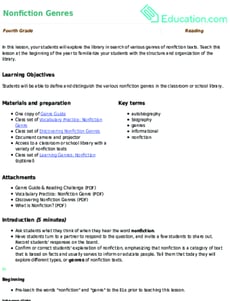
Nonfiction Genres
Lesson Plan
Nonfiction Genres
Fourth Grade
Writing
In this lesson, your students will explore the library in search of various genres of nonfiction texts. Teach this lesson at the beginning of the year to familiarize your students with the structure and organization of the library.
Lesson Plan
Nonfiction Genres
Lesson Plan
Nonfiction Genres
In this lesson, your students will explore the library in search of various genres of nonfiction texts. Teach this lesson at the beginning of the year to familiarize your students with the structure and organization of the library.
Fourth Grade
Writing
Lesson Plan
EL
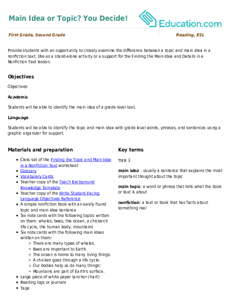
Main Idea or Topic? You Decide!
Lesson Plan
Main Idea or Topic? You Decide!
First Grade
Life Science
Provide students with an opportunity to closely examine the difference between a topic and main idea in a nonfiction text. Use as a stand-alone activity or a support for the Finding the Main Idea and Details in a Nonfiction Text lesson.
Lesson Plan
EL
Main Idea or Topic? You Decide!
Lesson Plan
Main Idea or Topic? You Decide!
Provide students with an opportunity to closely examine the difference between a topic and main idea in a nonfiction text. Use as a stand-alone activity or a support for the Finding the Main Idea and Details in a Nonfiction Text lesson.
First Grade
Life Science
Lesson Plan
EL
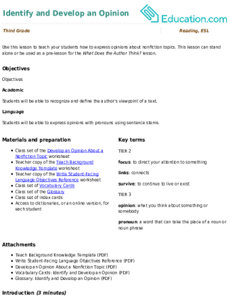
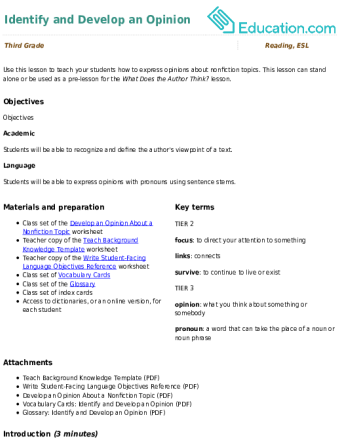
Identify and Develop an Opinion
Lesson Plan
Identify and Develop an Opinion
Third Grade
Grammar and Mechanics
Use this lesson to teach your students how to express opinions about nonfiction topics. This lesson can stand alone or be used as a pre-lesson for the
What Does the Author Think?
lesson.
Lesson Plan
EL
Identify and Develop an Opinion
Lesson Plan
Identify and Develop an Opinion
Use this lesson to teach your students how to express opinions about nonfiction topics. This lesson can stand alone or be used as a pre-lesson for the
What Does the Author Think?
lesson.
Third Grade
Grammar and Mechanics
Lesson Plan
What Does the Author Think?
Lesson Plan
What Does the Author Think?
Third Grade
Can you tell what the author thinks about this subject? What do
you
think about it? Use this resource to help your students recognize the author's point of view and establish their own.
Lesson Plan
What Does the Author Think?
Lesson Plan
What Does the Author Think?
Can you tell what the author thinks about this subject? What do
you
think about it? Use this resource to help your students recognize the author's point of view and establish their own.
Third Grade
Lesson Plan
EL
Exploring Sequence with Signal Words
Lesson Plan
Exploring Sequence with Signal Words
Third Grade
Use this lesson to teach your students how to retell the beginning, middle, and end of a story using sequencing words and phrases. This lesson can stand alone or be used as a pre-lesson for the
Story Structure Rollercoaster
lesson.
Lesson Plan
EL
Exploring Sequence with Signal Words
Lesson Plan
Exploring Sequence with Signal Words
Use this lesson to teach your students how to retell the beginning, middle, and end of a story using sequencing words and phrases. This lesson can stand alone or be used as a pre-lesson for the
Story Structure Rollercoaster
lesson.
Third Grade
Lesson Plan
Organize Your Data
Lesson Plan
Organize Your Data
Third Grade
Collect and graph! In this lesson, your students will practice collecting, organizing, and interpreting data by using real life examples.
Lesson Plan
Organize Your Data
Lesson Plan
Organize Your Data
Collect and graph! In this lesson, your students will practice collecting, organizing, and interpreting data by using real life examples.
Third Grade
Lesson Plan
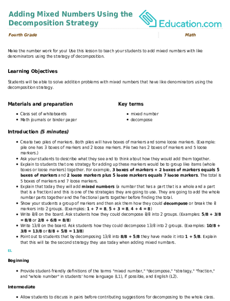
Adding Mixed Numbers Using the Decomposition Strategy
Lesson Plan
Adding Mixed Numbers Using the Decomposition Strategy
Fourth Grade
Make the number work for you! Use this lesson to teach your students to add mixed numbers with like denominators using the strategy of decomposition.
Lesson Plan
Adding Mixed Numbers Using the Decomposition Strategy
Lesson Plan
Adding Mixed Numbers Using the Decomposition Strategy
Make the number work for you! Use this lesson to teach your students to add mixed numbers with like denominators using the strategy of decomposition.
Fourth Grade
Lesson Plan
1
…
5
6
7
8