SKIP TO CONTENT
Worksheet Generator
Subjects
Grades
Worksheets
Games
Build a Worksheet
More Resources
Roly Recommends
Art Contest
Subjects
Grades
Worksheets
Games
Build a Worksheet
More Resources
Roly Recommends
Art Contest
1st - 4th Grade Lesson Plans : Page 10
Filters
1,670 results
1st - 4th Grade
✕
Lesson Plans
✕
Clear all
1,670 results
Filters
1st - 4th Grade
✕
Lesson Plans
✕
Subjects
Math
English Language Arts
Science
Social Studies
Technology
Grade Level
Pre-K
K
1st
2nd
3rd
4th
5th
6th
7th
8th
Early Childhood
Elementary School
Middle School
Resource Type
Worksheets
Games
Lesson Plans
Interactive Worksheets
Workbooks
Activities
Exercises
Stories
Songs
Offline Games
Guided Lessons
Teacher Resources
Teacher Editions
Occasion
Back to School
Common Core
Yes
Roly Recommends
Social Emotional Learning
English Language Support
Yes
Clear all
View 1,670 results
1st - 4th Grade Lesson Plans : Page 10
Filters
1,670 results
1st - 4th Grade
✕
Lesson Plans
✕
Clear all
1,670 results
Red Light, Green Light Questions
Lesson Plan
Red Light, Green Light Questions
Third Grade
Statistics
Teach your students to ask and differentiate between recall questions and inferential questions. This lesson will help build a classroom culture around asking deep, inferential questions.
Lesson Plan
Red Light, Green Light Questions
Lesson Plan
Red Light, Green Light Questions
Teach your students to ask and differentiate between recall questions and inferential questions. This lesson will help build a classroom culture around asking deep, inferential questions.
Third Grade
Statistics
Lesson Plan
Battle of the Texts: Print vs. Electronics
Lesson Plan
Battle of the Texts: Print vs. Electronics
Fourth Grade
Are you a page turner or a mouse clicker? In this lesson, students compare and contrast text features in two types of nonfictions texts: print and electronic.
Lesson Plan
Battle of the Texts: Print vs. Electronics
Lesson Plan
Battle of the Texts: Print vs. Electronics
Are you a page turner or a mouse clicker? In this lesson, students compare and contrast text features in two types of nonfictions texts: print and electronic.
Fourth Grade
Lesson Plan
What's Your Phase?
Lesson Plan
What's Your Phase?
Third Grade
Earth and Space Science
This lesson engages students in activity to help them understand the phases of the Moon, and why they occur. Students read literature, analyze it, and then apply it to the small group performance of one cycle of the Moon’s phases.
Lesson Plan
What's Your Phase?
Lesson Plan
What's Your Phase?
This lesson engages students in activity to help them understand the phases of the Moon, and why they occur. Students read literature, analyze it, and then apply it to the small group performance of one cycle of the Moon’s phases.
Third Grade
Earth and Space Science
Lesson Plan
Completing Sentences
Lesson Plan
Completing Sentences
Third Grade
If your students are drawn to using
and
or
because
at the beginning of their sentences, then this lesson is for you! With this lesson, you will empower your students to combine words and phrases to create single sentences.
Lesson Plan
Completing Sentences
Lesson Plan
Completing Sentences
If your students are drawn to using
and
or
because
at the beginning of their sentences, then this lesson is for you! With this lesson, you will empower your students to combine words and phrases to create single sentences.
Third Grade
Lesson Plan
Associating Adjectives
Lesson Plan
Associating Adjectives
Fourth Grade
Can your students associate similar adjectives and nouns using the roots and suffixes? In this lesson, students will learn how to associate nouns with adjectives. Along the way, they will use the roots and affixes to determine the meaning.
Lesson Plan
Associating Adjectives
Lesson Plan
Associating Adjectives
Can your students associate similar adjectives and nouns using the roots and suffixes? In this lesson, students will learn how to associate nouns with adjectives. Along the way, they will use the roots and affixes to determine the meaning.
Fourth Grade
Lesson Plan
Idiom Pictionary and Charades
Lesson Plan
Idiom Pictionary and Charades
Fourth Grade
Idioms can be a pain in the neck to understand! Help your students become acquainted with many of the English language's funny and confusing idioms in this lesson that has them using their creativity to act out or illustrate idioms.
Lesson Plan
Idiom Pictionary and Charades
Lesson Plan
Idiom Pictionary and Charades
Idioms can be a pain in the neck to understand! Help your students become acquainted with many of the English language's funny and confusing idioms in this lesson that has them using their creativity to act out or illustrate idioms.
Fourth Grade
Lesson Plan
Homophone Posters
Lesson Plan
Homophone Posters
Fourth Grade
Homophones are frequently misused in student writing. This lesson teaches students about many of the commonly misused homophones through the creation of a poster on one set of homophones.
Lesson Plan
Homophone Posters
Lesson Plan
Homophone Posters
Homophones are frequently misused in student writing. This lesson teaches students about many of the commonly misused homophones through the creation of a poster on one set of homophones.
Fourth Grade
Lesson Plan
EL
Compare with Adjectives
Lesson Plan
Compare with Adjectives
First Grade
Which traits do your students share with their favorite characters? Find out as you introduce new adjectives! This lesson can be used alone or with the lesson plan All About Me: Character Traits.
Lesson Plan
EL
Compare with Adjectives
Lesson Plan
Compare with Adjectives
Which traits do your students share with their favorite characters? Find out as you introduce new adjectives! This lesson can be used alone or with the lesson plan All About Me: Character Traits.
First Grade
Lesson Plan
Appreciating Diversity and Differences
Lesson Plan
Appreciating Diversity and Differences
Second Grade
In this lesson, students will hear the story
Lovely
and work in small groups to create a book or a symbol of appreciation for others' differences. Students will consider how appreciating differences supports community and relationships.
Lesson Plan
Appreciating Diversity and Differences
Lesson Plan
Appreciating Diversity and Differences
In this lesson, students will hear the story
Lovely
and work in small groups to create a book or a symbol of appreciation for others' differences. Students will consider how appreciating differences supports community and relationships.
Second Grade
Lesson Plan
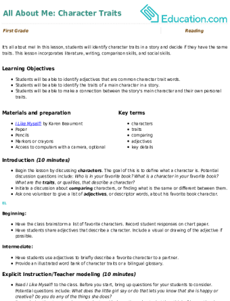
All About Me: Character Traits
Lesson Plan
All About Me: Character Traits
First Grade
It's all about me! In this lesson, students will identify character traits in a story and decide if they have the same traits. This lesson incorporates literature, writing, comparison skills, and social skills.
Lesson Plan
All About Me: Character Traits
Lesson Plan
All About Me: Character Traits
It's all about me! In this lesson, students will identify character traits in a story and decide if they have the same traits. This lesson incorporates literature, writing, comparison skills, and social skills.
First Grade
Lesson Plan
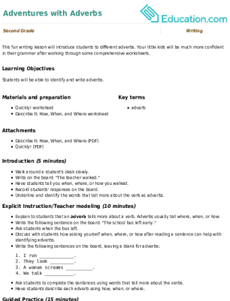
Adventures with Adverbs
Lesson Plan
Adventures with Adverbs
Second Grade
This fun writing lesson will introduce students to different adverbs. Your little kids will be much more confident in their grammar after working through some comprehensive worksheets.
Lesson Plan
Adventures with Adverbs
Lesson Plan
Adventures with Adverbs
This fun writing lesson will introduce students to different adverbs. Your little kids will be much more confident in their grammar after working through some comprehensive worksheets.
Second Grade
Lesson Plan
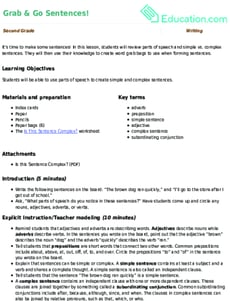
Grab & Go Sentences!
Lesson Plan
Grab & Go Sentences!
Second Grade
Grammar and Mechanics
It’s time to make some sentences! In this lesson, students will review parts of speech and simple vs. complex sentences. They will then use their knowledge to create word grab bags to use when forming sentences.
Lesson Plan
Grab & Go Sentences!
Lesson Plan
Grab & Go Sentences!
It’s time to make some sentences! In this lesson, students will review parts of speech and simple vs. complex sentences. They will then use their knowledge to create word grab bags to use when forming sentences.
Second Grade
Grammar and Mechanics
Lesson Plan
EL
Character Actions and Emotions
Lesson Plan
Character Actions and Emotions
Fourth Grade
Use this lesson to help your ELs describe a character’s emotion based on actions. It can be a stand-alone lesson or used as support to the lesson Close Reading: Reading Through Character Emotion.
Lesson Plan
EL
Character Actions and Emotions
Lesson Plan
Character Actions and Emotions
Use this lesson to help your ELs describe a character’s emotion based on actions. It can be a stand-alone lesson or used as support to the lesson Close Reading: Reading Through Character Emotion.
Fourth Grade
Lesson Plan
EL
Basic Fiction Summaries
Lesson Plan
Basic Fiction Summaries
Fourth Grade
This lesson gives students a structure to help them summarize fiction texts. When they are skilled at summarizing, they will be more capable of exploring various fiction genres. Use it as a precursor to Fiction Genres Library Exploration.
Lesson Plan
EL
Basic Fiction Summaries
Lesson Plan
Basic Fiction Summaries
This lesson gives students a structure to help them summarize fiction texts. When they are skilled at summarizing, they will be more capable of exploring various fiction genres. Use it as a precursor to Fiction Genres Library Exploration.
Fourth Grade
Lesson Plan
Use Your Mind and Visualize!
Lesson Plan
Use Your Mind and Visualize!
Kindergarten
Help students learn the crucial reading strategy of visualizing. Visualizing is a key component of learning to infer from a text. Kids will love using their imagination and drawing pictures of their visualizations.
Lesson Plan
Use Your Mind and Visualize!
Lesson Plan
Use Your Mind and Visualize!
Help students learn the crucial reading strategy of visualizing. Visualizing is a key component of learning to infer from a text. Kids will love using their imagination and drawing pictures of their visualizations.
Kindergarten
Lesson Plan
EL
Searching for Text Features
Lesson Plan
Searching for Text Features
First Grade
Vocabulary
Direct instruction about text features will help ELs better comprehend nonfiction texts. In this lesson, students will practice identifying text features. This lesson can be used alone or with the What's in a Text Feature? lesson plan.
Lesson Plan
EL
Searching for Text Features
Lesson Plan
Searching for Text Features
Direct instruction about text features will help ELs better comprehend nonfiction texts. In this lesson, students will practice identifying text features. This lesson can be used alone or with the What's in a Text Feature? lesson plan.
First Grade
Vocabulary
Lesson Plan
EL
Sharing Facts from Nonfiction
Lesson Plan
Sharing Facts from Nonfiction
First Grade
Tap into children's curiosity by having them record and share key details found in nonfiction texts! This lesson can be used alone or with the Nonfiction Reading: Learning and Recording New Information lesson plan.
Lesson Plan
EL
Sharing Facts from Nonfiction
Lesson Plan
Sharing Facts from Nonfiction
Tap into children's curiosity by having them record and share key details found in nonfiction texts! This lesson can be used alone or with the Nonfiction Reading: Learning and Recording New Information lesson plan.
First Grade
Lesson Plan
Money Math!
Lesson Plan
Money Math!
Second Grade
Time and Money
Money makes the world go 'round, but do your students know why money is important? In this lesson, students will learn the real world applications of money, as well as how to make a dollar with various coins.
Lesson Plan
Money Math!
Lesson Plan
Money Math!
Money makes the world go 'round, but do your students know why money is important? In this lesson, students will learn the real world applications of money, as well as how to make a dollar with various coins.
Second Grade
Time and Money
Lesson Plan
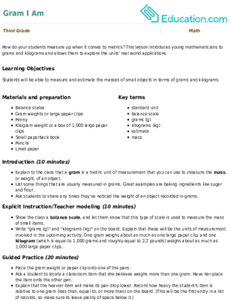
Gram I Am
Lesson Plan
Gram I Am
Third Grade
How do your students measure up when it comes to metrics? This lesson introduces young mathematicians to grams and kilograms and allows them to explore the units' real world applications.
Lesson Plan
Gram I Am
Lesson Plan
Gram I Am
How do your students measure up when it comes to metrics? This lesson introduces young mathematicians to grams and kilograms and allows them to explore the units' real world applications.
Third Grade
Lesson Plan
EL
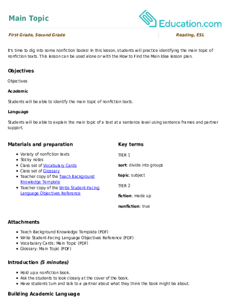
Main Topic
Lesson Plan
Main Topic
First Grade
It's time to dig into some nonfiction books! In this lesson, students will practice identifying the main topic of nonfiction texts. This lesson can be used alone or with the How to Find the Main Idea lesson plan.
Lesson Plan
EL
Main Topic
Lesson Plan
Main Topic
It's time to dig into some nonfiction books! In this lesson, students will practice identifying the main topic of nonfiction texts. This lesson can be used alone or with the How to Find the Main Idea lesson plan.
First Grade
Lesson Plan
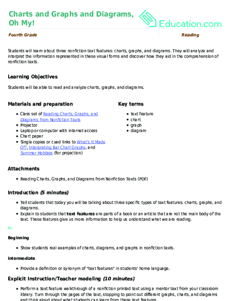
Charts and Graphs and Diagrams, Oh My!
Lesson Plan
Charts and Graphs and Diagrams, Oh My!
Fourth Grade
Reading
Students will learn about three nonfiction text features: charts, graphs, and diagrams. They will analyze and interpret the information represented in these visual forms and discover how they aid in the comprehension of nonfiction texts.
Lesson Plan
Charts and Graphs and Diagrams, Oh My!
Lesson Plan
Charts and Graphs and Diagrams, Oh My!
Students will learn about three nonfiction text features: charts, graphs, and diagrams. They will analyze and interpret the information represented in these visual forms and discover how they aid in the comprehension of nonfiction texts.
Fourth Grade
Reading
Lesson Plan
EL
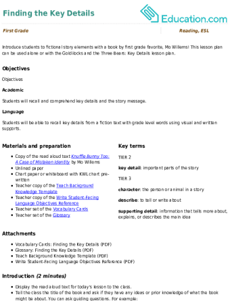
Finding the Key Details
Lesson Plan
Finding the Key Details
First Grade
Reading
Introduce students to fictional story elements with a book by first grade favorite, Mo Willems! This lesson plan can be used alone or with the Goldilocks and the Three Bears: Key Details lesson plan.
Lesson Plan
EL
Finding the Key Details
Lesson Plan
Finding the Key Details
Introduce students to fictional story elements with a book by first grade favorite, Mo Willems! This lesson plan can be used alone or with the Goldilocks and the Three Bears: Key Details lesson plan.
First Grade
Reading
Lesson Plan
He Said/She Said, I Said/You Said
Lesson Plan
He Said/She Said, I Said/You Said
Fourth Grade
In this engaging lesson, students compare and contrast a firsthand account and a secondhand account of the same historical event: the sinking of the Titanic.
Lesson Plan
He Said/She Said, I Said/You Said
Lesson Plan
He Said/She Said, I Said/You Said
In this engaging lesson, students compare and contrast a firsthand account and a secondhand account of the same historical event: the sinking of the Titanic.
Fourth Grade
Lesson Plan
It’s Game Time: Multisyllabic Words with R-Controlled Vowels
Lesson Plan
It’s Game Time: Multisyllabic Words with R-Controlled Vowels
Fourth Grade
Ready, set, go! This fun and exciting lesson utilizes board games and movement to help students practice identifying, reading, and creating multisyllabic words with R-controlled vowels.
Lesson Plan
It’s Game Time: Multisyllabic Words with R-Controlled Vowels
Lesson Plan
It’s Game Time: Multisyllabic Words with R-Controlled Vowels
Ready, set, go! This fun and exciting lesson utilizes board games and movement to help students practice identifying, reading, and creating multisyllabic words with R-controlled vowels.
Fourth Grade
Lesson Plan
Cooking Up a How-To Story
Lesson Plan
Cooking Up a How-To Story
Kindergarten
Cooking up a delicious Peanut Butter and Jelly is as simple as writing a how-to story in this lesson designed to teach students the different parts of a how-to story. Everyone will walk away with their heads and tummies filled!
Lesson Plan
Cooking Up a How-To Story
Lesson Plan
Cooking Up a How-To Story
Cooking up a delicious Peanut Butter and Jelly is as simple as writing a how-to story in this lesson designed to teach students the different parts of a how-to story. Everyone will walk away with their heads and tummies filled!
Kindergarten
Lesson Plan
Fractions: All Lined Up
Lesson Plan
Fractions: All Lined Up
Third Grade
In this lesson, students will practice identifying and modeling equivalent fractions by using number lines.
Lesson Plan
Fractions: All Lined Up
Lesson Plan
Fractions: All Lined Up
In this lesson, students will practice identifying and modeling equivalent fractions by using number lines.
Third Grade
Lesson Plan
Preview with Post-Its!
Lesson Plan
Preview with Post-Its!
First Grade
Teach students to be stronger readers before they even begin reading! All they need is a book, their mind, and some sticky notes!
Lesson Plan
Preview with Post-Its!
Lesson Plan
Preview with Post-Its!
Teach students to be stronger readers before they even begin reading! All they need is a book, their mind, and some sticky notes!
First Grade
Lesson Plan
Base-Ten Money: Hundreds, Tens, and Ones
Lesson Plan
Base-Ten Money: Hundreds, Tens, and Ones
Second Grade
Get your students excited about money! Have them make connections between their prior knowledge of base-ten numerals and one, ten, and hundred dollar bills.
Lesson Plan
Base-Ten Money: Hundreds, Tens, and Ones
Lesson Plan
Base-Ten Money: Hundreds, Tens, and Ones
Get your students excited about money! Have them make connections between their prior knowledge of base-ten numerals and one, ten, and hundred dollar bills.
Second Grade
Lesson Plan
SSSHHHH….
Lesson Plan
SSSHHHH….
Kindergarten
Students blend sounds all the time when they speak, but a whole new level of
ssshhh
is possible through selected literature and picture sorts!
Lesson Plan
SSSHHHH….
Lesson Plan
SSSHHHH….
Students blend sounds all the time when they speak, but a whole new level of
ssshhh
is possible through selected literature and picture sorts!
Kindergarten
Lesson Plan
These Stories Are (Almost) the Same
Lesson Plan
These Stories Are (Almost) the Same
First Grade
Reading
Stories can change a lot depending on the point of view they are told from. In this lesson, students explore point of view by comparing and contrasting two versions of "The Three Little Pigs."
Lesson Plan
These Stories Are (Almost) the Same
Lesson Plan
These Stories Are (Almost) the Same
Stories can change a lot depending on the point of view they are told from. In this lesson, students explore point of view by comparing and contrasting two versions of "The Three Little Pigs."
First Grade
Reading
Lesson Plan
1
…
9
10
11
…
56