SKIP TO CONTENT
Worksheet Generator
Subjects
Grades
Worksheets
Games
Build a Worksheet
More Resources
Roly Recommends
Subjects
Grades
Worksheets
Games
Build a Worksheet
More Resources
Roly Recommends
Filters
Search for: characters, setting...
✕
Lesson Plans
✕
1st - 4th Grade
✕
Subjects
Math
English Language Arts
Science
Social Studies
Grade Level
Pre-K
K
1st
2nd
3rd
4th
5th
6th
7th
8th
Early Childhood
Elementary School
Middle School
Resource Type
Worksheets
Games
Lesson Plans
Interactive Worksheets
Workbooks
Activities
Stories
Songs
Offline Games
Guided Lessons
Teacher Resources
Common Core
Yes
Roly Recommends
Social Emotional Learning
English Language Support
Yes
See More
Clear All
View 218 results
Showing Results for characters setting... : Page 7
218 results
Search for: characters, setting...
✕
Lesson Plans
✕
1st - 4th Grade
✕
Clear All
Sort by:
Relevance
Most recent
Most popular
Alphabetical A-Z
Alphabetical Z-A
All filters
218 results
Sort by:
Relevance
Most recent
Most popular
Alphabetical A-Z
Alphabetical Z-A
Elaborating on My Feelings
Lesson Plan
Elaborating on My Feelings
Second Grade
Identifying and describing their feelings is an important part of the way children develop social skills. This lesson teaches your students how to identify feelings, and then elaborate on them by speaking and writing in complete sentences.
Lesson Plan
Elaborating on My Feelings
Lesson Plan
Elaborating on My Feelings
Identifying and describing their feelings is an important part of the way children develop social skills. This lesson teaches your students how to identify feelings, and then elaborate on them by speaking and writing in complete sentences.
Second Grade
Lesson Plan
Fill Your Bucket
Lesson Plan
Fill Your Bucket
Third Grade
Are you a bucket filler? Children with good social skills lift each other up with compliments and praise, instead of put downs and negative comments. Use this lesson to teach your students about bucket filling and how to compliment others.
Lesson Plan
Fill Your Bucket
Lesson Plan
Fill Your Bucket
Are you a bucket filler? Children with good social skills lift each other up with compliments and praise, instead of put downs and negative comments. Use this lesson to teach your students about bucket filling and how to compliment others.
Third Grade
Lesson Plan
EL
Making Text Connections
Lesson Plan
Making Text Connections
Fourth Grade
This lesson helps your students practice making text connections so they can write about their reading. It can be taught on its own or serve as a precursor to the Reading Response Letters lesson.
Lesson Plan
EL
Making Text Connections
Lesson Plan
Making Text Connections
This lesson helps your students practice making text connections so they can write about their reading. It can be taught on its own or serve as a precursor to the Reading Response Letters lesson.
Fourth Grade
Lesson Plan
EL
Vocabulary in Context
Lesson Plan
Vocabulary in Context
Fourth Grade
In this lesson, students will improve their skills in using context clues to determine the meaning of difficult words. Use it as a stand-alone lesson or as support to the lesson Journey on the Underground Railroad.
Lesson Plan
EL
Vocabulary in Context
Lesson Plan
Vocabulary in Context
In this lesson, students will improve their skills in using context clues to determine the meaning of difficult words. Use it as a stand-alone lesson or as support to the lesson Journey on the Underground Railroad.
Fourth Grade
Lesson Plan
You're On a Roll! Practicing Multiplication Facts
Lesson Plan
You're On a Roll! Practicing Multiplication Facts
Third Grade
Are your students struggling to remember their times tables? We all know the only way to remembering math facts is to practice! This hands-on lesson is a fun way for your class get the practice they need to master multiplication facts.
Lesson Plan
You're On a Roll! Practicing Multiplication Facts
Lesson Plan
You're On a Roll! Practicing Multiplication Facts
Are your students struggling to remember their times tables? We all know the only way to remembering math facts is to practice! This hands-on lesson is a fun way for your class get the practice they need to master multiplication facts.
Third Grade
Lesson Plan
Craft Stick Story Elements
Lesson Plan
Craft Stick Story Elements
First Grade
Reading
This comprehensive overview of story elements will definitely leave students with a better understanding of author's purpose, character traits, sequence, and main idea. It features the acclaimed Leo the Late Bloomer by Robert Kraus.
Lesson Plan
Craft Stick Story Elements
Lesson Plan
Craft Stick Story Elements
This comprehensive overview of story elements will definitely leave students with a better understanding of author's purpose, character traits, sequence, and main idea. It features the acclaimed Leo the Late Bloomer by Robert Kraus.
First Grade
Reading
Lesson Plan
Numbers All A-Round
Lesson Plan
Numbers All A-Round
Fourth Grade
Teach your students to round to the hundred thousands place with this straightforward lesson.
Lesson Plan
Numbers All A-Round
Lesson Plan
Numbers All A-Round
Teach your students to round to the hundred thousands place with this straightforward lesson.
Fourth Grade
Lesson Plan
Action Verb Synonyms
Lesson Plan
Action Verb Synonyms
Third Grade
Using the same action verbs all the time can get old. Help your students spice up their writing by teaching them to identify and use action verbs. Your young writers will explore synonyms to improve their repertoire of action verbs.
Lesson Plan
Action Verb Synonyms
Lesson Plan
Action Verb Synonyms
Using the same action verbs all the time can get old. Help your students spice up their writing by teaching them to identify and use action verbs. Your young writers will explore synonyms to improve their repertoire of action verbs.
Third Grade
Lesson Plan
What Happened?
Lesson Plan
What Happened?
First Grade
Reading
Help your students' story telling abilities grow with this lesson that helps them recount what happened in a story and has them point out key details.
Lesson Plan
What Happened?
Lesson Plan
What Happened?
Help your students' story telling abilities grow with this lesson that helps them recount what happened in a story and has them point out key details.
First Grade
Reading
Lesson Plan
Who, When, What, Where, Why, and How?
Lesson Plan
Who, When, What, Where, Why, and How?
First Grade
Reading
Do you have students who are constantly asking what, who, where, why, how, and when? It's your turn to ask now! Have them read various stories and ask them to answer these questions in this lesson.
Lesson Plan
Who, When, What, Where, Why, and How?
Lesson Plan
Who, When, What, Where, Why, and How?
Do you have students who are constantly asking what, who, where, why, how, and when? It's your turn to ask now! Have them read various stories and ask them to answer these questions in this lesson.
First Grade
Reading
Lesson Plan
EL
Let's Read It With Expression!
Lesson Plan
Let's Read It With Expression!
Third Grade
Teach your students about text clues that will help them read with expression. This lesson can stand alone or be used as a pre-lesson for the
Reader's Theater: Read the Script
lesson.
Lesson Plan
EL
Let's Read It With Expression!
Lesson Plan
Let's Read It With Expression!
Teach your students about text clues that will help them read with expression. This lesson can stand alone or be used as a pre-lesson for the
Reader's Theater: Read the Script
lesson.
Third Grade
Lesson Plan
EL
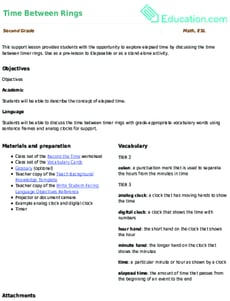
Time Between Rings
Lesson Plan
Time Between Rings
Second Grade
This support lesson provides students with the opportunity to explore elapsed time by discussing the time between timer rings. Use as a pre-lesson to Elapseable or as a stand-alone activity.
Lesson Plan
EL
Time Between Rings
Lesson Plan
Time Between Rings
This support lesson provides students with the opportunity to explore elapsed time by discussing the time between timer rings. Use as a pre-lesson to Elapseable or as a stand-alone activity.
Second Grade
Lesson Plan
Fraction of a Whole
Lesson Plan
Fraction of a Whole
Fourth Grade
Teach your students to use bar models and multiplication to find a fraction of a whole number.
Lesson Plan
Fraction of a Whole
Lesson Plan
Fraction of a Whole
Teach your students to use bar models and multiplication to find a fraction of a whole number.
Fourth Grade
Lesson Plan
EL
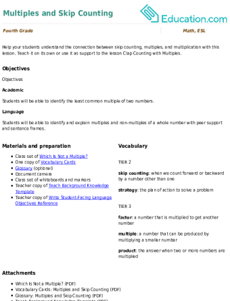
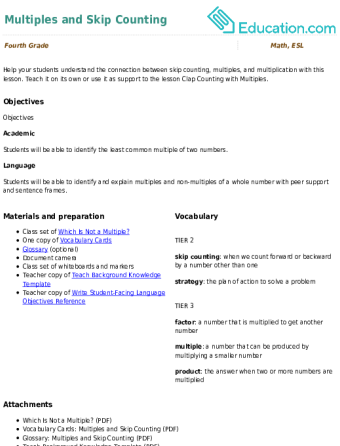
Multiples and Skip Counting
Lesson Plan
Multiples and Skip Counting
Fourth Grade
Help your students understand the connection between skip counting, multiples, and multiplication with this lesson. Teach it on its own or use it as support to the lesson Clap Counting with Multiples.
Lesson Plan
EL
Multiples and Skip Counting
Lesson Plan
Multiples and Skip Counting
Help your students understand the connection between skip counting, multiples, and multiplication with this lesson. Teach it on its own or use it as support to the lesson Clap Counting with Multiples.
Fourth Grade
Lesson Plan
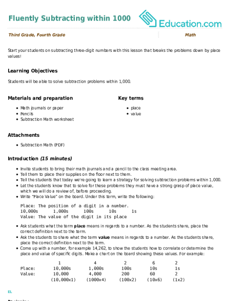
Fluently Subtracting within 1000
Lesson Plan
Fluently Subtracting within 1000
Third Grade
Start your students on subtracting three-digit numbers with this lesson that breaks the problems down by place values!
Lesson Plan
Fluently Subtracting within 1000
Lesson Plan
Fluently Subtracting within 1000
Start your students on subtracting three-digit numbers with this lesson that breaks the problems down by place values!
Third Grade
Lesson Plan
EL
Strategies to Make Multiplication a Breeze
Lesson Plan
Strategies to Make Multiplication a Breeze
Third Grade
Multiplication
With this lesson, your students will see how the order of the factors does not affect the product in a multiplication expression. Use this on its own or alongside
You're On a Roll! Practicing Multiplication Facts.
Lesson Plan
EL
Strategies to Make Multiplication a Breeze
Lesson Plan
Strategies to Make Multiplication a Breeze
With this lesson, your students will see how the order of the factors does not affect the product in a multiplication expression. Use this on its own or alongside
You're On a Roll! Practicing Multiplication Facts.
Third Grade
Multiplication
Lesson Plan
Solving Word Problems
Lesson Plan
Solving Word Problems
Second Grade
Word problems getting you down? Then spread the word on a lesson that will help students decide when to add or subtract, as they identify clue words that aid in solving word problems.
Lesson Plan
Solving Word Problems
Lesson Plan
Solving Word Problems
Word problems getting you down? Then spread the word on a lesson that will help students decide when to add or subtract, as they identify clue words that aid in solving word problems.
Second Grade
Lesson Plan
EL
Parts of a Drama
Lesson Plan
Parts of a Drama
Third Grade
Writing
Expose your students to the wonderful genre of drama, but be sure to teach them the important key terms so they understand the structure. Use this as a stand alone lesson or a pre-lesson for the
Putting a Play Together!
lesson.
Lesson Plan
EL
Parts of a Drama
Lesson Plan
Parts of a Drama
Expose your students to the wonderful genre of drama, but be sure to teach them the important key terms so they understand the structure. Use this as a stand alone lesson or a pre-lesson for the
Putting a Play Together!
lesson.
Third Grade
Writing
Lesson Plan
Questions for Comprehension
Lesson Plan
Questions for Comprehension
Kindergarten
Good readers ask questions before, during, and after reading. This lesson, which incorporates two wonderful activities and some practice with the 5 Ws, is sure to get your students ready to dive into literature.
Lesson Plan
Questions for Comprehension
Lesson Plan
Questions for Comprehension
Good readers ask questions before, during, and after reading. This lesson, which incorporates two wonderful activities and some practice with the 5 Ws, is sure to get your students ready to dive into literature.
Kindergarten
Lesson Plan
Increasing Reading Stamina and Comprehension
Lesson Plan
Increasing Reading Stamina and Comprehension
Second Grade
Reading
This lesson provides teachers with an opportunity to teach students about reading stamina and assess student comprehension during independent reading.
Lesson Plan
Increasing Reading Stamina and Comprehension
Lesson Plan
Increasing Reading Stamina and Comprehension
This lesson provides teachers with an opportunity to teach students about reading stamina and assess student comprehension during independent reading.
Second Grade
Reading
Lesson Plan
EL
Text Features and Their Purposes
Lesson Plan
Text Features and Their Purposes
Fourth Grade
This lesson helps your ELs identify nonfiction text features and explain how they enhance comprehension of the text. Use it as a stand-alone lesson or a support lesson for the Searching for Text Features lesson plan.
Lesson Plan
EL
Text Features and Their Purposes
Lesson Plan
Text Features and Their Purposes
This lesson helps your ELs identify nonfiction text features and explain how they enhance comprehension of the text. Use it as a stand-alone lesson or a support lesson for the Searching for Text Features lesson plan.
Fourth Grade
Lesson Plan
EL
Create Your Own Story
Lesson Plan
Create Your Own Story
Second Grade
Provide your ELs with extra practice using transition words to create a story. This activity can be used as a stand alone or a support lesson.
Lesson Plan
EL
Create Your Own Story
Lesson Plan
Create Your Own Story
Provide your ELs with extra practice using transition words to create a story. This activity can be used as a stand alone or a support lesson.
Second Grade
Lesson Plan
EL
Distinguish Between Facts and Opinions
Lesson Plan
Distinguish Between Facts and Opinions
Third Grade
Teach your students the difference between facts and opinions, and why an author would choose to use each type of information. This can stand-alone or be used as a pre-lesson for the
Exploring Author's Purpose and Point of View
lesson.
Lesson Plan
EL
Distinguish Between Facts and Opinions
Lesson Plan
Distinguish Between Facts and Opinions
Teach your students the difference between facts and opinions, and why an author would choose to use each type of information. This can stand-alone or be used as a pre-lesson for the
Exploring Author's Purpose and Point of View
lesson.
Third Grade
Lesson Plan
Parking Lot Multiplication
Lesson Plan
Parking Lot Multiplication
Third Grade
Help your students make sense of the commutative property of multiplication by relating it to arrangements of cars in parking lots.
Lesson Plan
Parking Lot Multiplication
Lesson Plan
Parking Lot Multiplication
Help your students make sense of the commutative property of multiplication by relating it to arrangements of cars in parking lots.
Third Grade
Lesson Plan
Questions that Gauge Comprehension
Lesson Plan
Questions that Gauge Comprehension
Third Grade
Vocabulary
Use this lesson to gauge your students’ basic comprehension of fiction text. If they can answer who, what, when, where, why, and how questions, you know they have a handle on it and it’s time to get into more critical thinking!
Lesson Plan
Questions that Gauge Comprehension
Lesson Plan
Questions that Gauge Comprehension
Use this lesson to gauge your students’ basic comprehension of fiction text. If they can answer who, what, when, where, why, and how questions, you know they have a handle on it and it’s time to get into more critical thinking!
Third Grade
Vocabulary
Lesson Plan
“Oh, My Word!” with Amelia Bedelia
Lesson Plan
“Oh, My Word!” with Amelia Bedelia
Second Grade
Let Amelia Bedelia introduce figurative language in this fun and interactive lesson that includes a game, group work and a chance for students to shine as idiom authors!
Lesson Plan
“Oh, My Word!” with Amelia Bedelia
Lesson Plan
“Oh, My Word!” with Amelia Bedelia
Let Amelia Bedelia introduce figurative language in this fun and interactive lesson that includes a game, group work and a chance for students to shine as idiom authors!
Second Grade
Lesson Plan
EL
First- and Third-Person Point of View
Lesson Plan
First- and Third-Person Point of View
Third Grade
Use this lesson to help your ELs understand which pronouns to use when writing from different points of view. Use this as a stand-alone lesson or as a support lesson for the
My View as an Ant
lesson.
Lesson Plan
EL
First- and Third-Person Point of View
Lesson Plan
First- and Third-Person Point of View
Use this lesson to help your ELs understand which pronouns to use when writing from different points of view. Use this as a stand-alone lesson or as a support lesson for the
My View as an Ant
lesson.
Third Grade
Lesson Plan
Examining Author's Purpose in a Fictional Text
Lesson Plan
Examining Author's Purpose in a Fictional Text
Second Grade
Reading
Students will read a short fictional story and discuss why the author included certain details and words. Use this lesson to help your students navigate parts of fictional text to determine the author's purpose!
Lesson Plan
Examining Author's Purpose in a Fictional Text
Lesson Plan
Examining Author's Purpose in a Fictional Text
Students will read a short fictional story and discuss why the author included certain details and words. Use this lesson to help your students navigate parts of fictional text to determine the author's purpose!
Second Grade
Reading
Lesson Plan
Fiction Comprehension: Problem and Solution
Lesson Plan
Fiction Comprehension: Problem and Solution
Third Grade
If you've ever had something go wrong, you know how it feels to search for a solution! Use this lesson to teach your students to identify problems and solutions in fictional text.
Lesson Plan
Fiction Comprehension: Problem and Solution
Lesson Plan
Fiction Comprehension: Problem and Solution
If you've ever had something go wrong, you know how it feels to search for a solution! Use this lesson to teach your students to identify problems and solutions in fictional text.
Third Grade
Lesson Plan
EL
Explaining Illustrations with Declarative Sentences
Lesson Plan
Explaining Illustrations with Declarative Sentences
Fourth Grade
In this lesson, students will examine illustrations and write about them using declarative sentences. This can be used on its own or as support for the lesson A Picture Is Worth a Thousand Words: Connecting Text and Illustrations.
Lesson Plan
EL
Explaining Illustrations with Declarative Sentences
Lesson Plan
Explaining Illustrations with Declarative Sentences
In this lesson, students will examine illustrations and write about them using declarative sentences. This can be used on its own or as support for the lesson A Picture Is Worth a Thousand Words: Connecting Text and Illustrations.
Fourth Grade
Lesson Plan
1
…
5
6
7
8