SKIP TO CONTENT
Worksheet Generator
Subjects
Grades
Worksheets
Games
Build a Worksheet
More Resources
Roly Recommends
Summer Boost
Subjects
Grades
Worksheets
Games
Build a Worksheet
More Resources
Roly Recommends
Summer Boost
Showing Results for pre : Page 10
Filters
299 results
Search for: pre
✕
2nd - 4th Grade
✕
Clear all
299 results
Filters
Search for: pre
✕
2nd - 4th Grade
✕
Subjects
Math
English Language Arts
Science
Social Studies
Grade Level
Pre-K
K
1st
2nd
3rd
4th
5th
6th
7th
8th
Early Childhood
Elementary School
Middle School
Resource Type
Worksheets
Games
Lesson Plans
Interactive Worksheets
Workbooks
Activities
Offline Games
Teacher Resources
Occasion
Women's History Month
St. Patrick's Day
Spring
Summer
Father's Day
Fall
Halloween
Veterans Day
Winter
Holidays
Thanksgiving
Christmas
Hanukkah
Valentine's Day
See more
Common Core
Yes
Roly Recommends
Social Emotional Learning
Game Type
Crossword
Puzzles & Sudoku
Arts & Crafts
Arts & Crafts
Fabric Projects
Beads & Jewelry
Paper & Glue Crafts
Construction & Sculpture
Painting & Drawing
Recycled Crafts
Coloring
Yes
Recipes
Snacks
Mains
Sides
English Language Support
Yes
Clear all
View 299 results
Showing Results for pre : Page 10
Filters
299 results
Search for: pre
✕
2nd - 4th Grade
✕
Clear all
299 results
Nonfiction Genres
Lesson Plan
Nonfiction Genres
Fourth Grade
Writing
In this lesson, your students will explore the library in search of various genres of nonfiction texts. Teach this lesson at the beginning of the year to familiarize your students with the structure and organization of the library.
Lesson Plan
Nonfiction Genres
Lesson Plan
Nonfiction Genres
In this lesson, your students will explore the library in search of various genres of nonfiction texts. Teach this lesson at the beginning of the year to familiarize your students with the structure and organization of the library.
Fourth Grade
Writing
Lesson Plan
Animal Kingdom Comparisons
Lesson Plan
Animal Kingdom Comparisons
Fourth Grade
How much longer is a blue whale than an orca? Teach your students to use bar models and number sentences with variables as they solve these wild word problems!
Lesson Plan
Animal Kingdom Comparisons
Lesson Plan
Animal Kingdom Comparisons
How much longer is a blue whale than an orca? Teach your students to use bar models and number sentences with variables as they solve these wild word problems!
Fourth Grade
Lesson Plan
Division and Multiplication Relationship
Lesson Plan
Division and Multiplication Relationship
Third Grade
Let's better understand multiplication and division concepts! Use this lesson to help students understand inverse operations between multiplication and division.
Lesson Plan
Division and Multiplication Relationship
Lesson Plan
Division and Multiplication Relationship
Let's better understand multiplication and division concepts! Use this lesson to help students understand inverse operations between multiplication and division.
Third Grade
Lesson Plan
Reader's Theater: Read the Script
Lesson Plan
Reader's Theater: Read the Script
Third Grade
Reading
Did you know that Reader's Theater promotes fluency and builds students' reading confidence? Use this lesson to inspire your students to practice reading and understanding text in the drama genre.
Lesson Plan
Reader's Theater: Read the Script
Lesson Plan
Reader's Theater: Read the Script
Did you know that Reader's Theater promotes fluency and builds students' reading confidence? Use this lesson to inspire your students to practice reading and understanding text in the drama genre.
Third Grade
Reading
Lesson Plan
Understanding Academic Vocabulary in a Nonfiction Text
Lesson Plan
Understanding Academic Vocabulary in a Nonfiction Text
Second Grade
Grammar and Mechanics
This lesson will provide students with an opportunity to become more comfortable with identifying and defining academic vocabulary words in a nonfiction text about a chicken's life cycle to support comprehension.
Lesson Plan
Understanding Academic Vocabulary in a Nonfiction Text
Lesson Plan
Understanding Academic Vocabulary in a Nonfiction Text
This lesson will provide students with an opportunity to become more comfortable with identifying and defining academic vocabulary words in a nonfiction text about a chicken's life cycle to support comprehension.
Second Grade
Grammar and Mechanics
Lesson Plan
Fiction Comprehension: Cause and Effect
Lesson Plan
Fiction Comprehension: Cause and Effect
Third Grade
Improve reading comprehension with a lesson on cause and effect! In this lesson, students will use a T-chart to identify examples of cause and effect in and by the end, you’ll all be singing along to the cause and effect song!
Lesson Plan
Fiction Comprehension: Cause and Effect
Lesson Plan
Fiction Comprehension: Cause and Effect
Improve reading comprehension with a lesson on cause and effect! In this lesson, students will use a T-chart to identify examples of cause and effect in and by the end, you’ll all be singing along to the cause and effect song!
Third Grade
Lesson Plan
EL
Problems and Solutions in Fiction
Lesson Plan
Problems and Solutions in Fiction
Fourth Grade
Every story has a problem and every problem has a solution! Use this lesson to help students identify the problem and solution in fiction texts. Use it as a stand-alone lesson or as support to the lesson Compare and Contrast Short Stories.
Lesson Plan
EL
Problems and Solutions in Fiction
Lesson Plan
Problems and Solutions in Fiction
Every story has a problem and every problem has a solution! Use this lesson to help students identify the problem and solution in fiction texts. Use it as a stand-alone lesson or as support to the lesson Compare and Contrast Short Stories.
Fourth Grade
Lesson Plan
EL
Explaining Illustrations with Declarative Sentences
Lesson Plan
Explaining Illustrations with Declarative Sentences
Fourth Grade
In this lesson, students will examine illustrations and write about them using declarative sentences. This can be used on its own or as support for the lesson A Picture Is Worth a Thousand Words: Connecting Text and Illustrations.
Lesson Plan
EL
Explaining Illustrations with Declarative Sentences
Lesson Plan
Explaining Illustrations with Declarative Sentences
In this lesson, students will examine illustrations and write about them using declarative sentences. This can be used on its own or as support for the lesson A Picture Is Worth a Thousand Words: Connecting Text and Illustrations.
Fourth Grade
Lesson Plan
Solving KenKen Puzzles
Lesson Plan
Solving KenKen Puzzles
Fourth Grade
It's time for some fun with grid puzzles! In this lesson, students will learn how to solve KenKen puzzles using logic and applying their knowledge of addition, subtraction, multiplication, and division skills.
Lesson Plan
Solving KenKen Puzzles
Lesson Plan
Solving KenKen Puzzles
It's time for some fun with grid puzzles! In this lesson, students will learn how to solve KenKen puzzles using logic and applying their knowledge of addition, subtraction, multiplication, and division skills.
Fourth Grade
Lesson Plan
EL
Steps to Make an Inference
Lesson Plan
Steps to Make an Inference
Fourth Grade
Vocabulary
It's time to infer! Students will read a variety of short passages and make inferences using modals and a step-by-step graphic organizer. It can be used on its own or as support for the lesson Inference Detectives.
Lesson Plan
EL
Steps to Make an Inference
Lesson Plan
Steps to Make an Inference
It's time to infer! Students will read a variety of short passages and make inferences using modals and a step-by-step graphic organizer. It can be used on its own or as support for the lesson Inference Detectives.
Fourth Grade
Vocabulary
Lesson Plan
What's So Different? Comparing Characters
Lesson Plan
What's So Different? Comparing Characters
Fourth Grade
Using your acting skills and a great book by Chris Van Allsburg, you will lead your students on an adventure to compare characters and events throughout a book.
Lesson Plan
What's So Different? Comparing Characters
Lesson Plan
What's So Different? Comparing Characters
Using your acting skills and a great book by Chris Van Allsburg, you will lead your students on an adventure to compare characters and events throughout a book.
Fourth Grade
Lesson Plan
“Oh, My Word!” with Amelia Bedelia
Lesson Plan
“Oh, My Word!” with Amelia Bedelia
Second Grade
Let Amelia Bedelia introduce figurative language in this fun and interactive lesson that includes a game, group work and a chance for students to shine as idiom authors!
Lesson Plan
“Oh, My Word!” with Amelia Bedelia
Lesson Plan
“Oh, My Word!” with Amelia Bedelia
Let Amelia Bedelia introduce figurative language in this fun and interactive lesson that includes a game, group work and a chance for students to shine as idiom authors!
Second Grade
Lesson Plan
Using the Partial Quotients Strategy for Division with One-Digit Divisors
Lesson Plan
Using the Partial Quotients Strategy for Division with One-Digit Divisors
Fourth Grade
It’s time to learn a new strategy! Teach your students to use the partial quotients strategy to solve long division problems with one-digit divisors and no remainder.
Lesson Plan
Using the Partial Quotients Strategy for Division with One-Digit Divisors
Lesson Plan
Using the Partial Quotients Strategy for Division with One-Digit Divisors
It’s time to learn a new strategy! Teach your students to use the partial quotients strategy to solve long division problems with one-digit divisors and no remainder.
Fourth Grade
Lesson Plan
Step By Step Decimal Subtraction
Lesson Plan
Step By Step Decimal Subtraction
Fourth Grade
It's as easy as one, two, three...four! Introduce your students to subtracting decimals in the tenth and hundredth place using a four-step process.
Lesson Plan
Step By Step Decimal Subtraction
Lesson Plan
Step By Step Decimal Subtraction
It's as easy as one, two, three...four! Introduce your students to subtracting decimals in the tenth and hundredth place using a four-step process.
Fourth Grade
Lesson Plan
Studying Authors: Nonfiction Writing
Lesson Plan
Studying Authors: Nonfiction Writing
First Grade
Learning from others is a huge part of getting better at something, including writing! In this lesson, students will study works by nonfiction authors to enhance their own nonfiction writing.
Lesson Plan
Studying Authors: Nonfiction Writing
Lesson Plan
Studying Authors: Nonfiction Writing
Learning from others is a huge part of getting better at something, including writing! In this lesson, students will study works by nonfiction authors to enhance their own nonfiction writing.
First Grade
Lesson Plan
EL
Equal Shares
Lesson Plan
Equal Shares
Second Grade
Fractions
Provide students with an opportunity to identify the wholes that are correctly divided into halves, thirds, and fourths (equal shares). Use this activity alone as a support lesson or alongside Cookie Fractions Fun.
Lesson Plan
EL
Equal Shares
Lesson Plan
Equal Shares
Provide students with an opportunity to identify the wholes that are correctly divided into halves, thirds, and fourths (equal shares). Use this activity alone as a support lesson or alongside Cookie Fractions Fun.
Second Grade
Fractions
Lesson Plan
Input and Output Boxes
Lesson Plan
Input and Output Boxes
Fourth Grade
Place Value
Input some patterns to T-charts in this lesson. Use this lesson about input and output boxes as a precursor to finding patterns within word problems.
Lesson Plan
Input and Output Boxes
Lesson Plan
Input and Output Boxes
Input some patterns to T-charts in this lesson. Use this lesson about input and output boxes as a precursor to finding patterns within word problems.
Fourth Grade
Place Value
Lesson Plan
Division Word Problems
Lesson Plan
Division Word Problems
Third Grade
Division
Freshen up on your understanding of division word problems with long division and one-digit divisors! Use this lesson to help students identify key division terms and solve word problems.
Lesson Plan
Division Word Problems
Lesson Plan
Division Word Problems
Freshen up on your understanding of division word problems with long division and one-digit divisors! Use this lesson to help students identify key division terms and solve word problems.
Third Grade
Division
Lesson Plan
Addition with Regrouping
Lesson Plan
Addition with Regrouping
Third Grade
In this lesson, students will add three-digit numbers using expanded form addition and standard algorithm addition. They'll explain their answers and highlight the steps for each of the strategies.
Lesson Plan
Addition with Regrouping
Lesson Plan
Addition with Regrouping
In this lesson, students will add three-digit numbers using expanded form addition and standard algorithm addition. They'll explain their answers and highlight the steps for each of the strategies.
Third Grade
Lesson Plan
Show Me Equivalent Fractions!
Lesson Plan
Show Me Equivalent Fractions!
Third Grade
In this lesson, students will construct their own number lines and bar models to find equivalent fractions.
Lesson Plan
Show Me Equivalent Fractions!
Lesson Plan
Show Me Equivalent Fractions!
In this lesson, students will construct their own number lines and bar models to find equivalent fractions.
Third Grade
Lesson Plan
Close Reading: Introduction
Lesson Plan
Close Reading: Introduction
Third Grade
Reading
Help your students absorb the details of a text and make inferences about what they read with the strategy of close reading. By reading closely, students will become better able to understand complex themes and nuances in a text.
Lesson Plan
Close Reading: Introduction
Lesson Plan
Close Reading: Introduction
Help your students absorb the details of a text and make inferences about what they read with the strategy of close reading. By reading closely, students will become better able to understand complex themes and nuances in a text.
Third Grade
Reading
Lesson Plan
EL
More, Less, or the Same?
Lesson Plan
More, Less, or the Same?
Second Grade
Help students learn the academic vocabulary and symbols used to record the results of comparing two three-digit numbers. This lesson can be used as a stand-alone activity or prior to Greater Than, Less Than: Comparing Three-Digit Numbers.
Lesson Plan
EL
More, Less, or the Same?
Lesson Plan
More, Less, or the Same?
Help students learn the academic vocabulary and symbols used to record the results of comparing two three-digit numbers. This lesson can be used as a stand-alone activity or prior to Greater Than, Less Than: Comparing Three-Digit Numbers.
Second Grade
Lesson Plan
Examining Author's Purpose in a Nonfiction Text
Lesson Plan
Examining Author's Purpose in a Nonfiction Text
Second Grade
Reading
This lesson will help students identify the author's point of view and purpose for writing an informational text.
Lesson Plan
Examining Author's Purpose in a Nonfiction Text
Lesson Plan
Examining Author's Purpose in a Nonfiction Text
This lesson will help students identify the author's point of view and purpose for writing an informational text.
Second Grade
Reading
Lesson Plan
EL
Telling Time Using Skip Counting
Lesson Plan
Telling Time Using Skip Counting
Second Grade
Vocabulary
Teach your students to read time to the nearest five minutes by counting by fives! Use this lesson as a stand-alone support lesson for ELs or alongside Tricky Time Telling.
Lesson Plan
EL
Telling Time Using Skip Counting
Lesson Plan
Telling Time Using Skip Counting
Teach your students to read time to the nearest five minutes by counting by fives! Use this lesson as a stand-alone support lesson for ELs or alongside Tricky Time Telling.
Second Grade
Vocabulary
Lesson Plan
EL
Analyzing Primary Sources with Past Tense Verbs
Lesson Plan
Analyzing Primary Sources with Past Tense Verbs
Fourth Grade
Reading
Students will analyze census data from Sojourner Truth and Walt Disney using past tense verbs and sentence frames. It can be used on its own or as support to the lesson Researching the Past Using Primary Sources.
Lesson Plan
EL
Analyzing Primary Sources with Past Tense Verbs
Lesson Plan
Analyzing Primary Sources with Past Tense Verbs
Students will analyze census data from Sojourner Truth and Walt Disney using past tense verbs and sentence frames. It can be used on its own or as support to the lesson Researching the Past Using Primary Sources.
Fourth Grade
Reading
Lesson Plan
EL
The Language of Estimation
Lesson Plan
The Language of Estimation
Second Grade
Use this support lesson to provide students with the opportunity to explore what it means to estimate. This hands on activity can be used alone or alongside the lesson Estimating Length.
Lesson Plan
EL
The Language of Estimation
Lesson Plan
The Language of Estimation
Use this support lesson to provide students with the opportunity to explore what it means to estimate. This hands on activity can be used alone or alongside the lesson Estimating Length.
Second Grade
Lesson Plan
EL
Rounding Roundtable
Lesson Plan
Rounding Roundtable
Fourth Grade
Challenge students to talk about rounded numbers to the millions place value. Use this lesson as a standalone lesson or as support to the lesson Numbers All A-Round.
Lesson Plan
EL
Rounding Roundtable
Lesson Plan
Rounding Roundtable
Challenge students to talk about rounded numbers to the millions place value. Use this lesson as a standalone lesson or as support to the lesson Numbers All A-Round.
Fourth Grade
Lesson Plan
EL
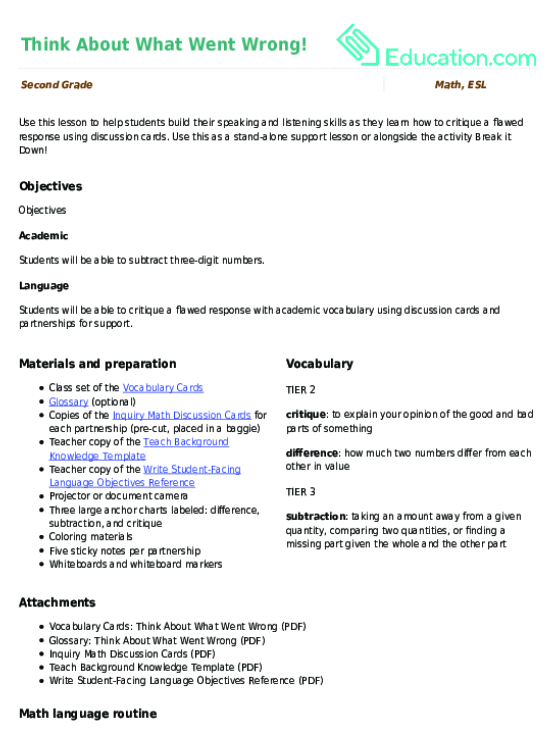
Think About What Went Wrong!
Lesson Plan
Think About What Went Wrong!
Second Grade
Use this lesson to help students build their speaking and listening skills as they learn how to critique a flawed response using discussion cards. Use this as a stand-alone support lesson or alongside the activity Break it Down!
Lesson Plan
EL
Think About What Went Wrong!
Lesson Plan
Think About What Went Wrong!
Use this lesson to help students build their speaking and listening skills as they learn how to critique a flawed response using discussion cards. Use this as a stand-alone support lesson or alongside the activity Break it Down!
Second Grade
Lesson Plan
A Picture Is Worth a Thousand Words: Connecting Text and Illustrations
Lesson Plan
A Picture Is Worth a Thousand Words: Connecting Text and Illustrations
Fourth Grade
By analzying picture books, students will make connections between the text and the illustrations of a story. They will compare and contrast the text and the illustrations and reflect upon how they impact their comprehension of a text.
Lesson Plan
A Picture Is Worth a Thousand Words: Connecting Text and Illustrations
Lesson Plan
A Picture Is Worth a Thousand Words: Connecting Text and Illustrations
By analzying picture books, students will make connections between the text and the illustrations of a story. They will compare and contrast the text and the illustrations and reflect upon how they impact their comprehension of a text.
Fourth Grade
Lesson Plan
1
…
7
8
9
10