SKIP TO CONTENT
Worksheet Generator
Subjects
Grades
Worksheets
Games
Build a Worksheet
More Resources
Roly Recommends
Subjects
Grades
Worksheets
Games
Build a Worksheet
More Resources
Roly Recommends
Filters
Search for: slideshow, lemonade, stand
✕
3rd and 4th Grade
✕
Subjects
Math
English Language Arts
Science
Social Studies
Grade Level
Pre-K
K
1st
2nd
3rd
4th
5th
6th
7th
8th
Early Childhood
Elementary School
Middle School
Resource Type
Worksheets
Lesson Plans
Interactive Worksheets
Activities
Offline Games
Guided Lessons
Occasion
St. Patrick's Day
Passover
Spring
Easter
Earth Day
Summer
Father's Day
Independence Day
Back to School
Fall
Halloween
Winter
Holidays
Thanksgiving
Christmas
Hanukkah
Martin Luther King Jr. Day
Black History Month
See more
Common Core
Yes
Roly Recommends
Social Emotional Learning
Game Type
Ball Games
Group Games
Outdoor Games
Travel Games
Word Puzzles
Arts & Crafts
Arts & Crafts
Fabric Projects
Beads & Jewelry
Paper & Glue Crafts
Construction & Sculpture
Painting & Drawing
Recycled Crafts
Recipes
Snacks
Mains
Sides
English Language Support
Yes
See More
Clear All
View 320 results
Showing Results for slideshow lemonade stand : Page 3
320 results
Search for: slideshow, lemonade, stand
✕
3rd and 4th Grade
✕
Clear All
Sort by:
Relevance
Most recent
Most popular
Alphabetical A-Z
Alphabetical Z-A
All filters
320 results
Sort by:
Relevance
Most recent
Most popular
Alphabetical A-Z
Alphabetical Z-A
EL
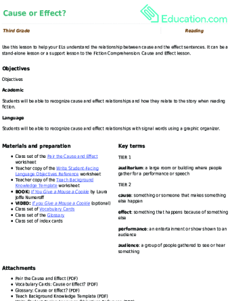
Cause or Effect?
Lesson Plan
Cause or Effect?
Third Grade
Use this lesson to help your ELs understand the relationship between cause and the effect sentences. It can be a stand-alone lesson or a support lesson to the Fiction Comprehension: Cause and Effect lesson.
Lesson Plan
EL
Cause or Effect?
Lesson Plan
Cause or Effect?
Use this lesson to help your ELs understand the relationship between cause and the effect sentences. It can be a stand-alone lesson or a support lesson to the Fiction Comprehension: Cause and Effect lesson.
Third Grade
Lesson Plan
EL
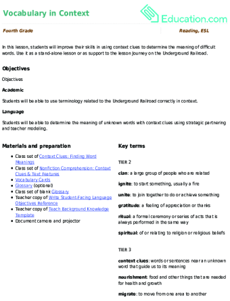
Vocabulary in Context
Lesson Plan
Vocabulary in Context
Fourth Grade
In this lesson, students will improve their skills in using context clues to determine the meaning of difficult words. Use it as a stand-alone lesson or as support to the lesson Journey on the Underground Railroad.
Lesson Plan
EL
Vocabulary in Context
Lesson Plan
Vocabulary in Context
In this lesson, students will improve their skills in using context clues to determine the meaning of difficult words. Use it as a stand-alone lesson or as support to the lesson Journey on the Underground Railroad.
Fourth Grade
Lesson Plan
EL
Pick Out the Parts of a Story
Lesson Plan
Pick Out the Parts of a Story
Third Grade
Reading
Use this lesson to teach your students to identify story elements and compare them to another text's story elements. This lesson can stand alone or be used as a pre-lesson for the
Comparing Texts by the Same Author
lesson.
Lesson Plan
EL
Pick Out the Parts of a Story
Lesson Plan
Pick Out the Parts of a Story
Use this lesson to teach your students to identify story elements and compare them to another text's story elements. This lesson can stand alone or be used as a pre-lesson for the
Comparing Texts by the Same Author
lesson.
Third Grade
Reading
Lesson Plan
EL
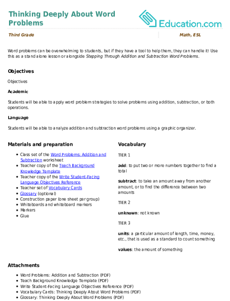
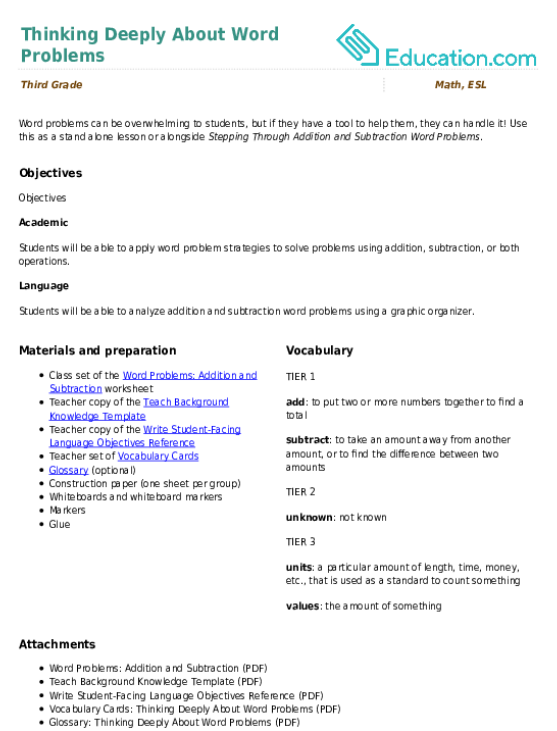
Thinking Deeply About Word Problems
Lesson Plan
Thinking Deeply About Word Problems
Third Grade
Subtraction
Word problems can be overwhelming to students, but if they have a tool to help them, they can handle it! Use this as a stand alone lesson or alongside
Stepping Through Addition and Subtraction Word Problems
.
Lesson Plan
EL
Thinking Deeply About Word Problems
Lesson Plan
Thinking Deeply About Word Problems
Word problems can be overwhelming to students, but if they have a tool to help them, they can handle it! Use this as a stand alone lesson or alongside
Stepping Through Addition and Subtraction Word Problems
.
Third Grade
Subtraction
Lesson Plan
EL
Problem and Solution Summaries
Lesson Plan
Problem and Solution Summaries
Third Grade
Use this lesson to guide your ELs towards identifying and discussing the problem and solution in a story. Teach this lesson as a stand-alone lesson or as support to the lesson Traditional Literature: Story Mapping.
Lesson Plan
EL
Problem and Solution Summaries
Lesson Plan
Problem and Solution Summaries
Use this lesson to guide your ELs towards identifying and discussing the problem and solution in a story. Teach this lesson as a stand-alone lesson or as support to the lesson Traditional Literature: Story Mapping.
Third Grade
Lesson Plan
EL
Explaining Equivalent Fractions
Lesson Plan
Explaining Equivalent Fractions
Third Grade
In order to build a strong foundation with fractions, students should be able to explain the concept and their thinking. Use this as a stand alone lesson or as a pre-lesson for
Let's Play Equivalent Fractions!
Lesson Plan
EL
Explaining Equivalent Fractions
Lesson Plan
Explaining Equivalent Fractions
In order to build a strong foundation with fractions, students should be able to explain the concept and their thinking. Use this as a stand alone lesson or as a pre-lesson for
Let's Play Equivalent Fractions!
Third Grade
Lesson Plan
EL
Adjectives: Comparative and Superlative
Lesson Plan
Adjectives: Comparative and Superlative
Third Grade
Big, bigger, biggest? Teach your students about comparative and superlative adjectives as they make comparisons. This lesson can stand alone or be used as a pre-lesson for the
Nonfiction Comprehension: Compare and Contrast
lesson.
Lesson Plan
EL
Adjectives: Comparative and Superlative
Lesson Plan
Adjectives: Comparative and Superlative
Big, bigger, biggest? Teach your students about comparative and superlative adjectives as they make comparisons. This lesson can stand alone or be used as a pre-lesson for the
Nonfiction Comprehension: Compare and Contrast
lesson.
Third Grade
Lesson Plan
EL
Shifting Points of View
Lesson Plan
Shifting Points of View
Fourth Grade
Reading
This lesson gives students practice identifying first person and third person narration in fiction and nonfiction texts. It could be taught as a stand-alone lesson or as a precursor to the lesson Fiction vs. Nonfiction.
Lesson Plan
EL
Shifting Points of View
Lesson Plan
Shifting Points of View
This lesson gives students practice identifying first person and third person narration in fiction and nonfiction texts. It could be taught as a stand-alone lesson or as a precursor to the lesson Fiction vs. Nonfiction.
Fourth Grade
Reading
Lesson Plan
EL
Realism and Fantasy
Lesson Plan
Realism and Fantasy
Third Grade
Use this lesson to help your ELs learn about the differences between realism and fantasy. This lesson can stand alone or be used as a pre-lesson for the
Making Sense of Realism and Fantasy
lesson.
Lesson Plan
EL
Realism and Fantasy
Lesson Plan
Realism and Fantasy
Use this lesson to help your ELs learn about the differences between realism and fantasy. This lesson can stand alone or be used as a pre-lesson for the
Making Sense of Realism and Fantasy
lesson.
Third Grade
Lesson Plan
EL
Explore the Associative Property of Multiplication
Lesson Plan
Explore the Associative Property of Multiplication
Third Grade
Use this lesson with your students to allow them to explore the associative property of multiplication by having deep discussions in small groups. Use this as a stand alone lesson or alongside
Associative Property of Multiplication
.
Lesson Plan
EL
Explore the Associative Property of Multiplication
Lesson Plan
Explore the Associative Property of Multiplication
Use this lesson with your students to allow them to explore the associative property of multiplication by having deep discussions in small groups. Use this as a stand alone lesson or alongside
Associative Property of Multiplication
.
Third Grade
Lesson Plan
EL
Character Comparisons
Lesson Plan
Character Comparisons
Fourth Grade
Reading
Use this lesson to help your ELs compare and contrast supporting characters from excerpted texts. It can be a stand-alone lesson or support the lesson Understanding Character Traits, Understanding Plot Lesson Part III.
Lesson Plan
EL
Character Comparisons
Lesson Plan
Character Comparisons
Use this lesson to help your ELs compare and contrast supporting characters from excerpted texts. It can be a stand-alone lesson or support the lesson Understanding Character Traits, Understanding Plot Lesson Part III.
Fourth Grade
Reading
Lesson Plan
EL
Focus on the Differences
Lesson Plan
Focus on the Differences
Third Grade
Reading
Use this lesson with your students to teach them to describe the differences between stories with contrasting conjunctions. This lesson can stand-alone or be used as a pre-lesson for the
Finding Similarities and Differences
lesson.
Lesson Plan
EL
Focus on the Differences
Lesson Plan
Focus on the Differences
Use this lesson with your students to teach them to describe the differences between stories with contrasting conjunctions. This lesson can stand-alone or be used as a pre-lesson for the
Finding Similarities and Differences
lesson.
Third Grade
Reading
Lesson Plan
EL
Discovering Nonfiction Details
Lesson Plan
Discovering Nonfiction Details
Fourth Grade
Writing
Give your ELs concrete experience with adverbs and adverbial phrases as a tool to discover details in nonfiction texts. Use this as a stand-alone lesson or as support to the Hey! What's the Big Idea? lesson.
Lesson Plan
EL
Discovering Nonfiction Details
Lesson Plan
Discovering Nonfiction Details
Give your ELs concrete experience with adverbs and adverbial phrases as a tool to discover details in nonfiction texts. Use this as a stand-alone lesson or as support to the Hey! What's the Big Idea? lesson.
Fourth Grade
Writing
Lesson Plan
EL
Adjectives in Informational Texts
Lesson Plan
Adjectives in Informational Texts
Fourth Grade
Describe the facts! This lesson teaches your ELs to identify adjectives and their important role as key details in informational texts. Use it as a stand-alone lesson or as support to the lesson Summarizing Nonfiction Texts.
Lesson Plan
EL
Adjectives in Informational Texts
Lesson Plan
Adjectives in Informational Texts
Describe the facts! This lesson teaches your ELs to identify adjectives and their important role as key details in informational texts. Use it as a stand-alone lesson or as support to the lesson Summarizing Nonfiction Texts.
Fourth Grade
Lesson Plan
EL
Decomposing Numbers
Lesson Plan
Decomposing Numbers
Third Grade
Numbers and Counting
Why make things harder on ourselves? Teach your students to decompose numbers to make math easier! Use this as a stand alone lesson or a pre-lesson for
Decompose to Multiply: 6, 7, 8, and 9.
Lesson Plan
EL
Decomposing Numbers
Lesson Plan
Decomposing Numbers
Why make things harder on ourselves? Teach your students to decompose numbers to make math easier! Use this as a stand alone lesson or a pre-lesson for
Decompose to Multiply: 6, 7, 8, and 9.
Third Grade
Numbers and Counting
Lesson Plan
EL
Strategies for Multiplying by Multiples of 10
Lesson Plan
Strategies for Multiplying by Multiples of 10
Third Grade
Help your students become detail-oriented mathematicians as they explore two strategies for multiplying a one-digit number by a multiple of 10. Use this as a stand alone lesson or alongside
Multiplying by Multiples of 10.
Lesson Plan
EL
Strategies for Multiplying by Multiples of 10
Lesson Plan
Strategies for Multiplying by Multiples of 10
Help your students become detail-oriented mathematicians as they explore two strategies for multiplying a one-digit number by a multiple of 10. Use this as a stand alone lesson or alongside
Multiplying by Multiples of 10.
Third Grade
Lesson Plan
EL
Asking and Answering Questions While Reading
Lesson Plan
Asking and Answering Questions While Reading
Third Grade
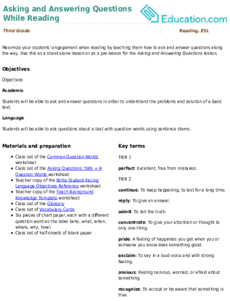
Maximize your students' engagement when reading by teaching them how to ask and answer questions along the way. Use this as a stand alone lesson or as a pre-lesson for the
Asking and Answering Questions
lesson.
Lesson Plan
EL
Asking and Answering Questions While Reading
Lesson Plan
Asking and Answering Questions While Reading
Maximize your students' engagement when reading by teaching them how to ask and answer questions along the way. Use this as a stand alone lesson or as a pre-lesson for the
Asking and Answering Questions
lesson.
Third Grade
Lesson Plan
EL
Evidence of Character Changes
Lesson Plan
Evidence of Character Changes
Third Grade
Writing
Create conversations about character changes! Use this lesson plan as a stand-alone lesson for practicing sequencing words in evidenced-based claims about a character, or before the Characters Change Just Like We Do lesson.
Lesson Plan
EL
Evidence of Character Changes
Lesson Plan
Evidence of Character Changes
Create conversations about character changes! Use this lesson plan as a stand-alone lesson for practicing sequencing words in evidenced-based claims about a character, or before the Characters Change Just Like We Do lesson.
Third Grade
Writing
Lesson Plan
EL
Repeated Words and Phrases
Lesson Plan
Repeated Words and Phrases
Third Grade
Teach your students to look for the repeated words and phrases in a nonfiction text as they pick out important information. This lesson can stand alone or be used as a pre-lesson for the
Determining Importance
lesson.
Lesson Plan
EL
Repeated Words and Phrases
Lesson Plan
Repeated Words and Phrases
Teach your students to look for the repeated words and phrases in a nonfiction text as they pick out important information. This lesson can stand alone or be used as a pre-lesson for the
Determining Importance
lesson.
Third Grade
Lesson Plan
EL
Idiom Meanings and Context Clues
Lesson Plan
Idiom Meanings and Context Clues
Third Grade
Idioms are a challenging piece of figurative language for students, but it can be an easier task with the help of context clues. Use this as a stand-alone lesson or as a pre-lesson for the
Capturing the Clues
lesson.
Lesson Plan
EL
Idiom Meanings and Context Clues
Lesson Plan
Idiom Meanings and Context Clues
Idioms are a challenging piece of figurative language for students, but it can be an easier task with the help of context clues. Use this as a stand-alone lesson or as a pre-lesson for the
Capturing the Clues
lesson.
Third Grade
Lesson Plan
EL
Using Adjectives and Similes to Describe
Lesson Plan
Using Adjectives and Similes to Describe
Third Grade
Vocabulary
Use this lesson to help your ELs explore adjectives and how we can use them to describe things. This lesson can stand alone or be used as a pre-lesson for the
Similes that Describe ME!
lesson.
Lesson Plan
EL
Using Adjectives and Similes to Describe
Lesson Plan
Using Adjectives and Similes to Describe
Use this lesson to help your ELs explore adjectives and how we can use them to describe things. This lesson can stand alone or be used as a pre-lesson for the
Similes that Describe ME!
lesson.
Third Grade
Vocabulary
Lesson Plan
EL
Using Text Features for Comprehension
Lesson Plan
Using Text Features for Comprehension
Third Grade
Use this lesson to help your ELs use information from text features to better understand the text. It can be a stand-alone lesson or a support lesson for the Text Features: Reading that Makes Sense lesson.
Lesson Plan
EL
Using Text Features for Comprehension
Lesson Plan
Using Text Features for Comprehension
Use this lesson to help your ELs use information from text features to better understand the text. It can be a stand-alone lesson or a support lesson for the Text Features: Reading that Makes Sense lesson.
Third Grade
Lesson Plan
EL
Solving Perimeter Word Problems
Lesson Plan
Solving Perimeter Word Problems
Third Grade
Support your students' comprehension of perimeter word problems by teaching them to use an engaging strategy and graphic organizer. This lesson can stand alone or be used as a pre-lesson for
Polygon Perimeters with Tantalizing Tangrams!
Lesson Plan
EL
Solving Perimeter Word Problems
Lesson Plan
Solving Perimeter Word Problems
Support your students' comprehension of perimeter word problems by teaching them to use an engaging strategy and graphic organizer. This lesson can stand alone or be used as a pre-lesson for
Polygon Perimeters with Tantalizing Tangrams!
Third Grade
Lesson Plan
EL
Sentence Parts and Making Predictions
Lesson Plan
Sentence Parts and Making Predictions
Fourth Grade
Grammar and Mechanics
In this lesson, students will practice identifying the subject and predicate of a sentence and making predictions with textual evidence as they read short fictional texts. Use it as a stand alone lesson or as a precursor to What's Next?
Lesson Plan
EL
Sentence Parts and Making Predictions
Lesson Plan
Sentence Parts and Making Predictions
In this lesson, students will practice identifying the subject and predicate of a sentence and making predictions with textual evidence as they read short fictional texts. Use it as a stand alone lesson or as a precursor to What's Next?
Fourth Grade
Grammar and Mechanics
Lesson Plan
EL
Fact or Opinion
Lesson Plan
Fact or Opinion
Second Grade
Help your ELs learn to understand and differentiate between fact and opinion through the analysis of nonfiction text. This can be a stand-alone lesson or a support lesson to the Fact or Opinion: Part 1 lesson plan.
Lesson Plan
EL
Fact or Opinion
Lesson Plan
Fact or Opinion
Help your ELs learn to understand and differentiate between fact and opinion through the analysis of nonfiction text. This can be a stand-alone lesson or a support lesson to the Fact or Opinion: Part 1 lesson plan.
Second Grade
Lesson Plan
EL
A Simple Summary
Lesson Plan
A Simple Summary
Third Grade
Use this lesson to help your ELs learn how to create a simple summary, paying attention to the sequence in a story. This lesson can stand alone or be used as a pre-lesson for the
Simple Summaries
lesson.
Lesson Plan
EL
A Simple Summary
Lesson Plan
A Simple Summary
Use this lesson to help your ELs learn how to create a simple summary, paying attention to the sequence in a story. This lesson can stand alone or be used as a pre-lesson for the
Simple Summaries
lesson.
Third Grade
Lesson Plan
EL
Similarities and Differences
Lesson Plan
Similarities and Differences
Third Grade
Measurement
Use this lesson with your students to practice comparing and contrasting the key details in two texts on the same topic. It can be a stand-alone lesson or a pre-lesson for the
What's Similar? What's Different?
lesson.
Lesson Plan
EL
Similarities and Differences
Lesson Plan
Similarities and Differences
Use this lesson with your students to practice comparing and contrasting the key details in two texts on the same topic. It can be a stand-alone lesson or a pre-lesson for the
What's Similar? What's Different?
lesson.
Third Grade
Measurement
Lesson Plan
EL
Focus on the Similarities
Lesson Plan
Focus on the Similarities
Third Grade
Reading
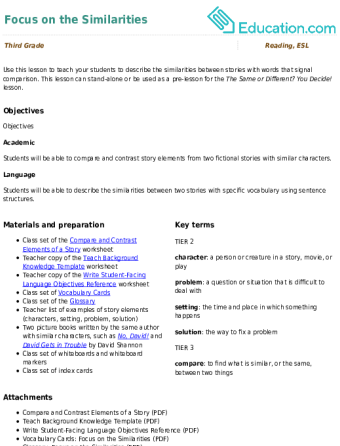
Use this lesson to teach your students to describe the similarities between stories with words that signal comparison. This lesson can stand-alone or be used as a pre-lesson for the
The Same or Different? You Decide!
lesson.
Lesson Plan
EL
Focus on the Similarities
Lesson Plan
Focus on the Similarities
Use this lesson to teach your students to describe the similarities between stories with words that signal comparison. This lesson can stand-alone or be used as a pre-lesson for the
The Same or Different? You Decide!
lesson.
Third Grade
Reading
Lesson Plan
EL
Area Strategies
Lesson Plan
Area Strategies
Third Grade
Geometry
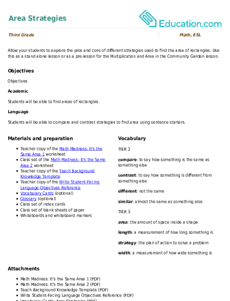
Allow your students to explore the pros and cons of different strategies used to find the area of rectangles. Use this as a stand alone lesson or as a pre-lesson for the Multiplication and Area in the Community Garden lesson.
Lesson Plan
EL
Area Strategies
Lesson Plan
Area Strategies
Allow your students to explore the pros and cons of different strategies used to find the area of rectangles. Use this as a stand alone lesson or as a pre-lesson for the Multiplication and Area in the Community Garden lesson.
Third Grade
Geometry
Lesson Plan
EL
First- and Third-Person Point of View
Lesson Plan
First- and Third-Person Point of View
Third Grade
Use this lesson to help your ELs understand which pronouns to use when writing from different points of view. Use this as a stand-alone lesson or as a support lesson for the
My View as an Ant
lesson.
Lesson Plan
EL
First- and Third-Person Point of View
Lesson Plan
First- and Third-Person Point of View
Use this lesson to help your ELs understand which pronouns to use when writing from different points of view. Use this as a stand-alone lesson or as a support lesson for the
My View as an Ant
lesson.
Third Grade
Lesson Plan
1
2
3
4
…
11