SKIP TO CONTENT
Worksheet Generator
Subjects
Grades
Worksheets
Games
Build a Worksheet
More Resources
Roly Recommends
Subjects
Grades
Worksheets
Games
Build a Worksheet
More Resources
Roly Recommends
Filters
Search for: identify...
✕
Lesson Plans
✕
Kindergarten - 4th Grade
✕
Subjects
Math
English Language Arts
Science
Social Studies
Grade Level
Pre-K
K
1st
2nd
3rd
4th
5th
6th
7th
8th
Early Childhood
Elementary School
Middle School
Resource Type
Worksheets
Games
Lesson Plans
Interactive Worksheets
Workbooks
Activities
Exercises
Stories
Songs
Offline Games
Guided Lessons
Teacher Resources
Common Core
Yes
Roly Recommends
Social Emotional Learning
English Language Support
Yes
See More
Clear All
View 939 results
Showing Results for identify... : Page 2
939 results
Search for: identify...
✕
Lesson Plans
✕
Kindergarten - 4th Grade
✕
Clear All
Sort by:
Relevance
Most recent
Most popular
Alphabetical A-Z
Alphabetical Z-A
All filters
939 results
Sort by:
Relevance
Most recent
Most popular
Alphabetical A-Z
Alphabetical Z-A
Storyboard Superstars
Lesson Plan
Storyboard Superstars
Fourth Grade
Help your students become super readers! In this lesson, your students will create storyboards to identify the beginning, middle, and end in fictional texts.
Lesson Plan
Storyboard Superstars
Lesson Plan
Storyboard Superstars
Help your students become super readers! In this lesson, your students will create storyboards to identify the beginning, middle, and end in fictional texts.
Fourth Grade
Lesson Plan
Nonfiction Text Features
Lesson Plan
Nonfiction Text Features
Second Grade
Students will be able to use and identify nonfiction text features. It can be a stand-alone lesson or a support lesson to the How Many Features? lesson plan.
Lesson Plan
Nonfiction Text Features
Lesson Plan
Nonfiction Text Features
Students will be able to use and identify nonfiction text features. It can be a stand-alone lesson or a support lesson to the How Many Features? lesson plan.
Second Grade
Lesson Plan
Classroom Directions
Lesson Plan
Classroom Directions
Second Grade
Community and Culture
In this lesson, your students will learn how to identify what direction they are going when they move from one place to another. They'll be able to visually see directions in the classroom.
Lesson Plan
Classroom Directions
Lesson Plan
Classroom Directions
In this lesson, your students will learn how to identify what direction they are going when they move from one place to another. They'll be able to visually see directions in the classroom.
Second Grade
Community and Culture
Lesson Plan
More Vowels
Lesson Plan
More Vowels
Pre-K
Phonics
Students will have fun working with partners as they identify the missing vowels in common animal CVC words. Can be used as a stand alone or support lesson for the
Animal Vowels
lesson plan.
Lesson Plan
More Vowels
Lesson Plan
More Vowels
Students will have fun working with partners as they identify the missing vowels in common animal CVC words. Can be used as a stand alone or support lesson for the
Animal Vowels
lesson plan.
Pre-K
Phonics
Lesson Plan
Silent E Syllable Search
Lesson Plan
Silent E Syllable Search
Second Grade
Crack the “VC-silent E” code to track down sneaky E syllables with this fun cut and paste game for second graders. Your students will be able to identify common words after identifying this pattern.
Lesson Plan
Silent E Syllable Search
Lesson Plan
Silent E Syllable Search
Crack the “VC-silent E” code to track down sneaky E syllables with this fun cut and paste game for second graders. Your students will be able to identify common words after identifying this pattern.
Second Grade
Lesson Plan
Analyzing Archetypes in Fairy Tales
Lesson Plan
Analyzing Archetypes in Fairy Tales
Second Grade
Reading
Engage students in analysis by examining archetypes in fairy tales. Teach students to identify heroes and villains in fairy tales, examine patterns, and create their own fairy tales to express their knowledge of archetypes.
Lesson Plan
Analyzing Archetypes in Fairy Tales
Lesson Plan
Analyzing Archetypes in Fairy Tales
Engage students in analysis by examining archetypes in fairy tales. Teach students to identify heroes and villains in fairy tales, examine patterns, and create their own fairy tales to express their knowledge of archetypes.
Second Grade
Reading
Lesson Plan
Parts of a Plant
Lesson Plan
Parts of a Plant
First Grade
Life Science
Root, stem, flower, leaf! In this hands-on science lesson, your students will create their own plants to help them identify and remember the parts of a plant.
Lesson Plan
Parts of a Plant
Lesson Plan
Parts of a Plant
Root, stem, flower, leaf! In this hands-on science lesson, your students will create their own plants to help them identify and remember the parts of a plant.
First Grade
Life Science
Lesson Plan
Elements of Fairy Tales
Lesson Plan
Elements of Fairy Tales
Second Grade
Reading
Use this lesson to help students identify the elements of a fictional text while gaining more knowledge about parts of speech. Use as a stand alone activity or a support lesson for Fairy Tales: Identifying Story Elements.
Lesson Plan
Elements of Fairy Tales
Lesson Plan
Elements of Fairy Tales
Use this lesson to help students identify the elements of a fictional text while gaining more knowledge about parts of speech. Use as a stand alone activity or a support lesson for Fairy Tales: Identifying Story Elements.
Second Grade
Reading
Lesson Plan
Which Way Can We Go?
Lesson Plan
Which Way Can We Go?
First Grade
Look all around! In this lesson, students will use real-life examples and an interactive mapping activity to identify the cardinal directions of north, south, east, and west.
Lesson Plan
Which Way Can We Go?
Lesson Plan
Which Way Can We Go?
Look all around! In this lesson, students will use real-life examples and an interactive mapping activity to identify the cardinal directions of north, south, east, and west.
First Grade
Lesson Plan
Chains of Strengths
Lesson Plan
Chains of Strengths
Fourth Grade
In this lesson, students will create a paper chain based on their greatest strengths and attributes. They will also work with peers to share and identify each other's strengths.
Lesson Plan
Chains of Strengths
Lesson Plan
Chains of Strengths
In this lesson, students will create a paper chain based on their greatest strengths and attributes. They will also work with peers to share and identify each other's strengths.
Fourth Grade
Lesson Plan
Characters and Dialogue
Lesson Plan
Characters and Dialogue
Third Grade
Writing
Help your ELs identify the characters and their dialogue in a story. This lesson can stand alone or be used as a pre-lesson for the
Action! Students Create Reader’s Theater
lesson.
Lesson Plan
Characters and Dialogue
Lesson Plan
Characters and Dialogue
Help your ELs identify the characters and their dialogue in a story. This lesson can stand alone or be used as a pre-lesson for the
Action! Students Create Reader’s Theater
lesson.
Third Grade
Writing
Lesson Plan
Verbs that Show Character Action
Lesson Plan
Verbs that Show Character Action
Third Grade
Use this lesson to teach your students how to identify character actions with verbs. This lesson can stand alone or be used as a pre-lesson for the
Look for the Clues
lesson.
Lesson Plan
Verbs that Show Character Action
Lesson Plan
Verbs that Show Character Action
Use this lesson to teach your students how to identify character actions with verbs. This lesson can stand alone or be used as a pre-lesson for the
Look for the Clues
lesson.
Third Grade
Lesson Plan
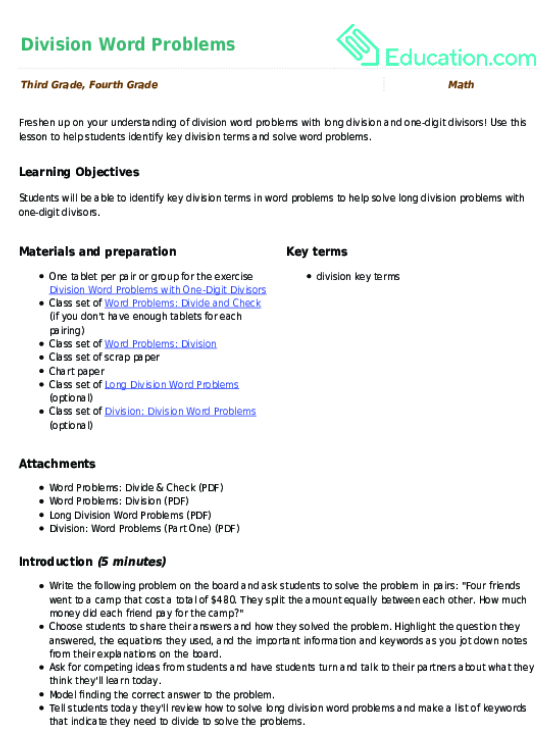
Division Word Problems
Lesson Plan
Division Word Problems
Third Grade
Division
Freshen up on your understanding of division word problems with long division and one-digit divisors! Use this lesson to help students identify key division terms and solve word problems.
Lesson Plan
Division Word Problems
Lesson Plan
Division Word Problems
Freshen up on your understanding of division word problems with long division and one-digit divisors! Use this lesson to help students identify key division terms and solve word problems.
Third Grade
Division
Lesson Plan
Equal Shares
Lesson Plan
Equal Shares
Second Grade
Fractions
Provide students with an opportunity to identify the wholes that are correctly divided into halves, thirds, and fourths (equal shares). Use this activity alone as a support lesson or alongside Cookie Fractions Fun.
Lesson Plan
Equal Shares
Lesson Plan
Equal Shares
Provide students with an opportunity to identify the wholes that are correctly divided into halves, thirds, and fourths (equal shares). Use this activity alone as a support lesson or alongside Cookie Fractions Fun.
Second Grade
Fractions
Lesson Plan
Arranging Numbers in Multiple Ways
Lesson Plan
Arranging Numbers in Multiple Ways
Fourth Grade
Place Value
In this lesson, students use cubes to build arrays to represent factor pairs of numbers within 100. They use this understanding to identify multiples as well.
Lesson Plan
Arranging Numbers in Multiple Ways
Lesson Plan
Arranging Numbers in Multiple Ways
In this lesson, students use cubes to build arrays to represent factor pairs of numbers within 100. They use this understanding to identify multiples as well.
Fourth Grade
Place Value
Lesson Plan
Solving Word Problems
Lesson Plan
Solving Word Problems
Second Grade
Word problems getting you down? Then spread the word on a lesson that will help students decide when to add or subtract, as they identify clue words that aid in solving word problems.
Lesson Plan
Solving Word Problems
Lesson Plan
Solving Word Problems
Word problems getting you down? Then spread the word on a lesson that will help students decide when to add or subtract, as they identify clue words that aid in solving word problems.
Second Grade
Lesson Plan
Nonfiction Main Idea
Lesson Plan
Nonfiction Main Idea
Fourth Grade
Reading
Let's get reading! In this lesson, students will identify the main idea and details of a nonfiction text. Use this on its own or as support for the lesson Connecting the Coasts: Effects of the Transcontinental Railroad.
Lesson Plan
Nonfiction Main Idea
Lesson Plan
Nonfiction Main Idea
Let's get reading! In this lesson, students will identify the main idea and details of a nonfiction text. Use this on its own or as support for the lesson Connecting the Coasts: Effects of the Transcontinental Railroad.
Fourth Grade
Reading
Lesson Plan
Fiction Comprehension: Problem and Solution
Lesson Plan
Fiction Comprehension: Problem and Solution
Third Grade
If you've ever had something go wrong, you know how it feels to search for a solution! Use this lesson to teach your students to identify problems and solutions in fictional text.
Lesson Plan
Fiction Comprehension: Problem and Solution
Lesson Plan
Fiction Comprehension: Problem and Solution
If you've ever had something go wrong, you know how it feels to search for a solution! Use this lesson to teach your students to identify problems and solutions in fictional text.
Third Grade
Lesson Plan
All About Me: Character Traits
Lesson Plan
All About Me: Character Traits
First Grade
It's all about me! In this lesson, students will identify character traits in a story and decide if they have the same traits. This lesson incorporates literature, writing, comparison skills, and social skills.
Lesson Plan
All About Me: Character Traits
Lesson Plan
All About Me: Character Traits
It's all about me! In this lesson, students will identify character traits in a story and decide if they have the same traits. This lesson incorporates literature, writing, comparison skills, and social skills.
First Grade
Lesson Plan
Summer Drama
Lesson Plan
Summer Drama
Fourth Grade
Vocabulary
You won't strike out with this lesson on finding the theme of a script. Use this lesson to help your students identify the elements of a script and find the theme.
Lesson Plan
Summer Drama
Lesson Plan
Summer Drama
You won't strike out with this lesson on finding the theme of a script. Use this lesson to help your students identify the elements of a script and find the theme.
Fourth Grade
Vocabulary
Lesson Plan
Main Idea and Supporting Evidence
Lesson Plan
Main Idea and Supporting Evidence
Fourth Grade
Use this lesson to help your ELs identify the main idea and supporting evidence in a short fictional text. It can be a stand-alone lesson or used as support for the lesson Reading Closely.
Lesson Plan
Main Idea and Supporting Evidence
Lesson Plan
Main Idea and Supporting Evidence
Use this lesson to help your ELs identify the main idea and supporting evidence in a short fictional text. It can be a stand-alone lesson or used as support for the lesson Reading Closely.
Fourth Grade
Lesson Plan
10 Again!
Lesson Plan
10 Again!
First Grade
Learning to quickly identify groups of 10 will be very helpful when your students begin working with multiple digit numbers. In this lesson, your students will work with manipulatives to make number pairs.
Lesson Plan
10 Again!
Lesson Plan
10 Again!
Learning to quickly identify groups of 10 will be very helpful when your students begin working with multiple digit numbers. In this lesson, your students will work with manipulatives to make number pairs.
First Grade
Lesson Plan
So Many Short A Words!
Lesson Plan
So Many Short A Words!
Kindergarten
Alphabet
Students will love becoming alphabet experts as they identify words that begin with the short A sound and create their very own A word posters for their classroom walls!
Lesson Plan
So Many Short A Words!
Lesson Plan
So Many Short A Words!
Students will love becoming alphabet experts as they identify words that begin with the short A sound and create their very own A word posters for their classroom walls!
Kindergarten
Alphabet
Lesson Plan
Rolling Math
Lesson Plan
Rolling Math
Pre-K
In this lesson, students will roll with numbers and identify what comes before and after a number. They will roll dice, add numbers and practice counting forward and backward from the sum.
Lesson Plan
Rolling Math
Lesson Plan
Rolling Math
In this lesson, students will roll with numbers and identify what comes before and after a number. They will roll dice, add numbers and practice counting forward and backward from the sum.
Pre-K
Lesson Plan
Contraction Action
Lesson Plan
Contraction Action
First Grade
Give your students a chance to create contractions and play with macaroni with this fun-filled reading lesson. Early learners will have a blast using flash cards to identify ways word combinations.
Lesson Plan
Contraction Action
Lesson Plan
Contraction Action
Give your students a chance to create contractions and play with macaroni with this fun-filled reading lesson. Early learners will have a blast using flash cards to identify ways word combinations.
First Grade
Lesson Plan
Compound Sentences in Nonfiction
Lesson Plan
Compound Sentences in Nonfiction
Fourth Grade
Writing
This lesson helps your ELs identify the role of coordinating conjunctions and compound sentences in nonfiction texts. Use it as a stand-alone lesson or as a pre-lesson to Nonfiction Genres.
Lesson Plan
Compound Sentences in Nonfiction
Lesson Plan
Compound Sentences in Nonfiction
This lesson helps your ELs identify the role of coordinating conjunctions and compound sentences in nonfiction texts. Use it as a stand-alone lesson or as a pre-lesson to Nonfiction Genres.
Fourth Grade
Writing
Lesson Plan
What’s Similar? What’s Different?
Lesson Plan
What’s Similar? What’s Different?
Second Grade
Measurement
How are plants’ traits affected by environmental factors? In this integrated science and reading lesson, students will use multiple sources to identify and determine how traits are influenced by the environment.
Lesson Plan
What’s Similar? What’s Different?
Lesson Plan
What’s Similar? What’s Different?
How are plants’ traits affected by environmental factors? In this integrated science and reading lesson, students will use multiple sources to identify and determine how traits are influenced by the environment.
Second Grade
Measurement
Lesson Plan
Comparing Solids
Lesson Plan
Comparing Solids
Second Grade
In this lesson, your students will play "I Spy" to identify 3-D shapes. They will use language to describe the shapes and be able to compare them easily.
Lesson Plan
Comparing Solids
Lesson Plan
Comparing Solids
In this lesson, your students will play "I Spy" to identify 3-D shapes. They will use language to describe the shapes and be able to compare them easily.
Second Grade
Lesson Plan
I Scream, You Scream, We All Scream for Pronouns!
Lesson Plan
I Scream, You Scream, We All Scream for Pronouns!
Fourth Grade
Grammar and Mechanics
If your students are screaming, make sure they are grammatically correct! In this pronoun lesson plan, your students will identify and use a variety of pronouns to replace common and proper nouns.
Lesson Plan
I Scream, You Scream, We All Scream for Pronouns!
Lesson Plan
I Scream, You Scream, We All Scream for Pronouns!
If your students are screaming, make sure they are grammatically correct! In this pronoun lesson plan, your students will identify and use a variety of pronouns to replace common and proper nouns.
Fourth Grade
Grammar and Mechanics
Lesson Plan
Adjectives in Informational Texts
Lesson Plan
Adjectives in Informational Texts
Fourth Grade
Describe the facts! This lesson teaches your ELs to identify adjectives and their important role as key details in informational texts. Use it as a stand-alone lesson or as support to the lesson Summarizing Nonfiction Texts.
Lesson Plan
Adjectives in Informational Texts
Lesson Plan
Adjectives in Informational Texts
Describe the facts! This lesson teaches your ELs to identify adjectives and their important role as key details in informational texts. Use it as a stand-alone lesson or as support to the lesson Summarizing Nonfiction Texts.
Fourth Grade
Lesson Plan
1
2
3
4
…
32