SKIP TO CONTENT
Worksheet Generator
Subjects
Grades
Worksheets
Games
Build a Worksheet
More Resources
Roly Recommends
Math Month
Subjects
Grades
Worksheets
Games
Build a Worksheet
More Resources
Roly Recommends
Math Month
Filters
Search for: using, lower, case
✕
Lesson Plans
✕
Kindergarten - 4th Grade
✕
Subjects
Math
English Language Arts
Science
Social Studies
Grade Level
Pre-K
K
1st
2nd
3rd
4th
5th
6th
7th
8th
Early Childhood
Elementary School
Middle School
Resource Type
Worksheets
Games
Lesson Plans
Interactive Worksheets
Workbooks
Activities
Exercises
Stories
Songs
Offline Games
Guided Lessons
Teacher Resources
Common Core
Yes
Roly Recommends
Social Emotional Learning
English Language Support
Yes
See More
Clear All
View 1,640 results
Showing Results for using lower case
1,640 results
Search for: using, lower, case
✕
Lesson Plans
✕
Kindergarten - 4th Grade
✕
Clear All
Sort by:
Relevance
Most recent
Most popular
Alphabetical A-Z
Alphabetical Z-A
All filters
1,640 results
Sort by:
Relevance
Most recent
Most popular
Alphabetical A-Z
Alphabetical Z-A
Matching Letters
Lesson Plan
Matching Letters
Kindergarten
Let your students practice their letter recognition skills with this hands-on activity that teaches them the difference between upper and lower case letter.
Lesson Plan
Matching Letters
Lesson Plan
Matching Letters
Let your students practice their letter recognition skills with this hands-on activity that teaches them the difference between upper and lower case letter.
Kindergarten
Lesson Plan
The Case of the Missing Rectangle Side
Lesson Plan
The Case of the Missing Rectangle Side
Fourth Grade
Your students will become junior math detectives as they hunt down the missing side of a rectangle by applying the area formula for rectangles. The only clues they have are the rectangle's area and the measure of one side.
Lesson Plan
The Case of the Missing Rectangle Side
Lesson Plan
The Case of the Missing Rectangle Side
Your students will become junior math detectives as they hunt down the missing side of a rectangle by applying the area formula for rectangles. The only clues they have are the rectangle's area and the measure of one side.
Fourth Grade
Lesson Plan
Using Tape Models to Compare Like Fractions
Lesson Plan
Using Tape Models to Compare Like Fractions
Third Grade
Teach your students to compare fractions using symbols ( >, < = ) in three easy steps. Using this lesson plan, your class will compare like fractions using tape diagrams.
Lesson Plan
Using Tape Models to Compare Like Fractions
Lesson Plan
Using Tape Models to Compare Like Fractions
Teach your students to compare fractions using symbols ( >, < = ) in three easy steps. Using this lesson plan, your class will compare like fractions using tape diagrams.
Third Grade
Lesson Plan
EL
Using Sentence Level Context to Decode Text
Lesson Plan
Using Sentence Level Context to Decode Text
Second Grade
Reading
Use this lesson to reinforce using sentence level context clues to decode challenging words in a nonfiction text. This can be used as a stand alone activity or a support the Using Context Clues to Understand Word Meanings lesson.
Lesson Plan
EL
Using Sentence Level Context to Decode Text
Lesson Plan
Using Sentence Level Context to Decode Text
Use this lesson to reinforce using sentence level context clues to decode challenging words in a nonfiction text. This can be used as a stand alone activity or a support the Using Context Clues to Understand Word Meanings lesson.
Second Grade
Reading
Lesson Plan
EL
Area Arrangements
Lesson Plan
Area Arrangements
Fourth Grade
Geometry
Students will use the inverse relationship between multiplication and division to complete an area formula in a real-world situation. Use this lesson on its own or as support for the lesson The Case of the Missing Rectangle Side.
Lesson Plan
EL
Area Arrangements
Lesson Plan
Area Arrangements
Students will use the inverse relationship between multiplication and division to complete an area formula in a real-world situation. Use this lesson on its own or as support for the lesson The Case of the Missing Rectangle Side.
Fourth Grade
Geometry
Lesson Plan
Sum It Up: Introduction to Writing Summaries
Lesson Plan
Sum It Up: Introduction to Writing Summaries
Fourth Grade
Writing
Students are often taught that written pieces should be long and detailed, but this isn't the case when it comes to summaries. This lesson gives students the chance to practice keeping summaries concise in a fun and engaging way.
Lesson Plan
Sum It Up: Introduction to Writing Summaries
Lesson Plan
Sum It Up: Introduction to Writing Summaries
Students are often taught that written pieces should be long and detailed, but this isn't the case when it comes to summaries. This lesson gives students the chance to practice keeping summaries concise in a fun and engaging way.
Fourth Grade
Writing
Lesson Plan
EL
Describing the World Using Sensory Language
Lesson Plan
Describing the World Using Sensory Language
First Grade
Life Science
What are the five senses and how do we use them everyday? Students get a chance to practice using sensory language as they think about the world around them. Can be used as a stand alone or support for the Writing a Five Senses Poem lesson.
Lesson Plan
EL
Describing the World Using Sensory Language
Lesson Plan
Describing the World Using Sensory Language
What are the five senses and how do we use them everyday? Students get a chance to practice using sensory language as they think about the world around them. Can be used as a stand alone or support for the Writing a Five Senses Poem lesson.
First Grade
Life Science
Lesson Plan
Adding Mixed Numbers Using the Decomposition Strategy
Lesson Plan
Adding Mixed Numbers Using the Decomposition Strategy
Fourth Grade
Make the number work for you! Use this lesson to teach your students to add mixed numbers with like denominators using the strategy of decomposition.
Lesson Plan
Adding Mixed Numbers Using the Decomposition Strategy
Lesson Plan
Adding Mixed Numbers Using the Decomposition Strategy
Make the number work for you! Use this lesson to teach your students to add mixed numbers with like denominators using the strategy of decomposition.
Fourth Grade
Lesson Plan
Subtracting Mixed Numbers Using the Decomposition Strategy
Lesson Plan
Subtracting Mixed Numbers Using the Decomposition Strategy
Fourth Grade
Teach your students to subtract mixed numbers with like denominators using the strategy of decomposition. This strategy helps students to manipulate and break down numbers to help them solve tricky subtraction problems.
Lesson Plan
Subtracting Mixed Numbers Using the Decomposition Strategy
Lesson Plan
Subtracting Mixed Numbers Using the Decomposition Strategy
Teach your students to subtract mixed numbers with like denominators using the strategy of decomposition. This strategy helps students to manipulate and break down numbers to help them solve tricky subtraction problems.
Fourth Grade
Lesson Plan
Using Text Features
Lesson Plan
Using Text Features
First Grade
Help students enrich their informational writing by learning to use text features.
Lesson Plan
Using Text Features
Lesson Plan
Using Text Features
Help students enrich their informational writing by learning to use text features.
First Grade
Lesson Plan
EL
Using a Dictionary to Clarify the Meaning of Unknown Words
Lesson Plan
Using a Dictionary to Clarify the Meaning of Unknown Words
Second Grade
Vocabulary
This lesson will help students explore using a dictionary to figure out tricky words with suffixes. Use as a stand-alone activity or a support for the Understanding Academic Vocabulary in a Nonfiction Text lesson.
Lesson Plan
EL
Using a Dictionary to Clarify the Meaning of Unknown Words
Lesson Plan
Using a Dictionary to Clarify the Meaning of Unknown Words
This lesson will help students explore using a dictionary to figure out tricky words with suffixes. Use as a stand-alone activity or a support for the Understanding Academic Vocabulary in a Nonfiction Text lesson.
Second Grade
Vocabulary
Lesson Plan
EL
Using Regrouping to Add
Lesson Plan
Using Regrouping to Add
Second Grade
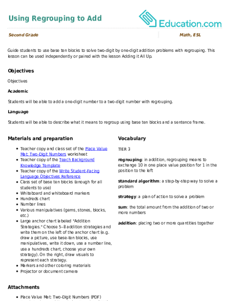
Guide students to use base ten blocks to solve two-digit by one-digit addition problems with regrouping. This lesson can be used independently or paired with the lesson Adding it All Up.
Lesson Plan
EL
Using Regrouping to Add
Lesson Plan
Using Regrouping to Add
Guide students to use base ten blocks to solve two-digit by one-digit addition problems with regrouping. This lesson can be used independently or paired with the lesson Adding it All Up.
Second Grade
Lesson Plan
EL
Using the 5 W's
Lesson Plan
Using the 5 W's
Second Grade
Reading
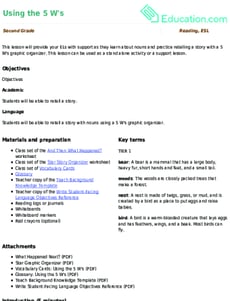
This lesson will provide your ELs with support as they learn about nouns and practice retelling a story with a 5 W's graphic organizer. This lesson can be used as a stand alone activity or a support lesson.
Lesson Plan
EL
Using the 5 W's
Lesson Plan
Using the 5 W's
This lesson will provide your ELs with support as they learn about nouns and practice retelling a story with a 5 W's graphic organizer. This lesson can be used as a stand alone activity or a support lesson.
Second Grade
Reading
Lesson Plan
Using Adjectives and Verbs to Make Writing Come to Life
Lesson Plan
Using Adjectives and Verbs to Make Writing Come to Life
Fourth Grade
Writing
Imagery is one of the most important tools in a narrative writer's arsenal. In this lesson, students will will learn to craft vivid scenes by selecting powerful verbs and adjectives, as well as to critique descriptive writing using the same criteria.
Lesson Plan
Using Adjectives and Verbs to Make Writing Come to Life
Lesson Plan
Using Adjectives and Verbs to Make Writing Come to Life
Imagery is one of the most important tools in a narrative writer's arsenal. In this lesson, students will will learn to craft vivid scenes by selecting powerful verbs and adjectives, as well as to critique descriptive writing using the same criteria.
Fourth Grade
Writing
Lesson Plan
EL
Using Pictures to Read Words
Lesson Plan
Using Pictures to Read Words
Kindergarten
Reading
This is a great introductory lesson to teach students about the importance of illustrations when reading. It can be used as a stand alone or support lesson for the Introducing Reader's Workshop lesson plan.
Lesson Plan
EL
Using Pictures to Read Words
Lesson Plan
Using Pictures to Read Words
This is a great introductory lesson to teach students about the importance of illustrations when reading. It can be used as a stand alone or support lesson for the Introducing Reader's Workshop lesson plan.
Kindergarten
Reading
Lesson Plan
Interpreting Data Using Graphs
Lesson Plan
Interpreting Data Using Graphs
Kindergarten
Data and Graphing
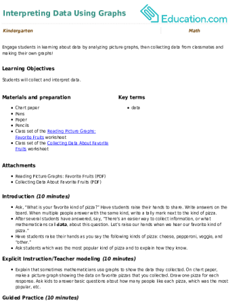
Engage students in learning about data by analyzing picture graphs, then collecting data from classmates and making their own graphs!
Lesson Plan
Interpreting Data Using Graphs
Lesson Plan
Interpreting Data Using Graphs
Engage students in learning about data by analyzing picture graphs, then collecting data from classmates and making their own graphs!
Kindergarten
Data and Graphing
Lesson Plan
EL
Using Text Features for Comprehension
Lesson Plan
Using Text Features for Comprehension
Third Grade
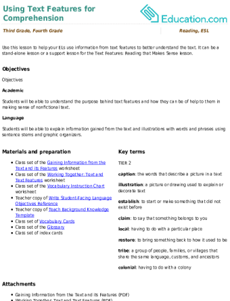
Use this lesson to help your ELs use information from text features to better understand the text. It can be a stand-alone lesson or a support lesson for the Text Features: Reading that Makes Sense lesson.
Lesson Plan
EL
Using Text Features for Comprehension
Lesson Plan
Using Text Features for Comprehension
Use this lesson to help your ELs use information from text features to better understand the text. It can be a stand-alone lesson or a support lesson for the Text Features: Reading that Makes Sense lesson.
Third Grade
Lesson Plan
Equivalent Fractions Using Area Models
Lesson Plan
Equivalent Fractions Using Area Models
Fourth Grade
Teach your students to create equivalent fractions by multiplying by different fraction forms of 1 whole like 2/2 or 4/4. This lesson also includes drafts of area models.
Lesson Plan
Equivalent Fractions Using Area Models
Lesson Plan
Equivalent Fractions Using Area Models
Teach your students to create equivalent fractions by multiplying by different fraction forms of 1 whole like 2/2 or 4/4. This lesson also includes drafts of area models.
Fourth Grade
Lesson Plan
EL
Telling Time Using Skip Counting
Lesson Plan
Telling Time Using Skip Counting
Second Grade
Vocabulary
Teach your students to read time to the nearest five minutes by counting by fives! Use this lesson as a stand-alone support lesson for ELs or alongside Tricky Time Telling.
Lesson Plan
EL
Telling Time Using Skip Counting
Lesson Plan
Telling Time Using Skip Counting
Teach your students to read time to the nearest five minutes by counting by fives! Use this lesson as a stand-alone support lesson for ELs or alongside Tricky Time Telling.
Second Grade
Vocabulary
Lesson Plan
EL
Using Evidence to Analyze a Character
Lesson Plan
Using Evidence to Analyze a Character
First Grade
Writing
Your students will love learning all about the playful characters in a classic read-aloud text while digging into what makes characters unique. Use as a stand-alone or support lesson for the How to Analyze a Character lesson plan.
Lesson Plan
EL
Using Evidence to Analyze a Character
Lesson Plan
Using Evidence to Analyze a Character
Your students will love learning all about the playful characters in a classic read-aloud text while digging into what makes characters unique. Use as a stand-alone or support lesson for the How to Analyze a Character lesson plan.
First Grade
Writing
Lesson Plan
Synonyms: Using Shades of Meaning
Lesson Plan
Synonyms: Using Shades of Meaning
Second Grade
Why walk when you can mosey? In this lesson, students will learn how to use synonyms to express shades of meaning in their writing. Introduce the topic with a book, then brainstorm descriptive options for overused words.
Lesson Plan
Synonyms: Using Shades of Meaning
Lesson Plan
Synonyms: Using Shades of Meaning
Why walk when you can mosey? In this lesson, students will learn how to use synonyms to express shades of meaning in their writing. Introduce the topic with a book, then brainstorm descriptive options for overused words.
Second Grade
Lesson Plan
Using Articles: A, An, The
Lesson Plan
Using Articles: A, An, The
Fourth Grade
Articles are a simple yet critical part of speech. This lesson helps your fourth graders distinguish the three articles and understand how to use them correctly in sentences.
Lesson Plan
Using Articles: A, An, The
Lesson Plan
Using Articles: A, An, The
Articles are a simple yet critical part of speech. This lesson helps your fourth graders distinguish the three articles and understand how to use them correctly in sentences.
Fourth Grade
Lesson Plan
EL
Using Picture Walks to Examine Purpose
Lesson Plan
Using Picture Walks to Examine Purpose
Second Grade
Reading
Teach your students about picture walks as a strategy to understand the author's purpose in a fictional text. This lesson can be used as a stand-alone lesson or as support for the Examining Author's Purpose in a Fictional Text lesson.
Lesson Plan
EL
Using Picture Walks to Examine Purpose
Lesson Plan
Using Picture Walks to Examine Purpose
Teach your students about picture walks as a strategy to understand the author's purpose in a fictional text. This lesson can be used as a stand-alone lesson or as support for the Examining Author's Purpose in a Fictional Text lesson.
Second Grade
Reading
Lesson Plan
Researching the Past Using Primary Sources
Lesson Plan
Researching the Past Using Primary Sources
Fourth Grade
Reading
Knock, knock! It’s the U.S. Census Bureau! In this lesson plan, students analyze primary sources in the form of census data to do research that helps them answer questions about famous people and the time period during which they lived.
Lesson Plan
Researching the Past Using Primary Sources
Lesson Plan
Researching the Past Using Primary Sources
Knock, knock! It’s the U.S. Census Bureau! In this lesson plan, students analyze primary sources in the form of census data to do research that helps them answer questions about famous people and the time period during which they lived.
Fourth Grade
Reading
Lesson Plan
Using Context Clues to Understand Word Meanings
Lesson Plan
Using Context Clues to Understand Word Meanings
Second Grade
Reading
This lesson will help your students use sentence level context clues to decode challenging words in a nonfiction text. Students will enjoy learning about maps and figuring out tricky words along the way!
Lesson Plan
Using Context Clues to Understand Word Meanings
Lesson Plan
Using Context Clues to Understand Word Meanings
This lesson will help your students use sentence level context clues to decode challenging words in a nonfiction text. Students will enjoy learning about maps and figuring out tricky words along the way!
Second Grade
Reading
Lesson Plan
EL
Using Adjectives and Similes to Describe
Lesson Plan
Using Adjectives and Similes to Describe
Third Grade
Vocabulary
Use this lesson to help your ELs explore adjectives and how we can use them to describe things. This lesson can stand alone or be used as a pre-lesson for the
Similes that Describe ME!
lesson.
Lesson Plan
EL
Using Adjectives and Similes to Describe
Lesson Plan
Using Adjectives and Similes to Describe
Use this lesson to help your ELs explore adjectives and how we can use them to describe things. This lesson can stand alone or be used as a pre-lesson for the
Similes that Describe ME!
lesson.
Third Grade
Vocabulary
Lesson Plan
Estimating Measurements of Mass and Volume Using Metric Units
Lesson Plan
Estimating Measurements of Mass and Volume Using Metric Units
Third Grade
Students will become more familiar with common metric measurements by matching everyday objects with the metric mass and volume units they would use to measure them.
Lesson Plan
Estimating Measurements of Mass and Volume Using Metric Units
Lesson Plan
Estimating Measurements of Mass and Volume Using Metric Units
Students will become more familiar with common metric measurements by matching everyday objects with the metric mass and volume units they would use to measure them.
Third Grade
Lesson Plan
Metric Measurements, Fractions and Number Lines
Lesson Plan
Metric Measurements, Fractions and Number Lines
Fourth Grade
Fractions
Teach your students to calculate fractions of 100 using a number line model.
Lesson Plan
Metric Measurements, Fractions and Number Lines
Lesson Plan
Metric Measurements, Fractions and Number Lines
Teach your students to calculate fractions of 100 using a number line model.
Fourth Grade
Fractions
Lesson Plan
Using Font and Text Features in Your Writing
Lesson Plan
Using Font and Text Features in Your Writing
Fourth Grade
Learn to use text formatting tools like capitalization, bold, underline, and italics to give emphasis to your writing.
Lesson Plan
Using Font and Text Features in Your Writing
Lesson Plan
Using Font and Text Features in Your Writing
Learn to use text formatting tools like capitalization, bold, underline, and italics to give emphasis to your writing.
Fourth Grade
Lesson Plan
Using Story Elements to Compare and Contrast Fiction Texts
Lesson Plan
Using Story Elements to Compare and Contrast Fiction Texts
Fourth Grade
Reading
All fictional stories have story elements but they sure can differ between stories. In this lesson, students will compare and contrast the story elements of two fictional stories and document their findings in a graphic organizer.
Lesson Plan
Using Story Elements to Compare and Contrast Fiction Texts
Lesson Plan
Using Story Elements to Compare and Contrast Fiction Texts
All fictional stories have story elements but they sure can differ between stories. In this lesson, students will compare and contrast the story elements of two fictional stories and document their findings in a graphic organizer.
Fourth Grade
Reading
Lesson Plan
1
2
3
4
…
55