SKIP TO CONTENT
Worksheet Generator
Subjects
Grades
Worksheets
Games
Build a Worksheet
More Resources
Roly Recommends
Back to School
Subjects
Grades
Worksheets
Games
Build a Worksheet
More Resources
Roly Recommends
Back to School
Showing Results for cell model : Page 50
Filters
1,608 results
Search for: cell, model
✕
Common Core
✕
Clear all
1,608 results
Filters
Search for: cell, model
✕
Common Core
✕
Subjects
Math
English Language Arts
Science
Social Studies
Grade Level
Pre-K
K
1st
2nd
3rd
4th
5th
6th
7th
8th
Early Childhood
Elementary School
Middle School
Resource Type
Worksheets
Games
Lesson Plans
Interactive Worksheets
Activities
Exercises
Offline Games
Teacher Resources
Occasion
Spring
Summer
Independence Day
Fall
Winter
Holidays
Thanksgiving
Common Core
Yes
Roly Recommends
Social Emotional Learning
Game Type
Crossword
Arts & Crafts
Arts & Crafts
Paper & Glue Crafts
Painting & Drawing
English Language Support
Yes
Clear all
View 1,608 results
Showing Results for cell model : Page 50
Filters
1,608 results
Search for: cell, model
✕
Common Core
✕
Clear all
1,608 results
EL
Pick Out the Parts of a Story
Lesson Plan
Pick Out the Parts of a Story
Third Grade
Reading
Use this lesson to teach your students to identify story elements and compare them to another text's story elements. This lesson can stand alone or be used as a pre-lesson for the
Comparing Texts by the Same Author
lesson.
Lesson Plan
EL
Pick Out the Parts of a Story
Lesson Plan
Pick Out the Parts of a Story
Use this lesson to teach your students to identify story elements and compare them to another text's story elements. This lesson can stand alone or be used as a pre-lesson for the
Comparing Texts by the Same Author
lesson.
Third Grade
Reading
Lesson Plan
EL
Vocabulary in Context
Lesson Plan
Vocabulary in Context
Fourth Grade
In this lesson, students will improve their skills in using context clues to determine the meaning of difficult words. Use it as a stand-alone lesson or as support to the lesson Journey on the Underground Railroad.
Lesson Plan
EL
Vocabulary in Context
Lesson Plan
Vocabulary in Context
In this lesson, students will improve their skills in using context clues to determine the meaning of difficult words. Use it as a stand-alone lesson or as support to the lesson Journey on the Underground Railroad.
Fourth Grade
Lesson Plan
EL
Signal Cause and Effect
Lesson Plan
Signal Cause and Effect
Third Grade
Teach your students to recognize the words that signal cause and effect relationships. This lesson can stand alone or be used as a pre-lesson for the
Nonfiction Comprehension: Cause and Effect
lesson.
Lesson Plan
EL
Signal Cause and Effect
Lesson Plan
Signal Cause and Effect
Teach your students to recognize the words that signal cause and effect relationships. This lesson can stand alone or be used as a pre-lesson for the
Nonfiction Comprehension: Cause and Effect
lesson.
Third Grade
Lesson Plan
What's a Metaphor?
Lesson Plan
What's a Metaphor?
Fifth Grade
Vocabulary
In this lesson, students complete worksheets and engage in peer discussions to learn more about metaphors. Young writers will love making their own creative metaphors.
Lesson Plan
What's a Metaphor?
Lesson Plan
What's a Metaphor?
In this lesson, students complete worksheets and engage in peer discussions to learn more about metaphors. Young writers will love making their own creative metaphors.
Fifth Grade
Vocabulary
Lesson Plan
Being Our Best Selves
Lesson Plan
Being Our Best Selves
Fourth Grade
Reflecting on moments when we have been at our best can be a powerful thing! In this lesson, students will reflect on how they contribute to their classroom community and when they have been their best self over the past week.
Lesson Plan
Being Our Best Selves
Lesson Plan
Being Our Best Selves
Reflecting on moments when we have been at our best can be a powerful thing! In this lesson, students will reflect on how they contribute to their classroom community and when they have been their best self over the past week.
Fourth Grade
Lesson Plan
What Do You Love About Them?
Lesson Plan
What Do You Love About Them?
Fourth Grade
In this lesson, students will express their love for someone they deeply care for. They will complete a guided mindfulness practice to send kind wishes and will make a craft that represents their love for this person.
Lesson Plan
What Do You Love About Them?
Lesson Plan
What Do You Love About Them?
In this lesson, students will express their love for someone they deeply care for. They will complete a guided mindfulness practice to send kind wishes and will make a craft that represents their love for this person.
Fourth Grade
Lesson Plan
Sensory Language: Writing a Five Senses Poem
Lesson Plan
Sensory Language: Writing a Five Senses Poem
First Grade
Life Science
Combine the power of poetry and storytelling to teach your first graders about sensory language in this exciting lesson.
Lesson Plan
Sensory Language: Writing a Five Senses Poem
Lesson Plan
Sensory Language: Writing a Five Senses Poem
Combine the power of poetry and storytelling to teach your first graders about sensory language in this exciting lesson.
First Grade
Life Science
Lesson Plan
Superhero Senses
Lesson Plan
Superhero Senses
Kindergarten
In this lesson, students will learn about their superpower sense of listening and speaking by listening and responding to questions with kindness, attention, and mindfulness.
Lesson Plan
Superhero Senses
Lesson Plan
Superhero Senses
In this lesson, students will learn about their superpower sense of listening and speaking by listening and responding to questions with kindness, attention, and mindfulness.
Kindergarten
Lesson Plan
Who Was Frederick Douglass?
Lesson Plan
Who Was Frederick Douglass?
Kindergarten
Reading
Use this lesson to teach your students about the life of Frederick Douglass. First, they will read a picture book that shares facts and beautiful illustrations to teach about his life, and then they will record important information about him on a graphic organizer. Lastly, they'll choose an important event from his life to illustrate and caption.
Lesson Plan
Who Was Frederick Douglass?
Lesson Plan
Who Was Frederick Douglass?
Use this lesson to teach your students about the life of Frederick Douglass. First, they will read a picture book that shares facts and beautiful illustrations to teach about his life, and then they will record important information about him on a graphic organizer. Lastly, they'll choose an important event from his life to illustrate and caption.
Kindergarten
Reading
Lesson Plan
Play With Reading
Lesson Plan
Play With Reading
Pre-K
Learning and reviewing letters can be lots of fun! Students will learn and release some energy as they participate in a variety of get-up-and-go reading games.
Lesson Plan
Play With Reading
Lesson Plan
Play With Reading
Learning and reviewing letters can be lots of fun! Students will learn and release some energy as they participate in a variety of get-up-and-go reading games.
Pre-K
Lesson Plan
EL
Using Regrouping to Add
Lesson Plan
Using Regrouping to Add
Second Grade
Guide students to use base ten blocks to solve two-digit by one-digit addition problems with regrouping. This lesson can be used independently or paired with the lesson Adding it All Up.
Lesson Plan
EL
Using Regrouping to Add
Lesson Plan
Using Regrouping to Add
Guide students to use base ten blocks to solve two-digit by one-digit addition problems with regrouping. This lesson can be used independently or paired with the lesson Adding it All Up.
Second Grade
Lesson Plan
SSSHHHH….
Lesson Plan
SSSHHHH….
Kindergarten
Students blend sounds all the time when they speak, but a whole new level of
ssshhh
is possible through selected literature and picture sorts!
Lesson Plan
SSSHHHH….
Lesson Plan
SSSHHHH….
Students blend sounds all the time when they speak, but a whole new level of
ssshhh
is possible through selected literature and picture sorts!
Kindergarten
Lesson Plan
All About Me: Character Traits
Lesson Plan
All About Me: Character Traits
First Grade
It's all about me! In this lesson, students will identify character traits in a story and decide if they have the same traits. This lesson incorporates literature, writing, comparison skills, and social skills.
Lesson Plan
All About Me: Character Traits
Lesson Plan
All About Me: Character Traits
It's all about me! In this lesson, students will identify character traits in a story and decide if they have the same traits. This lesson incorporates literature, writing, comparison skills, and social skills.
First Grade
Lesson Plan
Multiply Decimals
Lesson Plan
Multiply Decimals
Fifth Grade
Teach your students to multiply decimals using the standard algorithm.
Lesson Plan
Multiply Decimals
Lesson Plan
Multiply Decimals
Teach your students to multiply decimals using the standard algorithm.
Fifth Grade
Lesson Plan
Divide it Up!
Lesson Plan
Divide it Up!
Third Grade
Division
Make division come to life with this hands-on, introductory lesson on the operation of division! Students will use authentic problems and manipulatives to experience division in action.
Lesson Plan
Divide it Up!
Lesson Plan
Divide it Up!
Make division come to life with this hands-on, introductory lesson on the operation of division! Students will use authentic problems and manipulatives to experience division in action.
Third Grade
Division
Lesson Plan
Regrouping with Popsicle Sticks: Double-Digit Subtraction
Lesson Plan
Regrouping with Popsicle Sticks: Double-Digit Subtraction
Third Grade
Can you break a ten? An everyday exchange of money can help students think about regrouping to subtract. Students will use bundled popsicle sticks to see how values grouped into tens can be regrouped into ones to allow us to subtract.
Lesson Plan
Regrouping with Popsicle Sticks: Double-Digit Subtraction
Lesson Plan
Regrouping with Popsicle Sticks: Double-Digit Subtraction
Can you break a ten? An everyday exchange of money can help students think about regrouping to subtract. Students will use bundled popsicle sticks to see how values grouped into tens can be regrouped into ones to allow us to subtract.
Third Grade
Lesson Plan
EL
What's the Value?
Lesson Plan
What's the Value?
Second Grade
This lesson provides students with practice as they find the missing parts of a whole and justify their reasoning. Use alongside the What's That Number lesson or alone as a support lesson for students.
Lesson Plan
EL
What's the Value?
Lesson Plan
What's the Value?
This lesson provides students with practice as they find the missing parts of a whole and justify their reasoning. Use alongside the What's That Number lesson or alone as a support lesson for students.
Second Grade
Lesson Plan
Varsity Parts of Speech Review
Lesson Plan
Varsity Parts of Speech Review
Fifth Grade
By the upper grades, students are pretty familiar with nouns, verbs, and adjectives. This rich, engaging varsity-level review incorporates the lesser-studied parts of speech: articles, prepositions, adverbs, and superlative adjectives.
Lesson Plan
Varsity Parts of Speech Review
Lesson Plan
Varsity Parts of Speech Review
By the upper grades, students are pretty familiar with nouns, verbs, and adjectives. This rich, engaging varsity-level review incorporates the lesser-studied parts of speech: articles, prepositions, adverbs, and superlative adjectives.
Fifth Grade
Lesson Plan
Compare and Contrast Experiences: Reading and Listening to Poetry
Lesson Plan
Compare and Contrast Experiences: Reading and Listening to Poetry
Sixth Grade
In this lesson, students read and then listen to the audio version of a classic poem, Auld Lang Syne. They'll use a graphic organizer to compare and contrast their experience of reading the poem to listening to musical version of the poem.
Lesson Plan
Compare and Contrast Experiences: Reading and Listening to Poetry
Lesson Plan
Compare and Contrast Experiences: Reading and Listening to Poetry
In this lesson, students read and then listen to the audio version of a classic poem, Auld Lang Syne. They'll use a graphic organizer to compare and contrast their experience of reading the poem to listening to musical version of the poem.
Sixth Grade
Lesson Plan
EL
Two Perspectives
Lesson Plan
Two Perspectives
Fifth Grade
Reading
Use this lesson to help your ELs understand how to use conjunctions when contrasting information from two different characters’ perspectives. It can be a stand-alone lesson or used as support to the Whose Point Is It Anyway? lesson.
Lesson Plan
EL
Two Perspectives
Lesson Plan
Two Perspectives
Use this lesson to help your ELs understand how to use conjunctions when contrasting information from two different characters’ perspectives. It can be a stand-alone lesson or used as support to the Whose Point Is It Anyway? lesson.
Fifth Grade
Reading
Lesson Plan
My View as an Ant
Lesson Plan
My View as an Ant
Third Grade
Vocabulary
Give students a chance to experience a different point of view! This fANTastic lesson on narrative style turns young readers into characters of Chris Van Allsburg's Two Bad Ants.
Lesson Plan
My View as an Ant
Lesson Plan
My View as an Ant
Give students a chance to experience a different point of view! This fANTastic lesson on narrative style turns young readers into characters of Chris Van Allsburg's Two Bad Ants.
Third Grade
Vocabulary
Lesson Plan
EL
Cause or Effect?
Lesson Plan
Cause or Effect?
Third Grade
Use this lesson to help your ELs understand the relationship between cause and the effect sentences. It can be a stand-alone lesson or a support lesson to the Fiction Comprehension: Cause and Effect lesson.
Lesson Plan
EL
Cause or Effect?
Lesson Plan
Cause or Effect?
Use this lesson to help your ELs understand the relationship between cause and the effect sentences. It can be a stand-alone lesson or a support lesson to the Fiction Comprehension: Cause and Effect lesson.
Third Grade
Lesson Plan
What's the Big Idea? Summarizing Nonfiction Texts
Lesson Plan
What's the Big Idea? Summarizing Nonfiction Texts
Fourth Grade
Reading
Understanding the big idea of a nonfiction text and being able to write a succinct summary are key fourth grade skills. This lesson focuses on summarizing a nonfiction passage in three to four sentences.
Lesson Plan
What's the Big Idea? Summarizing Nonfiction Texts
Lesson Plan
What's the Big Idea? Summarizing Nonfiction Texts
Understanding the big idea of a nonfiction text and being able to write a succinct summary are key fourth grade skills. This lesson focuses on summarizing a nonfiction passage in three to four sentences.
Fourth Grade
Reading
Lesson Plan
EL
Inferences and Quotes as Proof
Lesson Plan
Inferences and Quotes as Proof
Fifth Grade
Vocabulary
Got quotes? Use this lesson plan to teach your EL students how to select appropriate quotes from the text that support their conclusions! Use this lesson on its own or as support to The Not-So-Great Depression: Bud, Not Buddy lesson.
Lesson Plan
EL
Inferences and Quotes as Proof
Lesson Plan
Inferences and Quotes as Proof
Got quotes? Use this lesson plan to teach your EL students how to select appropriate quotes from the text that support their conclusions! Use this lesson on its own or as support to The Not-So-Great Depression: Bud, Not Buddy lesson.
Fifth Grade
Vocabulary
Lesson Plan
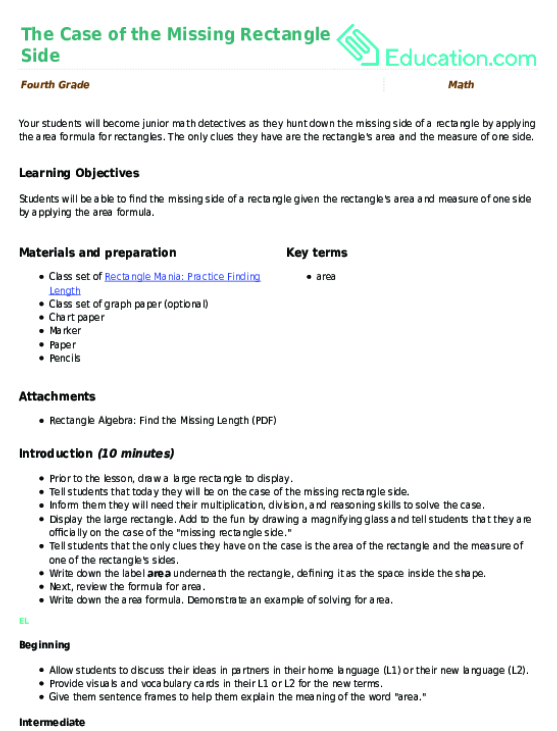
The Case of the Missing Rectangle Side
Lesson Plan
The Case of the Missing Rectangle Side
Fourth Grade
Your students will become junior math detectives as they hunt down the missing side of a rectangle by applying the area formula for rectangles. The only clues they have are the rectangle's area and the measure of one side.
Lesson Plan
The Case of the Missing Rectangle Side
Lesson Plan
The Case of the Missing Rectangle Side
Your students will become junior math detectives as they hunt down the missing side of a rectangle by applying the area formula for rectangles. The only clues they have are the rectangle's area and the measure of one side.
Fourth Grade
Lesson Plan
Researching the Past Using Primary Sources
Lesson Plan
Researching the Past Using Primary Sources
Fourth Grade
Reading
Knock, knock! It’s the U.S. Census Bureau! In this lesson plan, students analyze primary sources in the form of census data to do research that helps them answer questions about famous people and the time period during which they lived.
Lesson Plan
Researching the Past Using Primary Sources
Lesson Plan
Researching the Past Using Primary Sources
Knock, knock! It’s the U.S. Census Bureau! In this lesson plan, students analyze primary sources in the form of census data to do research that helps them answer questions about famous people and the time period during which they lived.
Fourth Grade
Reading
Lesson Plan
Subtracting Mixed Numbers Using the Decomposition Strategy
Lesson Plan
Subtracting Mixed Numbers Using the Decomposition Strategy
Fourth Grade
Teach your students to subtract mixed numbers with like denominators using the strategy of decomposition. This strategy helps students to manipulate and break down numbers to help them solve tricky subtraction problems.
Lesson Plan
Subtracting Mixed Numbers Using the Decomposition Strategy
Lesson Plan
Subtracting Mixed Numbers Using the Decomposition Strategy
Teach your students to subtract mixed numbers with like denominators using the strategy of decomposition. This strategy helps students to manipulate and break down numbers to help them solve tricky subtraction problems.
Fourth Grade
Lesson Plan
How Many Slices Are Left?
Lesson Plan
How Many Slices Are Left?
Pre-K
In this food-focused lesson plan, students will get to learn from real-world examples how to solve a subtraction problem. Perfect for all of your pizza lovers!
Lesson Plan
How Many Slices Are Left?
Lesson Plan
How Many Slices Are Left?
In this food-focused lesson plan, students will get to learn from real-world examples how to solve a subtraction problem. Perfect for all of your pizza lovers!
Pre-K
Lesson Plan
Introduction to Division with Remainders
Lesson Plan
Introduction to Division with Remainders
Fourth Grade
In this lesson, your students will use visual and hands-on strategies to divide whole numbers with remainders.
Lesson Plan
Introduction to Division with Remainders
Lesson Plan
Introduction to Division with Remainders
In this lesson, your students will use visual and hands-on strategies to divide whole numbers with remainders.
Fourth Grade
Lesson Plan
Decompose to Multiply: 6, 7, 8, and 9
Lesson Plan
Decompose to Multiply: 6, 7, 8, and 9
Third Grade
Teach your students to decompose factors as a strategy to find multiples of 6, 7, 8, and 9. This lesson supports flexible thinking and number sense.
Lesson Plan
Decompose to Multiply: 6, 7, 8, and 9
Lesson Plan
Decompose to Multiply: 6, 7, 8, and 9
Teach your students to decompose factors as a strategy to find multiples of 6, 7, 8, and 9. This lesson supports flexible thinking and number sense.
Third Grade
Lesson Plan
1
…
49
50
51
…
54