SKIP TO CONTENT
Worksheet Generator
Subjects
Grades
Worksheets
Games
Build a Worksheet
More Resources
Roly Recommends
Subjects
Grades
Worksheets
Games
Build a Worksheet
More Resources
Roly Recommends
Filters
Search for: /rest
✕
Subjects
Math
English Language Arts
Science
Social Studies
Foreign Language
Grade Level
Pre-K
K
1st
2nd
3rd
4th
5th
6th
7th
8th
Early Childhood
Elementary School
Middle School
Resource Type
Worksheets
Games
Lesson Plans
Interactive Worksheets
Activities
Stories
Songs
Offline Games
Teacher Resources
See more
Occasion
Birthdays
Women's History Month
St. Patrick's Day
Passover
Spring
Easter
Earth Day
Cinco de Mayo
Mother's Day
Memorial Day
Asian Pacific American Heritage Month
Summer
Father's Day
Independence Day
Back to School
Fall
Hispanic Heritage Month
Halloween
Veterans Day
Winter
Holidays
Thanksgiving
Christmas
Hanukkah
Kwanzaa
New Year
Martin Luther King Jr. Day
Lunar New Year
Valentine's Day
Presidents' Day
Black History Month
See more
Common Core
Yes
No
Roly Recommends
Social Emotional Learning
Game Type
Mazes
Dot to Dot
Ball Games
Crossword
Fitness & Exercise
Group Games
Memory Games
Outdoor Games
Puzzles & Sudoku
Travel Games
Word Puzzles
Word Search
See more
Arts & Crafts
Arts & Crafts
Fabric Projects
Beads & Jewelry
Paper & Glue Crafts
Construction & Sculpture
Painting & Drawing
Recycled Crafts
Coloring
Yes
Recipes
Snacks
Mains
Sides
English Language Support
Yes
See More
Clear All
View 2,266 results
Showing Results for /rest : Page 74
2,266 results
Search for: /rest
✕
Sort by:
Relevance
Most recent
Most popular
Alphabetical A-Z
Alphabetical Z-A
All filters
2,266 results
Sort by:
Relevance
Most recent
Most popular
Alphabetical A-Z
Alphabetical Z-A
Characters and Settings
Lesson Plan
Characters and Settings
Fourth Grade
In this lesson, your students will identify adjectives in noun phrases and understand how noun phrases are used to describe characters and settings in fictional texts. Use it as a stand-alone lesson or as support to Tell Me More.
Lesson Plan
Characters and Settings
Lesson Plan
Characters and Settings
In this lesson, your students will identify adjectives in noun phrases and understand how noun phrases are used to describe characters and settings in fictional texts. Use it as a stand-alone lesson or as support to Tell Me More.
Fourth Grade
Lesson Plan
Examining Author's Purpose in a Fictional Text
Lesson Plan
Examining Author's Purpose in a Fictional Text
Second Grade
Reading
Students will read a short fictional story and discuss why the author included certain details and words. Use this lesson to help your students navigate parts of fictional text to determine the author's purpose!
Lesson Plan
Examining Author's Purpose in a Fictional Text
Lesson Plan
Examining Author's Purpose in a Fictional Text
Students will read a short fictional story and discuss why the author included certain details and words. Use this lesson to help your students navigate parts of fictional text to determine the author's purpose!
Second Grade
Reading
Lesson Plan
Subtraction with Regrouping
Lesson Plan
Subtraction with Regrouping
Third Grade
Subtraction
Help your students subtract with confidence by sharing two different strategies. Use this lesson to build on students’ understanding of subtraction and to evaluate this key skill.
Lesson Plan
Subtraction with Regrouping
Lesson Plan
Subtraction with Regrouping
Help your students subtract with confidence by sharing two different strategies. Use this lesson to build on students’ understanding of subtraction and to evaluate this key skill.
Third Grade
Subtraction
Lesson Plan
Summarizing with Sequence Words
Lesson Plan
Summarizing with Sequence Words
Fourth Grade
This lesson helps students summarize fictional stories using sequence words. Students will have a chance to practice distinguishing the different parts of a story in this lesson, which can be taught as a precursor to Storyboard Superstars.
Lesson Plan
Summarizing with Sequence Words
Lesson Plan
Summarizing with Sequence Words
This lesson helps students summarize fictional stories using sequence words. Students will have a chance to practice distinguishing the different parts of a story in this lesson, which can be taught as a precursor to Storyboard Superstars.
Fourth Grade
Lesson Plan
Many Measurement Tools
Lesson Plan
Many Measurement Tools
Second Grade
Measurement
This support lesson provides students the opportunity to use two different tools to measure the length of familiar objects while introducing content specific vocabulary words. Use alone or alongside the lesson How Big is the Playground?
Lesson Plan
Many Measurement Tools
Lesson Plan
Many Measurement Tools
This support lesson provides students the opportunity to use two different tools to measure the length of familiar objects while introducing content specific vocabulary words. Use alone or alongside the lesson How Big is the Playground?
Second Grade
Measurement
Lesson Plan
Adding Cards
Lesson Plan
Adding Cards
Pre-K
Use a fun card game to practice adding numbers in this fun hands-on addition lesson!
Lesson Plan
Adding Cards
Lesson Plan
Adding Cards
Use a fun card game to practice adding numbers in this fun hands-on addition lesson!
Pre-K
Lesson Plan
Nonfiction Comprehension: Compare and Contrast
Lesson Plan
Nonfiction Comprehension: Compare and Contrast
Third Grade
Teach your students to compare and contrast to boost their comprehension! Use this lesson to teach your students to compare and contrast information from two nonfiction texts on the same topic.
Lesson Plan
Nonfiction Comprehension: Compare and Contrast
Lesson Plan
Nonfiction Comprehension: Compare and Contrast
Teach your students to compare and contrast to boost their comprehension! Use this lesson to teach your students to compare and contrast information from two nonfiction texts on the same topic.
Third Grade
Lesson Plan
Exploring Sequence with Signal Words
Lesson Plan
Exploring Sequence with Signal Words
Third Grade
Use this lesson to teach your students how to retell the beginning, middle, and end of a story using sequencing words and phrases. This lesson can stand alone or be used as a pre-lesson for the
Story Structure Rollercoaster
lesson.
Lesson Plan
Exploring Sequence with Signal Words
Lesson Plan
Exploring Sequence with Signal Words
Use this lesson to teach your students how to retell the beginning, middle, and end of a story using sequencing words and phrases. This lesson can stand alone or be used as a pre-lesson for the
Story Structure Rollercoaster
lesson.
Third Grade
Lesson Plan
Strategies to Make Multiplication a Breeze
Lesson Plan
Strategies to Make Multiplication a Breeze
Third Grade
Multiplication
With this lesson, your students will see how the order of the factors does not affect the product in a multiplication expression. Use this on its own or alongside
You're On a Roll! Practicing Multiplication Facts.
Lesson Plan
Strategies to Make Multiplication a Breeze
Lesson Plan
Strategies to Make Multiplication a Breeze
With this lesson, your students will see how the order of the factors does not affect the product in a multiplication expression. Use this on its own or alongside
You're On a Roll! Practicing Multiplication Facts.
Third Grade
Multiplication
Lesson Plan
Creating Cause and Effect Skits
Lesson Plan
Creating Cause and Effect Skits
Second Grade
Help your ELs look deeply at cause and effect at the sentence level. Using skits to reinforce comprehension, this lesson can be used as a support lesson for Learning About Cause and Effect! or a stand alone activity.
Lesson Plan
Creating Cause and Effect Skits
Lesson Plan
Creating Cause and Effect Skits
Help your ELs look deeply at cause and effect at the sentence level. Using skits to reinforce comprehension, this lesson can be used as a support lesson for Learning About Cause and Effect! or a stand alone activity.
Second Grade
Lesson Plan
What Was the Problem?
Lesson Plan
What Was the Problem?
Third Grade
Use this lesson to teach your students to use the correct past tense language when speaking about a story they have read. This lesson can stand alone or be used as a pre-lesson for the
Fiction Comprehension: Problem and Solution
lesson.
Lesson Plan
What Was the Problem?
Lesson Plan
What Was the Problem?
Use this lesson to teach your students to use the correct past tense language when speaking about a story they have read. This lesson can stand alone or be used as a pre-lesson for the
Fiction Comprehension: Problem and Solution
lesson.
Third Grade
Lesson Plan
Leafy Numbers
Lesson Plan
Leafy Numbers
Kindergarten
Numbers and Counting
In this leafy, plant-themed lesson, students will use leaves as they practice recognizing various numbers from 1 to 15. This lesson can be easily adapted for use with specific ranges of numbers.
Lesson Plan
Leafy Numbers
Lesson Plan
Leafy Numbers
In this leafy, plant-themed lesson, students will use leaves as they practice recognizing various numbers from 1 to 15. This lesson can be easily adapted for use with specific ranges of numbers.
Kindergarten
Numbers and Counting
Lesson Plan
Adding Within 20
Lesson Plan
Adding Within 20
Second Grade
This scaffolded EL lesson will help your students fluently add within 20, while reinforcing parts of a whole. Use as a pre-lesson for Addition: Over in a Flash, or as a stand alone activity.
Lesson Plan
Adding Within 20
Lesson Plan
Adding Within 20
This scaffolded EL lesson will help your students fluently add within 20, while reinforcing parts of a whole. Use as a pre-lesson for Addition: Over in a Flash, or as a stand alone activity.
Second Grade
Lesson Plan
Area Arrangements
Lesson Plan
Area Arrangements
Fourth Grade
Geometry
Students will use the inverse relationship between multiplication and division to complete an area formula in a real-world situation. Use this lesson on its own or as support for the lesson The Case of the Missing Rectangle Side.
Lesson Plan
Area Arrangements
Lesson Plan
Area Arrangements
Students will use the inverse relationship between multiplication and division to complete an area formula in a real-world situation. Use this lesson on its own or as support for the lesson The Case of the Missing Rectangle Side.
Fourth Grade
Geometry
Lesson Plan
Modeling Fraction Subtraction
Lesson Plan
Modeling Fraction Subtraction
Fifth Grade
Fractions
Encourage student explanations and visual representation of fraction subtraction in this interactive lesson. Use this lesson on its own or as support to the lesson Modeling Mixed Number Subtraction.
Lesson Plan
Modeling Fraction Subtraction
Lesson Plan
Modeling Fraction Subtraction
Encourage student explanations and visual representation of fraction subtraction in this interactive lesson. Use this lesson on its own or as support to the lesson Modeling Mixed Number Subtraction.
Fifth Grade
Fractions
Lesson Plan
What's So Different? Comparing Characters
Lesson Plan
What's So Different? Comparing Characters
Fourth Grade
Using your acting skills and a great book by Chris Van Allsburg, you will lead your students on an adventure to compare characters and events throughout a book.
Lesson Plan
What's So Different? Comparing Characters
Lesson Plan
What's So Different? Comparing Characters
Using your acting skills and a great book by Chris Van Allsburg, you will lead your students on an adventure to compare characters and events throughout a book.
Fourth Grade
Lesson Plan
Subtracting Numbers
Lesson Plan
Subtracting Numbers
Pre-K
In this fun hands-on lesson plan, your students will get to practice identifying numbers to 10 while learning all about subtraction!
Lesson Plan
Subtracting Numbers
Lesson Plan
Subtracting Numbers
In this fun hands-on lesson plan, your students will get to practice identifying numbers to 10 while learning all about subtraction!
Pre-K
Lesson Plan
“Oh, My Word!” with Amelia Bedelia
Lesson Plan
“Oh, My Word!” with Amelia Bedelia
Second Grade
Let Amelia Bedelia introduce figurative language in this fun and interactive lesson that includes a game, group work and a chance for students to shine as idiom authors!
Lesson Plan
“Oh, My Word!” with Amelia Bedelia
Lesson Plan
“Oh, My Word!” with Amelia Bedelia
Let Amelia Bedelia introduce figurative language in this fun and interactive lesson that includes a game, group work and a chance for students to shine as idiom authors!
Second Grade
Lesson Plan
Thoughts as Bubbles
Lesson Plan
Thoughts as Bubbles
Kindergarten
In this lesson, students will hear the story
Mind Bubbles
, practice mindful breathing (anchor breathing), and use bubbles to draw pictures of their thoughts from the mindfulness practice session.
Lesson Plan
Thoughts as Bubbles
Lesson Plan
Thoughts as Bubbles
In this lesson, students will hear the story
Mind Bubbles
, practice mindful breathing (anchor breathing), and use bubbles to draw pictures of their thoughts from the mindfulness practice session.
Kindergarten
Lesson Plan
Musical Chairs with Complex Sentences
Lesson Plan
Musical Chairs with Complex Sentences
Fifth Grade
Grammar and Mechanics
In this great grammar lesson, students will learn to identify the independent and dependent clause in a complex sentence. Then, they will play a game of grammar-themed musical chairs!
Lesson Plan
Musical Chairs with Complex Sentences
Lesson Plan
Musical Chairs with Complex Sentences
In this great grammar lesson, students will learn to identify the independent and dependent clause in a complex sentence. Then, they will play a game of grammar-themed musical chairs!
Fifth Grade
Grammar and Mechanics
Lesson Plan
Tree of Cranes
Lesson Plan
Tree of Cranes
Second Grade
Reading
This winter-themed lesson plan, which incorporates the book
Tree of Cranes
by Allen Say, teaches students about Japanese traditions and customs. They will review the basic elements of a narrative story, and then write their own narratives about a special event or moment in their life.
Lesson Plan
Tree of Cranes
Lesson Plan
Tree of Cranes
This winter-themed lesson plan, which incorporates the book
Tree of Cranes
by Allen Say, teaches students about Japanese traditions and customs. They will review the basic elements of a narrative story, and then write their own narratives about a special event or moment in their life.
Second Grade
Reading
Lesson Plan
Using the Partial Quotients Strategy for Division with One-Digit Divisors
Lesson Plan
Using the Partial Quotients Strategy for Division with One-Digit Divisors
Fourth Grade
It’s time to learn a new strategy! Teach your students to use the partial quotients strategy to solve long division problems with one-digit divisors and no remainder.
Lesson Plan
Using the Partial Quotients Strategy for Division with One-Digit Divisors
Lesson Plan
Using the Partial Quotients Strategy for Division with One-Digit Divisors
It’s time to learn a new strategy! Teach your students to use the partial quotients strategy to solve long division problems with one-digit divisors and no remainder.
Fourth Grade
Lesson Plan
Equal Shares
Lesson Plan
Equal Shares
Second Grade
Fractions
Provide students with an opportunity to identify the wholes that are correctly divided into halves, thirds, and fourths (equal shares). Use this activity alone as a support lesson or alongside Cookie Fractions Fun.
Lesson Plan
Equal Shares
Lesson Plan
Equal Shares
Provide students with an opportunity to identify the wholes that are correctly divided into halves, thirds, and fourths (equal shares). Use this activity alone as a support lesson or alongside Cookie Fractions Fun.
Second Grade
Fractions
Lesson Plan
Explore the Associative Property of Multiplication
Lesson Plan
Explore the Associative Property of Multiplication
Third Grade
Use this lesson with your students to allow them to explore the associative property of multiplication by having deep discussions in small groups. Use this as a stand alone lesson or alongside
Associative Property of Multiplication
.
Lesson Plan
Explore the Associative Property of Multiplication
Lesson Plan
Explore the Associative Property of Multiplication
Use this lesson with your students to allow them to explore the associative property of multiplication by having deep discussions in small groups. Use this as a stand alone lesson or alongside
Associative Property of Multiplication
.
Third Grade
Lesson Plan
Main Idea and Supporting Details
Lesson Plan
Main Idea and Supporting Details
Fifth Grade
Writing
Help your ELs learn how to identify the main idea and supporting details in a nonfiction text by using nouns and pronouns as guide words. It can be a stand-alone lesson or used as support to the lesson Explorer Letters.
Lesson Plan
Main Idea and Supporting Details
Lesson Plan
Main Idea and Supporting Details
Help your ELs learn how to identify the main idea and supporting details in a nonfiction text by using nouns and pronouns as guide words. It can be a stand-alone lesson or used as support to the lesson Explorer Letters.
Fifth Grade
Writing
Lesson Plan
What's in a Text Feature?
Lesson Plan
What's in a Text Feature?
First Grade
Ever wondered how to explain what an index is to a 6 year old? Look no further! Use this engaging lesson to help your students become text feature experts.
Lesson Plan
What's in a Text Feature?
Lesson Plan
What's in a Text Feature?
Ever wondered how to explain what an index is to a 6 year old? Look no further! Use this engaging lesson to help your students become text feature experts.
First Grade
Lesson Plan
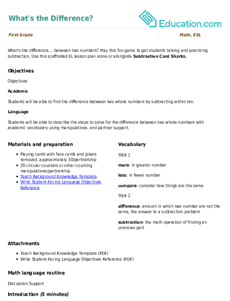
What's the Difference?
Lesson Plan
What's the Difference?
First Grade
Subtraction
What's the difference.... between two numbers? Play this fun game to get students talking and practicing subtraction. Use this scaffolded EL lesson plan alone or alongside
Subtraction Card Sharks.
Lesson Plan
What's the Difference?
Lesson Plan
What's the Difference?
What's the difference.... between two numbers? Play this fun game to get students talking and practicing subtraction. Use this scaffolded EL lesson plan alone or alongside
Subtraction Card Sharks.
First Grade
Subtraction
Lesson Plan
Strategies for Multiplying by Multiples of 10
Lesson Plan
Strategies for Multiplying by Multiples of 10
Third Grade
Help your students become detail-oriented mathematicians as they explore two strategies for multiplying a one-digit number by a multiple of 10. Use this as a stand alone lesson or alongside
Multiplying by Multiples of 10.
Lesson Plan
Strategies for Multiplying by Multiples of 10
Lesson Plan
Strategies for Multiplying by Multiples of 10
Help your students become detail-oriented mathematicians as they explore two strategies for multiplying a one-digit number by a multiple of 10. Use this as a stand alone lesson or alongside
Multiplying by Multiples of 10.
Third Grade
Lesson Plan
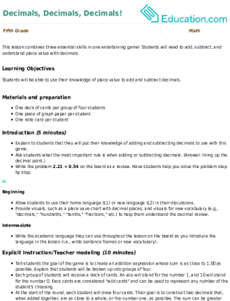
Decimals, Decimals, Decimals!
Lesson Plan
Decimals, Decimals, Decimals!
Fifth Grade
This lesson combines three essential skills in one entertaining game! Students will need to add, subtract, and understand place value with decimals.
Lesson Plan
Decimals, Decimals, Decimals!
Lesson Plan
Decimals, Decimals, Decimals!
This lesson combines three essential skills in one entertaining game! Students will need to add, subtract, and understand place value with decimals.
Fifth Grade
Lesson Plan
Multiplication and Division: What's the Connection?
Lesson Plan
Multiplication and Division: What's the Connection?
Fourth Grade
Numbers are connected in many ways! Take students on a journey to uncover multiplication and division fact families and inverse relationships. Teach this lesson on its own or prior to the lesson Division and Multiplication Relationship.
Lesson Plan
Multiplication and Division: What's the Connection?
Lesson Plan
Multiplication and Division: What's the Connection?
Numbers are connected in many ways! Take students on a journey to uncover multiplication and division fact families and inverse relationships. Teach this lesson on its own or prior to the lesson Division and Multiplication Relationship.
Fourth Grade
Lesson Plan
1
…
73
74
75
76