SKIP TO CONTENT
Worksheet Generator
Subjects
Grades
Worksheets
Games
Build a Worksheet
More Resources
Roly Recommends
Subjects
Grades
Worksheets
Games
Build a Worksheet
More Resources
Roly Recommends
All Subjects
English Language Arts
Reading
Subtopics:
Reading Comprehension
Reading Passages
Show Less
Filters
Search for: identify...
✕
English Language Arts
✕
1st - 4th Grade
✕
Lesson Plans
✕
Subjects
Math
English Language Arts
Science
Social Studies
Grade Level
Pre-K
K
1st
2nd
3rd
4th
5th
6th
7th
8th
Early Childhood
Elementary School
Middle School
Resource Type
Worksheets
Games
Lesson Plans
Interactive Worksheets
Workbooks
Activities
Stories
Common Core
Yes
English Language Support
Yes
See More
Clear All
View 57 results
Showing Results for identify...
57 results
Search for: identify...
✕
English Language Arts
✕
1st - 4th Grade
✕
Lesson Plans
✕
Clear All
Sort by:
Relevance
Most recent
Most popular
Alphabetical A-Z
Alphabetical Z-A
All filters
57 results
Sort by:
Relevance
Most recent
Most popular
Alphabetical A-Z
Alphabetical Z-A
Fairy Tales: Identifying Story Elements
Lesson Plan
Fairy Tales: Identifying Story Elements
Second Grade
Reading
Story elements help to bring beloved fairy tales to life in this literacy lesson. Your students will learn to identify the title, author, setting, characters, problem, and solution in a fiction text.
Lesson Plan
Fairy Tales: Identifying Story Elements
Lesson Plan
Fairy Tales: Identifying Story Elements
Story elements help to bring beloved fairy tales to life in this literacy lesson. Your students will learn to identify the title, author, setting, characters, problem, and solution in a fiction text.
Second Grade
Reading
Lesson Plan
Examining Author's Purpose in a Nonfiction Text
Lesson Plan
Examining Author's Purpose in a Nonfiction Text
Second Grade
Reading
This lesson will help students identify the author's point of view and purpose for writing an informational text.
Lesson Plan
Examining Author's Purpose in a Nonfiction Text
Lesson Plan
Examining Author's Purpose in a Nonfiction Text
This lesson will help students identify the author's point of view and purpose for writing an informational text.
Second Grade
Reading
Lesson Plan
Analyzing Archetypes in Fairy Tales
Lesson Plan
Analyzing Archetypes in Fairy Tales
Second Grade
Reading
Engage students in analysis by examining archetypes in fairy tales. Teach students to identify heroes and villains in fairy tales, examine patterns, and create their own fairy tales to express their knowledge of archetypes.
Lesson Plan
Analyzing Archetypes in Fairy Tales
Lesson Plan
Analyzing Archetypes in Fairy Tales
Engage students in analysis by examining archetypes in fairy tales. Teach students to identify heroes and villains in fairy tales, examine patterns, and create their own fairy tales to express their knowledge of archetypes.
Second Grade
Reading
Lesson Plan
Elements of Fairy Tales
Lesson Plan
Elements of Fairy Tales
Second Grade
Reading
Use this lesson to help students identify the elements of a fictional text while gaining more knowledge about parts of speech. Use as a stand alone activity or a support lesson for Fairy Tales: Identifying Story Elements.
Lesson Plan
Elements of Fairy Tales
Lesson Plan
Elements of Fairy Tales
Use this lesson to help students identify the elements of a fictional text while gaining more knowledge about parts of speech. Use as a stand alone activity or a support lesson for Fairy Tales: Identifying Story Elements.
Second Grade
Reading
Lesson Plan
Nonfiction Main Idea
Lesson Plan
Nonfiction Main Idea
Fourth Grade
Reading
Let's get reading! In this lesson, students will identify the main idea and details of a nonfiction text. Use this on its own or as support for the lesson Connecting the Coasts: Effects of the Transcontinental Railroad.
Lesson Plan
Nonfiction Main Idea
Lesson Plan
Nonfiction Main Idea
Let's get reading! In this lesson, students will identify the main idea and details of a nonfiction text. Use this on its own or as support for the lesson Connecting the Coasts: Effects of the Transcontinental Railroad.
Fourth Grade
Reading
Lesson Plan
Myths and Man
Lesson Plan
Myths and Man
Fourth Grade
Reading
Popular fiction throughout the ages colors the way people speak. In this short lesson, students will read a myth and non-fiction paragraph in order to identify and define words that come from mythology.
Lesson Plan
Myths and Man
Lesson Plan
Myths and Man
Popular fiction throughout the ages colors the way people speak. In this short lesson, students will read a myth and non-fiction paragraph in order to identify and define words that come from mythology.
Fourth Grade
Reading
Lesson Plan
Traditional Literature: Story Mapping
Lesson Plan
Traditional Literature: Story Mapping
Second Grade
Reading
Students will learn how to identify story elements and create a short and sweet summary. They will fill out a graphic organizer and solidify their understanding by creating illustrations to show major plot points that they find themselves!
Lesson Plan
Traditional Literature: Story Mapping
Lesson Plan
Traditional Literature: Story Mapping
Students will learn how to identify story elements and create a short and sweet summary. They will fill out a graphic organizer and solidify their understanding by creating illustrations to show major plot points that they find themselves!
Second Grade
Reading
Lesson Plan
Main Idea and Details in Nonfiction
Lesson Plan
Main Idea and Details in Nonfiction
Fourth Grade
Reading
In this lesson, students will identify nouns and pronouns as they distinguish between the main idea and supporting details. It may be taught on its own or used as support for the lesson Compare and Contrast Texts on the Same Topic.
Lesson Plan
Main Idea and Details in Nonfiction
Lesson Plan
Main Idea and Details in Nonfiction
In this lesson, students will identify nouns and pronouns as they distinguish between the main idea and supporting details. It may be taught on its own or used as support for the lesson Compare and Contrast Texts on the Same Topic.
Fourth Grade
Reading
Lesson Plan
Pick Out the Parts of a Story
Lesson Plan
Pick Out the Parts of a Story
Third Grade
Reading
Use this lesson to teach your students to identify story elements and compare them to another text's story elements. This lesson can stand alone or be used as a pre-lesson for the
Comparing Texts by the Same Author
lesson.
Lesson Plan
Pick Out the Parts of a Story
Lesson Plan
Pick Out the Parts of a Story
Use this lesson to teach your students to identify story elements and compare them to another text's story elements. This lesson can stand alone or be used as a pre-lesson for the
Comparing Texts by the Same Author
lesson.
Third Grade
Reading
Lesson Plan
Choosing Character Traits
Lesson Plan
Choosing Character Traits
Third Grade
Reading
Use this lesson to help your ELs learn character traits and find them in a text. It can be a stand-alone lesson or a support lesson to the Identifying Character Traits lesson.
Lesson Plan
Choosing Character Traits
Lesson Plan
Choosing Character Traits
Use this lesson to help your ELs learn character traits and find them in a text. It can be a stand-alone lesson or a support lesson to the Identifying Character Traits lesson.
Third Grade
Reading
Lesson Plan
Shifting Points of View
Lesson Plan
Shifting Points of View
Fourth Grade
Reading
This lesson gives students practice identifying first person and third person narration in fiction and nonfiction texts. It could be taught as a stand-alone lesson or as a precursor to the lesson Fiction vs. Nonfiction.
Lesson Plan
Shifting Points of View
Lesson Plan
Shifting Points of View
This lesson gives students practice identifying first person and third person narration in fiction and nonfiction texts. It could be taught as a stand-alone lesson or as a precursor to the lesson Fiction vs. Nonfiction.
Fourth Grade
Reading
Lesson Plan
Connecting the Coasts: Effects of the Transcontinental Railroad
Lesson Plan
Connecting the Coasts: Effects of the Transcontinental Railroad
Fourth Grade
Reading
Look at history! In this lesson, guide students through an exploration of the context, causes, and effects of the Transcontinental Railroad, and help them practice identifying the main idea and supporting details in a nonfiction text.
Lesson Plan
Connecting the Coasts: Effects of the Transcontinental Railroad
Lesson Plan
Connecting the Coasts: Effects of the Transcontinental Railroad
Look at history! In this lesson, guide students through an exploration of the context, causes, and effects of the Transcontinental Railroad, and help them practice identifying the main idea and supporting details in a nonfiction text.
Fourth Grade
Reading
Lesson Plan
Understand Text Features
Lesson Plan
Understand Text Features
Fourth Grade
Reading
Let's practice reading nonfiction texts! In this lesson, teach your ELs about identifying and describing text features. This lesson can be taught on its own or used as support for the lesson Formatting Text Features.
Lesson Plan
Understand Text Features
Lesson Plan
Understand Text Features
Let's practice reading nonfiction texts! In this lesson, teach your ELs about identifying and describing text features. This lesson can be taught on its own or used as support for the lesson Formatting Text Features.
Fourth Grade
Reading
Lesson Plan
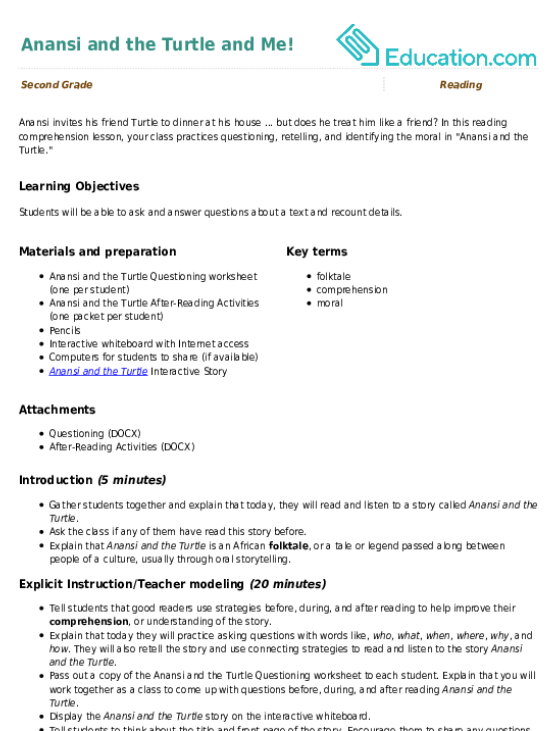
Anansi and the Turtle and Me!
Lesson Plan
Anansi and the Turtle and Me!
Second Grade
Reading
Anansi invites his friend Turtle to dinner at his house ... but does he treat him like a friend? In this reading comprehension lesson, your class practices questioning, retelling, and identifying the moral in "Anansi and the Turtle."
Lesson Plan
Anansi and the Turtle and Me!
Lesson Plan
Anansi and the Turtle and Me!
Anansi invites his friend Turtle to dinner at his house ... but does he treat him like a friend? In this reading comprehension lesson, your class practices questioning, retelling, and identifying the moral in "Anansi and the Turtle."
Second Grade
Reading
Lesson Plan
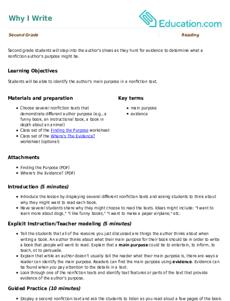
Why I Write
Lesson Plan
Why I Write
Second Grade
Reading
Second grade students will step into the author’s shoes as they hunt for evidence to determine what a nonfiction author’s purpose might be.
Lesson Plan
Why I Write
Lesson Plan
Why I Write
Second grade students will step into the author’s shoes as they hunt for evidence to determine what a nonfiction author’s purpose might be.
Second Grade
Reading
Lesson Plan
Putting it Together to Find the Main Idea
Lesson Plan
Putting it Together to Find the Main Idea
First Grade
Reading
Get students curious about reading with these activities designed to support comprehension. This lesson plan can be used alone or with the Main Ideas and Details lesson plan.
Lesson Plan
Putting it Together to Find the Main Idea
Lesson Plan
Putting it Together to Find the Main Idea
Get students curious about reading with these activities designed to support comprehension. This lesson plan can be used alone or with the Main Ideas and Details lesson plan.
First Grade
Reading
Lesson Plan
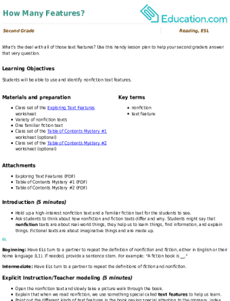
How Many Features?
Lesson Plan
How Many Features?
Second Grade
Reading
What’s the deal with all of those text features? Use this handy lesson plan to help your second graders answer that very question.
Lesson Plan
How Many Features?
Lesson Plan
How Many Features?
What’s the deal with all of those text features? Use this handy lesson plan to help your second graders answer that very question.
Second Grade
Reading
Lesson Plan
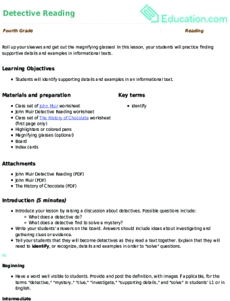
Detective Reading
Lesson Plan
Detective Reading
Fourth Grade
Reading
Roll up your sleeves and get out the magnifying glasses! In this lesson, your students will practice finding supportive details and examples in informational texts.
Lesson Plan
Detective Reading
Lesson Plan
Detective Reading
Roll up your sleeves and get out the magnifying glasses! In this lesson, your students will practice finding supportive details and examples in informational texts.
Fourth Grade
Reading
Lesson Plan
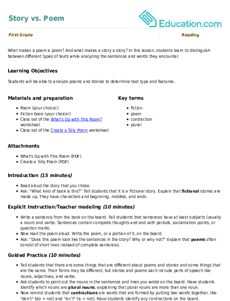
Story vs. Poem
Lesson Plan
Story vs. Poem
First Grade
Reading
What makes a poem a poem? And what makes a story a story? In this lesson, students learn to distinguish between different types of texts while analyzing the sentences and words they encounter.
Lesson Plan
Story vs. Poem
Lesson Plan
Story vs. Poem
What makes a poem a poem? And what makes a story a story? In this lesson, students learn to distinguish between different types of texts while analyzing the sentences and words they encounter.
First Grade
Reading
Lesson Plan
The Recipe for a Perfect Story
Lesson Plan
The Recipe for a Perfect Story
Second Grade
Reading
In this lesson, your students will learn all about the perfect recipe for a story! Your students will practice their knowledge by rolling a story element die and sharing with the class.
Lesson Plan
The Recipe for a Perfect Story
Lesson Plan
The Recipe for a Perfect Story
In this lesson, your students will learn all about the perfect recipe for a story! Your students will practice their knowledge by rolling a story element die and sharing with the class.
Second Grade
Reading
Lesson Plan
Main Ideas and Details
Lesson Plan
Main Ideas and Details
First Grade
Reading
Take your students to a magical place by having them read stories such as "The Ugly Duckling" and "Rumpelstiltskin." They can read these magical stories and figure out the main idea and details in them!
Lesson Plan
Main Ideas and Details
Lesson Plan
Main Ideas and Details
Take your students to a magical place by having them read stories such as "The Ugly Duckling" and "Rumpelstiltskin." They can read these magical stories and figure out the main idea and details in them!
First Grade
Reading
Lesson Plan
Elements of Poetry
Lesson Plan
Elements of Poetry
Fourth Grade
Reading
Introduce your students to some of the major structural elements of poetry in this comprehensive lesson.
Lesson Plan
Elements of Poetry
Lesson Plan
Elements of Poetry
Introduce your students to some of the major structural elements of poetry in this comprehensive lesson.
Fourth Grade
Reading
Lesson Plan
Finding the Key Details
Lesson Plan
Finding the Key Details
First Grade
Reading
Introduce students to fictional story elements with a book by first grade favorite, Mo Willems! This lesson plan can be used alone or with the Goldilocks and the Three Bears: Key Details lesson plan.
Lesson Plan
Finding the Key Details
Lesson Plan
Finding the Key Details
Introduce students to fictional story elements with a book by first grade favorite, Mo Willems! This lesson plan can be used alone or with the Goldilocks and the Three Bears: Key Details lesson plan.
First Grade
Reading
Lesson Plan
State Memories
Lesson Plan
State Memories
Fourth Grade
Reading
In this lesson, your students will practice writing about places important to them through poetry. By the time they are done, students will have become better writers and taken a walk down memory lane!
Lesson Plan
State Memories
Lesson Plan
State Memories
In this lesson, your students will practice writing about places important to them through poetry. By the time they are done, students will have become better writers and taken a walk down memory lane!
Fourth Grade
Reading
Lesson Plan
Going on a Nonfiction Picture Walk
Lesson Plan
Going on a Nonfiction Picture Walk
First Grade
Reading
ELs will gain valuable practice learning about text features as they practice close reading and communication skills during a nonfiction picture walk. Use on its own or as a support for the Classifying Nonfiction Text Features lesson plan.
Lesson Plan
Going on a Nonfiction Picture Walk
Lesson Plan
Going on a Nonfiction Picture Walk
ELs will gain valuable practice learning about text features as they practice close reading and communication skills during a nonfiction picture walk. Use on its own or as a support for the Classifying Nonfiction Text Features lesson plan.
First Grade
Reading
Lesson Plan
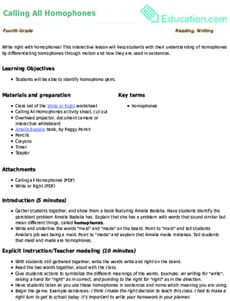
Calling All Homophones
Lesson Plan
Calling All Homophones
Fourth Grade
Reading
Write right with homophones! This interactive lesson will help students with their understanding of homophones by differentiating homophones through motion and how they are used in sentences.
Lesson Plan
Calling All Homophones
Lesson Plan
Calling All Homophones
Write right with homophones! This interactive lesson will help students with their understanding of homophones by differentiating homophones through motion and how they are used in sentences.
Fourth Grade
Reading
Lesson Plan
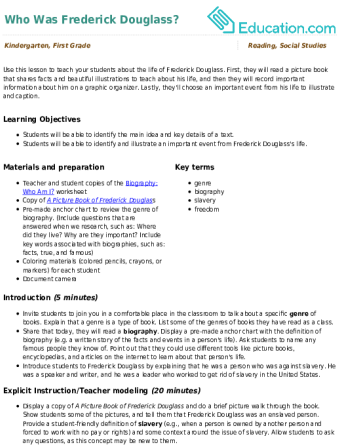
Who Was Frederick Douglass?
Lesson Plan
Who Was Frederick Douglass?
Kindergarten
Reading
Use this lesson to teach your students about the life of Frederick Douglass. First, they will read a picture book that shares facts and beautiful illustrations to teach about his life, and then they will record important information about him on a graphic organizer. Lastly, they'll choose an important event from his life to illustrate and caption.
Lesson Plan
Who Was Frederick Douglass?
Lesson Plan
Who Was Frederick Douglass?
Use this lesson to teach your students about the life of Frederick Douglass. First, they will read a picture book that shares facts and beautiful illustrations to teach about his life, and then they will record important information about him on a graphic organizer. Lastly, they'll choose an important event from his life to illustrate and caption.
Kindergarten
Reading
Lesson Plan
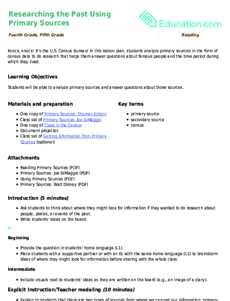
Researching the Past Using Primary Sources
Lesson Plan
Researching the Past Using Primary Sources
Fourth Grade
Reading
Knock, knock! It’s the U.S. Census Bureau! In this lesson plan, students analyze primary sources in the form of census data to do research that helps them answer questions about famous people and the time period during which they lived.
Lesson Plan
Researching the Past Using Primary Sources
Lesson Plan
Researching the Past Using Primary Sources
Knock, knock! It’s the U.S. Census Bureau! In this lesson plan, students analyze primary sources in the form of census data to do research that helps them answer questions about famous people and the time period during which they lived.
Fourth Grade
Reading
Lesson Plan
Parts of Speech: Breaking Down Sentences
Lesson Plan
Parts of Speech: Breaking Down Sentences
Third Grade
Reading
Let your students find out that the sentences they speak so easily are formed of many different parts. Have them break down sentences to learn the various parts that form a sentence!
Lesson Plan
Parts of Speech: Breaking Down Sentences
Lesson Plan
Parts of Speech: Breaking Down Sentences
Let your students find out that the sentences they speak so easily are formed of many different parts. Have them break down sentences to learn the various parts that form a sentence!
Third Grade
Reading
Lesson Plan
Text Features: Reading that Makes Sense
Lesson Plan
Text Features: Reading that Makes Sense
Third Grade
Reading
Improve your students' comprehension of non-fictional reading through this lesson that teaches them about text features. Students will find their own text features and explain why they aid in the reading process.
Lesson Plan
Text Features: Reading that Makes Sense
Lesson Plan
Text Features: Reading that Makes Sense
Improve your students' comprehension of non-fictional reading through this lesson that teaches them about text features. Students will find their own text features and explain why they aid in the reading process.
Third Grade
Reading
Lesson Plan
1
2