SKIP TO CONTENT
Worksheet Generator
Subjects
Grades
Worksheets
Games
Build a Worksheet
More Resources
Roly Recommends
Subjects
Grades
Worksheets
Games
Build a Worksheet
More Resources
Roly Recommends
Filters
Search for: template
✕
Lesson Plans
✕
2nd Grade
✕
Common Core
✕
Subjects
Math
English Language Arts
Science
Grade Level
Pre-K
K
1st
2nd
3rd
4th
5th
6th
7th
8th
Early Childhood
Elementary School
Middle School
Resource Type
Worksheets
Lesson Plans
Interactive Worksheets
Teacher Resources
Common Core
Yes
Roly Recommends
Social Emotional Learning
English Language Support
Yes
See More
Clear All
View 87 results
Showing Results for template
87 results
Search for: template
✕
Lesson Plans
✕
2nd Grade
✕
Common Core
✕
Clear All
Sort by:
Relevance
Most recent
Most popular
Alphabetical A-Z
Alphabetical Z-A
All filters
87 results
Sort by:
Relevance
Most recent
Most popular
Alphabetical A-Z
Alphabetical Z-A
Fish Bowl Word Families
Lesson Plan
Fish Bowl Word Families
First Grade
With some help from Goodnight Moon by Margaret Wise Brown and fish-themed templates, students will be able to learn about rhyming while having fun making pretend fishbowls.
Lesson Plan
Fish Bowl Word Families
Lesson Plan
Fish Bowl Word Families
With some help from Goodnight Moon by Margaret Wise Brown and fish-themed templates, students will be able to learn about rhyming while having fun making pretend fishbowls.
First Grade
Lesson Plan
Dear Student...Love, Your Pencil
Lesson Plan
Dear Student...Love, Your Pencil
Second Grade
This fun lesson plan will inspire your budding letter writers to write a hilarious letter from the perspective of classroom supplies!
Lesson Plan
Dear Student...Love, Your Pencil
Lesson Plan
Dear Student...Love, Your Pencil
This fun lesson plan will inspire your budding letter writers to write a hilarious letter from the perspective of classroom supplies!
Second Grade
Lesson Plan
EL
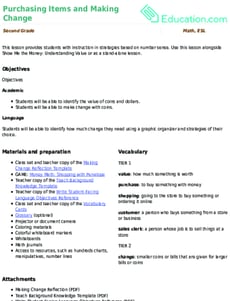
Purchasing Items and Making Change
Lesson Plan
Purchasing Items and Making Change
Second Grade
Time and Money
This lesson provides students with instruction in strategies based on number sense. Use this lesson alongside Show Me the Money: Understanding Value or as a stand-alone lesson.
Lesson Plan
EL
Purchasing Items and Making Change
Lesson Plan
Purchasing Items and Making Change
This lesson provides students with instruction in strategies based on number sense. Use this lesson alongside Show Me the Money: Understanding Value or as a stand-alone lesson.
Second Grade
Time and Money
Lesson Plan
Can You Find the -er, -ir, -ur Sound?
Lesson Plan
Can You Find the -er, -ir, -ur Sound?
Second Grade
Poetry? Scavenger hunts? Use this lesson to teach your students about the R-controlled vowels that say “er” using both! Your students will be reading those pesky er/ir/ur words in no time!
Lesson Plan
Can You Find the -er, -ir, -ur Sound?
Lesson Plan
Can You Find the -er, -ir, -ur Sound?
Poetry? Scavenger hunts? Use this lesson to teach your students about the R-controlled vowels that say “er” using both! Your students will be reading those pesky er/ir/ur words in no time!
Second Grade
Lesson Plan
Show Me the Money: Understanding Value
Lesson Plan
Show Me the Money: Understanding Value
Second Grade
Time and Money
In this lesson, your students will learn how to buy items and use money to purchase items in the real world. You will set up a store for the students to learn about money.
Lesson Plan
Show Me the Money: Understanding Value
Lesson Plan
Show Me the Money: Understanding Value
In this lesson, your students will learn how to buy items and use money to purchase items in the real world. You will set up a store for the students to learn about money.
Second Grade
Time and Money
Lesson Plan
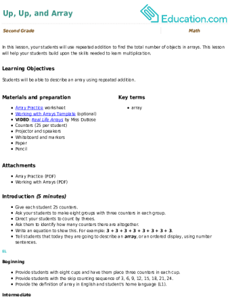
Up, Up, and Array
Lesson Plan
Up, Up, and Array
Second Grade
In this lesson, your students will use repeated addition to find the total number of objects in arrays. This lesson will help your students build upon the skills needed to learn multiplication.
Lesson Plan
Up, Up, and Array
Lesson Plan
Up, Up, and Array
In this lesson, your students will use repeated addition to find the total number of objects in arrays. This lesson will help your students build upon the skills needed to learn multiplication.
Second Grade
Lesson Plan
EL
The Key Elements of Fictional Text
Lesson Plan
The Key Elements of Fictional Text
Second Grade
Vocabulary
This lesson will provide your ELs with support as they learn about the key elements of fictional text, including characters, setting, and plot. Use as a stand alone activity or a support lesson.
Lesson Plan
EL
The Key Elements of Fictional Text
Lesson Plan
The Key Elements of Fictional Text
This lesson will provide your ELs with support as they learn about the key elements of fictional text, including characters, setting, and plot. Use as a stand alone activity or a support lesson.
Second Grade
Vocabulary
Lesson Plan
EL
I Pledge Allegiance
Lesson Plan
I Pledge Allegiance
Second Grade
Give your students an introduction to the trickiest vocabulary in the Pledge of Allegiance with this lesson. This can be a stand-alone lesson or a support lesson to be used prior to the All About the Pledge of Allegiance lesson plan.
Lesson Plan
EL
I Pledge Allegiance
Lesson Plan
I Pledge Allegiance
Give your students an introduction to the trickiest vocabulary in the Pledge of Allegiance with this lesson. This can be a stand-alone lesson or a support lesson to be used prior to the All About the Pledge of Allegiance lesson plan.
Second Grade
Lesson Plan
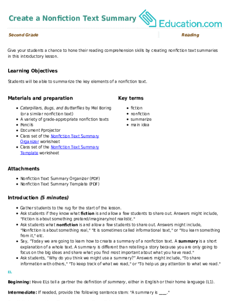
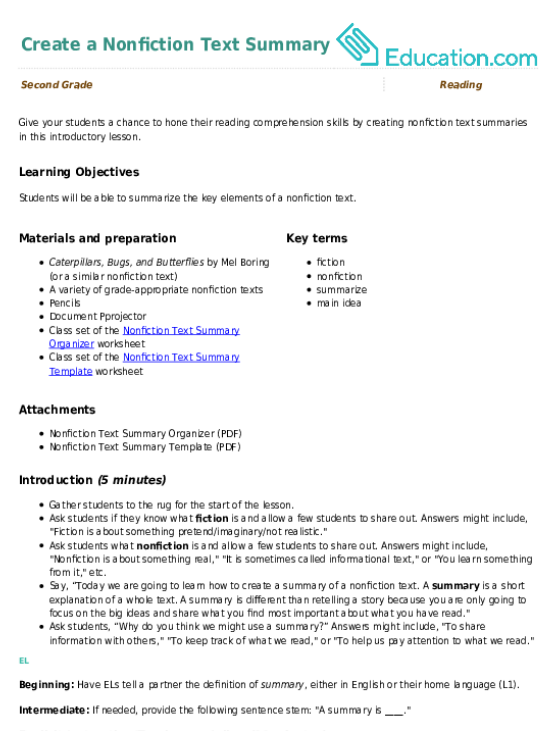
Create a Nonfiction Text Summary
Lesson Plan
Create a Nonfiction Text Summary
Second Grade
Writing
Give your students a chance to hone their reading comprehension skills by creating nonfiction text summaries in this introductory lesson.
Lesson Plan
Create a Nonfiction Text Summary
Lesson Plan
Create a Nonfiction Text Summary
Give your students a chance to hone their reading comprehension skills by creating nonfiction text summaries in this introductory lesson.
Second Grade
Writing
Lesson Plan
EL
Main Topic
Lesson Plan
Main Topic
First Grade
It's time to dig into some nonfiction books! In this lesson, students will practice identifying the main topic of nonfiction texts. This lesson can be used alone or with the How to Find the Main Idea lesson plan.
Lesson Plan
EL
Main Topic
Lesson Plan
Main Topic
It's time to dig into some nonfiction books! In this lesson, students will practice identifying the main topic of nonfiction texts. This lesson can be used alone or with the How to Find the Main Idea lesson plan.
First Grade
Lesson Plan
EL
Inference Making
Lesson Plan
Inference Making
Second Grade
Writing
Use this lesson to help your ELs understand inference, evidence, and schema. They'll analyze sentences to make inferences using evidence. It can be a stand-alone lesson or a support lesson to the Inferring With Pictures lesson plan.
Lesson Plan
EL
Inference Making
Lesson Plan
Inference Making
Use this lesson to help your ELs understand inference, evidence, and schema. They'll analyze sentences to make inferences using evidence. It can be a stand-alone lesson or a support lesson to the Inferring With Pictures lesson plan.
Second Grade
Writing
Lesson Plan
EL
Sorting & Describing Books
Lesson Plan
Sorting & Describing Books
First Grade
In this lesson, students will look at picture clues to determine the topic of texts. ELs will build vocabulary and language skills by working with partners to discuss and represent texts using drawings.
Lesson Plan
EL
Sorting & Describing Books
Lesson Plan
Sorting & Describing Books
In this lesson, students will look at picture clues to determine the topic of texts. ELs will build vocabulary and language skills by working with partners to discuss and represent texts using drawings.
First Grade
Lesson Plan
EL
Draw Beginning, Middle, and End
Lesson Plan
Draw Beginning, Middle, and End
First Grade
In this lesson, students will retell stories by drawing and talking about what happens at the beginning, middle, and end. This lesson can be used alone or with the Goldilocks and Beginning, Middle, and End lesson plan.
Lesson Plan
EL
Draw Beginning, Middle, and End
Lesson Plan
Draw Beginning, Middle, and End
In this lesson, students will retell stories by drawing and talking about what happens at the beginning, middle, and end. This lesson can be used alone or with the Goldilocks and Beginning, Middle, and End lesson plan.
First Grade
Lesson Plan
EL
Map a Story
Lesson Plan
Map a Story
Second Grade
Reading
This lesson will help your students summarize short stories and describe how characters respond to challenges using a story map. Use this lesson as a stand-alone activity or a support lesson for the Story Mapping Group Work lesson plan.
Lesson Plan
EL
Map a Story
Lesson Plan
Map a Story
This lesson will help your students summarize short stories and describe how characters respond to challenges using a story map. Use this lesson as a stand-alone activity or a support lesson for the Story Mapping Group Work lesson plan.
Second Grade
Reading
Lesson Plan
EL
Idioms
Lesson Plan
Idioms
Second Grade
Idioms are especially difficult for English Language Learners! Give your students an introduction to idioms with this lesson.
Lesson Plan
EL
Idioms
Lesson Plan
Idioms
Idioms are especially difficult for English Language Learners! Give your students an introduction to idioms with this lesson.
Second Grade
Lesson Plan
EL
Conclude a Story
Lesson Plan
Conclude a Story
Second Grade
Writing
Good storytelling always includes a great ending! Your students will learn academic vocabulary and add their own conclusion to a short story. Use this as a stand-alone lesson or as an introduction to the Write Your Own Ending lesson plan.
Lesson Plan
EL
Conclude a Story
Lesson Plan
Conclude a Story
Good storytelling always includes a great ending! Your students will learn academic vocabulary and add their own conclusion to a short story. Use this as a stand-alone lesson or as an introduction to the Write Your Own Ending lesson plan.
Second Grade
Writing
Lesson Plan
EL
Fact or Opinion
Lesson Plan
Fact or Opinion
Second Grade
Help your ELs learn to understand and differentiate between fact and opinion through the analysis of nonfiction text. This can be a stand-alone lesson or a support lesson to the Fact or Opinion: Part 1 lesson plan.
Lesson Plan
EL
Fact or Opinion
Lesson Plan
Fact or Opinion
Help your ELs learn to understand and differentiate between fact and opinion through the analysis of nonfiction text. This can be a stand-alone lesson or a support lesson to the Fact or Opinion: Part 1 lesson plan.
Second Grade
Lesson Plan
EL
Summarize a Nonfiction Text
Lesson Plan
Summarize a Nonfiction Text
Second Grade
Writing
Use this lesson to help your ELs understand how to write effective nonfiction text summaries. It can be a stand-alone lesson or a support lesson to the Create a Non-fiction Text Summary lesson plan.
Lesson Plan
EL
Summarize a Nonfiction Text
Lesson Plan
Summarize a Nonfiction Text
Use this lesson to help your ELs understand how to write effective nonfiction text summaries. It can be a stand-alone lesson or a support lesson to the Create a Non-fiction Text Summary lesson plan.
Second Grade
Writing
Lesson Plan
EL
Urban, Suburban, and Rural Places
Lesson Plan
Urban, Suburban, and Rural Places
Second Grade
Your ELs will analyze CLOZE sentences to understand community vocabulary. It can be a stand-alone lesson or a support lesson to be used prior to the Urban, Suburban, or Rural lesson.
Lesson Plan
EL
Urban, Suburban, and Rural Places
Lesson Plan
Urban, Suburban, and Rural Places
Your ELs will analyze CLOZE sentences to understand community vocabulary. It can be a stand-alone lesson or a support lesson to be used prior to the Urban, Suburban, or Rural lesson.
Second Grade
Lesson Plan
EL
Figurative Language
Lesson Plan
Figurative Language
Second Grade
Figurative language is so tricky, especially for English Learners! Use this lesson to introduce the concept with a focus on similes and metaphors.
Lesson Plan
EL
Figurative Language
Lesson Plan
Figurative Language
Figurative language is so tricky, especially for English Learners! Use this lesson to introduce the concept with a focus on similes and metaphors.
Second Grade
Lesson Plan
EL
Fairy Tale Character Traits
Lesson Plan
Fairy Tale Character Traits
Second Grade
Students will be able to answer questions to show understanding of character traits. This can be a stand-alone lesson or a support lesson to be used prior to The Paper Bag Princess lesson plan.
Lesson Plan
EL
Fairy Tale Character Traits
Lesson Plan
Fairy Tale Character Traits
Students will be able to answer questions to show understanding of character traits. This can be a stand-alone lesson or a support lesson to be used prior to The Paper Bag Princess lesson plan.
Second Grade
Lesson Plan
EL
All About the 5 W's
Lesson Plan
All About the 5 W's
Second Grade
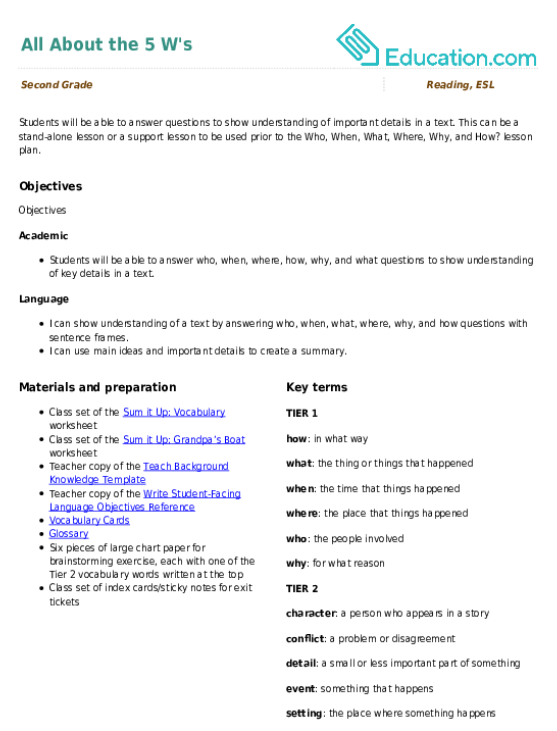
Students will be able to answer questions to show understanding of important details in a text. This can be a stand-alone lesson or a support lesson to be used prior to the Who, When, What, Where, Why, and How? lesson plan.
Lesson Plan
EL
All About the 5 W's
Lesson Plan
All About the 5 W's
Students will be able to answer questions to show understanding of important details in a text. This can be a stand-alone lesson or a support lesson to be used prior to the Who, When, What, Where, Why, and How? lesson plan.
Second Grade
Lesson Plan
EL
The Purpose of Fiction Texts
Lesson Plan
The Purpose of Fiction Texts
Second Grade
Why does someone write a story? Give your students the tools to find out the author's purpose! Use this as a stand-alone lesson or as an introduction to the Author’s Purpose in Fiction Texts lesson plan.
Lesson Plan
EL
The Purpose of Fiction Texts
Lesson Plan
The Purpose of Fiction Texts
Why does someone write a story? Give your students the tools to find out the author's purpose! Use this as a stand-alone lesson or as an introduction to the Author’s Purpose in Fiction Texts lesson plan.
Second Grade
Lesson Plan
EL
What's the Moral?
Lesson Plan
What's the Moral?
Second Grade
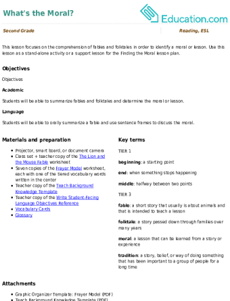
This lesson focuses on the comprehension of fables and folktales in order to identify a moral or lesson. Use this lesson as a stand-alone activity or a support lesson for the Finding the Moral lesson plan.
Lesson Plan
EL
What's the Moral?
Lesson Plan
What's the Moral?
This lesson focuses on the comprehension of fables and folktales in order to identify a moral or lesson. Use this lesson as a stand-alone activity or a support lesson for the Finding the Moral lesson plan.
Second Grade
Lesson Plan
EL
Learn to Compare and Contrast
Lesson Plan
Learn to Compare and Contrast
Second Grade
Reading
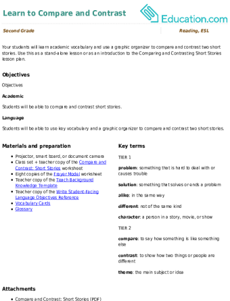
Your students will learn academic vocabulary and use a graphic organizer to compare and contrast two short stories. Use this as a stand-alone lesson or as an introduction to the Comparing and Contrasting Short Stories lesson plan.
Lesson Plan
EL
Learn to Compare and Contrast
Lesson Plan
Learn to Compare and Contrast
Your students will learn academic vocabulary and use a graphic organizer to compare and contrast two short stories. Use this as a stand-alone lesson or as an introduction to the Comparing and Contrasting Short Stories lesson plan.
Second Grade
Reading
Lesson Plan
EL
Story Hooks
Lesson Plan
Story Hooks
Second Grade
Writing
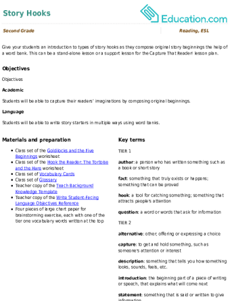
Give your students an introduction to types of story hooks as they compose original story beginnings the help of a word bank. This can be a stand-alone lesson or a support lesson for the Capture That Reader! lesson plan.
Lesson Plan
EL
Story Hooks
Lesson Plan
Story Hooks
Give your students an introduction to types of story hooks as they compose original story beginnings the help of a word bank. This can be a stand-alone lesson or a support lesson for the Capture That Reader! lesson plan.
Second Grade
Writing
Lesson Plan
EL
Nonfiction Text Features
Lesson Plan
Nonfiction Text Features
Second Grade
Students will be able to use and identify nonfiction text features. It can be a stand-alone lesson or a support lesson to the How Many Features? lesson plan.
Lesson Plan
EL
Nonfiction Text Features
Lesson Plan
Nonfiction Text Features
Students will be able to use and identify nonfiction text features. It can be a stand-alone lesson or a support lesson to the How Many Features? lesson plan.
Second Grade
Lesson Plan
EL
Let's Collect Data!
Lesson Plan
Let's Collect Data!
Second Grade
This hands-on EL Math Lesson will help students develop compare and contrast skills while they think about effective ways to collect data. Use alongside Bar Graphs: Interpreting Data or as a stand-alone lesson.
Lesson Plan
EL
Let's Collect Data!
Lesson Plan
Let's Collect Data!
This hands-on EL Math Lesson will help students develop compare and contrast skills while they think about effective ways to collect data. Use alongside Bar Graphs: Interpreting Data or as a stand-alone lesson.
Second Grade
Lesson Plan
EL
Compare and Contrast Clocks
Lesson Plan
Compare and Contrast Clocks
Second Grade
Help students develop compare and contrast skills while they examine digital and analog clocks. This lesson can be used independently or in conjunction with the lesson Time to Tell Time: Showing and Writing Time.
Lesson Plan
EL
Compare and Contrast Clocks
Lesson Plan
Compare and Contrast Clocks
Help students develop compare and contrast skills while they examine digital and analog clocks. This lesson can be used independently or in conjunction with the lesson Time to Tell Time: Showing and Writing Time.
Second Grade
Lesson Plan
Frederick Douglass's Words
Lesson Plan
Frederick Douglass's Words
Second Grade
Reading
Use this lesson to teach your students about Frederick Douglass and the impact that words had on his life. First, they will read a picture book that shares facts and beautiful illustrations to teach about his life. Then, they'll complete a graphic organizer with peers to record important details and events in his life. Students will then demonstrate understanding by creating a poster with images and key words that stand out when they think about Frederick Douglass.
Lesson Plan
Frederick Douglass's Words
Lesson Plan
Frederick Douglass's Words
Use this lesson to teach your students about Frederick Douglass and the impact that words had on his life. First, they will read a picture book that shares facts and beautiful illustrations to teach about his life. Then, they'll complete a graphic organizer with peers to record important details and events in his life. Students will then demonstrate understanding by creating a poster with images and key words that stand out when they think about Frederick Douglass.
Second Grade
Reading
Lesson Plan
1
2
3