SKIP TO CONTENT
Worksheet Generator
Subjects
Grades
Worksheets
Games
Build a Worksheet
More Resources
Roly Recommends
Subjects
Grades
Worksheets
Games
Build a Worksheet
More Resources
Roly Recommends
Filters
Search for: same, and, different
✕
Lesson Plans
✕
2nd - 4th Grade
✕
Subjects
Math
English Language Arts
Science
Social Studies
Grade Level
Pre-K
K
1st
2nd
3rd
4th
5th
6th
7th
8th
Early Childhood
Elementary School
Middle School
Resource Type
Worksheets
Games
Lesson Plans
Interactive Worksheets
Workbooks
Activities
Exercises
Stories
Songs
Offline Games
Guided Lessons
Teacher Resources
Common Core
Yes
Roly Recommends
Social Emotional Learning
English Language Support
Yes
See More
Clear All
View 926 results
Showing Results for same and different : Page 10
926 results
Search for: same, and, different
✕
Lesson Plans
✕
2nd - 4th Grade
✕
Clear All
Sort by:
Relevance
Most recent
Most popular
Alphabetical A-Z
Alphabetical Z-A
All filters
926 results
Sort by:
Relevance
Most recent
Most popular
Alphabetical A-Z
Alphabetical Z-A
EL
Strategies for Multiplying by Multiples of 10
Lesson Plan
Strategies for Multiplying by Multiples of 10
Third Grade
Help your students become detail-oriented mathematicians as they explore two strategies for multiplying a one-digit number by a multiple of 10. Use this as a stand alone lesson or alongside
Multiplying by Multiples of 10.
Lesson Plan
EL
Strategies for Multiplying by Multiples of 10
Lesson Plan
Strategies for Multiplying by Multiples of 10
Help your students become detail-oriented mathematicians as they explore two strategies for multiplying a one-digit number by a multiple of 10. Use this as a stand alone lesson or alongside
Multiplying by Multiples of 10.
Third Grade
Lesson Plan
EL
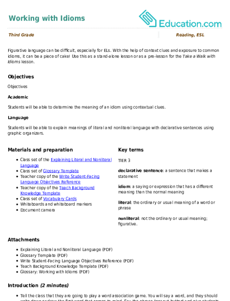
Working with Idioms
Lesson Plan
Working with Idioms
Third Grade
Writing
Figurative language can be difficult, especially for ELs. With the help of context clues and exposure to common idioms, it can be a piece of cake! Use this as a stand-alone lesson or as a pre-lesson for the
Take a Walk with Idioms
lesson.
Lesson Plan
EL
Working with Idioms
Lesson Plan
Working with Idioms
Figurative language can be difficult, especially for ELs. With the help of context clues and exposure to common idioms, it can be a piece of cake! Use this as a stand-alone lesson or as a pre-lesson for the
Take a Walk with Idioms
lesson.
Third Grade
Writing
Lesson Plan
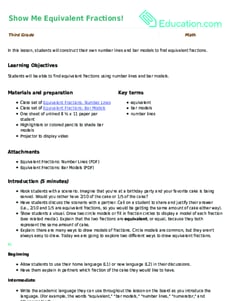
Show Me Equivalent Fractions!
Lesson Plan
Show Me Equivalent Fractions!
Third Grade
In this lesson, students will construct their own number lines and bar models to find equivalent fractions.
Lesson Plan
Show Me Equivalent Fractions!
Lesson Plan
Show Me Equivalent Fractions!
In this lesson, students will construct their own number lines and bar models to find equivalent fractions.
Third Grade
Lesson Plan
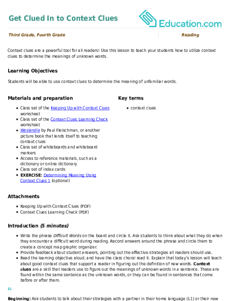
Get Clued In to Context Clues
Lesson Plan
Get Clued In to Context Clues
Third Grade
Vocabulary
Context clues are a powerful tool for all readers! Use this lesson to teach your students how to utilize context clues to determine the meanings of unknown words.
Lesson Plan
Get Clued In to Context Clues
Lesson Plan
Get Clued In to Context Clues
Context clues are a powerful tool for all readers! Use this lesson to teach your students how to utilize context clues to determine the meanings of unknown words.
Third Grade
Vocabulary
Lesson Plan
EL
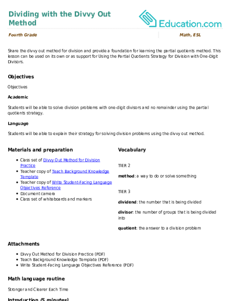
Dividing with the Divvy Out Method
Lesson Plan
Dividing with the Divvy Out Method
Fourth Grade
Share the divvy out method for division and provide a foundation for learning the partial quotients method. This lesson can be used on its own or as support for Using the Partial Quotients Strategy for Division with One-Digit Divisors.
Lesson Plan
EL
Dividing with the Divvy Out Method
Lesson Plan
Dividing with the Divvy Out Method
Share the divvy out method for division and provide a foundation for learning the partial quotients method. This lesson can be used on its own or as support for Using the Partial Quotients Strategy for Division with One-Digit Divisors.
Fourth Grade
Lesson Plan
EL
Making Text Connections
Lesson Plan
Making Text Connections
Fourth Grade
This lesson helps your students practice making text connections so they can write about their reading. It can be taught on its own or serve as a precursor to the Reading Response Letters lesson.
Lesson Plan
EL
Making Text Connections
Lesson Plan
Making Text Connections
This lesson helps your students practice making text connections so they can write about their reading. It can be taught on its own or serve as a precursor to the Reading Response Letters lesson.
Fourth Grade
Lesson Plan
EL
Vocabulary in Context
Lesson Plan
Vocabulary in Context
Fourth Grade
In this lesson, students will improve their skills in using context clues to determine the meaning of difficult words. Use it as a stand-alone lesson or as support to the lesson Journey on the Underground Railroad.
Lesson Plan
EL
Vocabulary in Context
Lesson Plan
Vocabulary in Context
In this lesson, students will improve their skills in using context clues to determine the meaning of difficult words. Use it as a stand-alone lesson or as support to the lesson Journey on the Underground Railroad.
Fourth Grade
Lesson Plan
EL
Comparing Character Traits
Lesson Plan
Comparing Character Traits
Fourth Grade
Use this lesson to help your ELs compare and contrast characters' thoughts and actions using a Venn Diagram. It can be a stand-alone lesson or a support lesson.
Lesson Plan
EL
Comparing Character Traits
Lesson Plan
Comparing Character Traits
Use this lesson to help your ELs compare and contrast characters' thoughts and actions using a Venn Diagram. It can be a stand-alone lesson or a support lesson.
Fourth Grade
Lesson Plan
EL
Money Values
Lesson Plan
Money Values
Second Grade
Place Value
Use this scaffolded EL lesson to teach students about money and the bills we use to pay for things. Use alongside Base Ten Money: Hundreds, Tens, and Ones or alone as an independent lesson.
Lesson Plan
EL
Money Values
Lesson Plan
Money Values
Use this scaffolded EL lesson to teach students about money and the bills we use to pay for things. Use alongside Base Ten Money: Hundreds, Tens, and Ones or alone as an independent lesson.
Second Grade
Place Value
Lesson Plan
Sentence Variety
Lesson Plan
Sentence Variety
Fourth Grade
During this lesson, students will learn how to edit their writing. They will edit their writing by adding variety to their sentences. Students will also work on writing sentences that are clearer to the reader.
Lesson Plan
Sentence Variety
Lesson Plan
Sentence Variety
During this lesson, students will learn how to edit their writing. They will edit their writing by adding variety to their sentences. Students will also work on writing sentences that are clearer to the reader.
Fourth Grade
Lesson Plan
Slice it in Half!
Lesson Plan
Slice it in Half!
Fourth Grade
Teach your students about symmetry with real life objects! Have them draw lines of symmetry for various shapes, food items, and objects.
Lesson Plan
Slice it in Half!
Lesson Plan
Slice it in Half!
Teach your students about symmetry with real life objects! Have them draw lines of symmetry for various shapes, food items, and objects.
Fourth Grade
Lesson Plan
Pledging Allegiance to the Flag
Lesson Plan
Pledging Allegiance to the Flag
First Grade
The Pledge of Allegiance has been recited for years, but how many truly know its meaning? This lesson allows our student citizens a chance to learn and appreciate the pledge, as they understand the meaning behind it.
Lesson Plan
Pledging Allegiance to the Flag
Lesson Plan
Pledging Allegiance to the Flag
The Pledge of Allegiance has been recited for years, but how many truly know its meaning? This lesson allows our student citizens a chance to learn and appreciate the pledge, as they understand the meaning behind it.
First Grade
Lesson Plan
Candy Multiplication
Lesson Plan
Candy Multiplication
Third Grade
Multiplication
Delicious multiplication! In this sweet lesson, your students will learn how to relate multiplication to repeated addition using candy counters.
Lesson Plan
Candy Multiplication
Lesson Plan
Candy Multiplication
Delicious multiplication! In this sweet lesson, your students will learn how to relate multiplication to repeated addition using candy counters.
Third Grade
Multiplication
Lesson Plan
EL
Mental Math Bingo with Multiples of 10
Lesson Plan
Mental Math Bingo with Multiples of 10
Second Grade
Vocabulary
Students will practice mentally adding and subtracting 10 to multiples of 10 up to 100 by playing an all time favorite: BINGO! Use alone or alongside the lesson Subtracting From Multiples of 100.
Lesson Plan
EL
Mental Math Bingo with Multiples of 10
Lesson Plan
Mental Math Bingo with Multiples of 10
Students will practice mentally adding and subtracting 10 to multiples of 10 up to 100 by playing an all time favorite: BINGO! Use alone or alongside the lesson Subtracting From Multiples of 100.
Second Grade
Vocabulary
Lesson Plan
Sentence Menu
Lesson Plan
Sentence Menu
Second Grade
Grammar and Mechanics
We write sentences to tell thoughts, but what happens when we add some parameters? In this lesson, students dissect the words they find in sentences then follow directions to create their own wacky sentences.
Lesson Plan
Sentence Menu
Lesson Plan
Sentence Menu
We write sentences to tell thoughts, but what happens when we add some parameters? In this lesson, students dissect the words they find in sentences then follow directions to create their own wacky sentences.
Second Grade
Grammar and Mechanics
Lesson Plan
Beyond Just Addition
Lesson Plan
Beyond Just Addition
Third Grade
In this interactive lesson that includes the use of clock manipulatives, students will discover that addition goes beyond straightforward addition problems. Finding the elapsed time is easy with addition!
Lesson Plan
Beyond Just Addition
Lesson Plan
Beyond Just Addition
In this interactive lesson that includes the use of clock manipulatives, students will discover that addition goes beyond straightforward addition problems. Finding the elapsed time is easy with addition!
Third Grade
Lesson Plan
What's the Big Idea? Summarizing Nonfiction Texts
Lesson Plan
What's the Big Idea? Summarizing Nonfiction Texts
Fourth Grade
Reading
Understanding the big idea of a nonfiction text and being able to write a succinct summary are key fourth grade skills. This lesson focuses on summarizing a nonfiction passage in three to four sentences.
Lesson Plan
What's the Big Idea? Summarizing Nonfiction Texts
Lesson Plan
What's the Big Idea? Summarizing Nonfiction Texts
Understanding the big idea of a nonfiction text and being able to write a succinct summary are key fourth grade skills. This lesson focuses on summarizing a nonfiction passage in three to four sentences.
Fourth Grade
Reading
Lesson Plan
Labeling Emotions
Lesson Plan
Labeling Emotions
Fourth Grade
In this lesson, students will explore how to use mindfulness to reflect on, label, and express emotions. They will each help design a page for their classroom book on mindfulness of emotions, including tools to cope with strong emotions.
Lesson Plan
Labeling Emotions
Lesson Plan
Labeling Emotions
In this lesson, students will explore how to use mindfulness to reflect on, label, and express emotions. They will each help design a page for their classroom book on mindfulness of emotions, including tools to cope with strong emotions.
Fourth Grade
Lesson Plan
Two-Step Word Problems with Mixed Operations - Gamified!
Lesson Plan
Two-Step Word Problems with Mixed Operations - Gamified!
Third Grade
Students will have fun learning the Read, Draw, Write (RDW) strategy on two-step, mixed operation problems. First they will learn RDW, and then they will practice it in a game called Four in a Row.
Lesson Plan
Two-Step Word Problems with Mixed Operations - Gamified!
Lesson Plan
Two-Step Word Problems with Mixed Operations - Gamified!
Students will have fun learning the Read, Draw, Write (RDW) strategy on two-step, mixed operation problems. First they will learn RDW, and then they will practice it in a game called Four in a Row.
Third Grade
Lesson Plan
EL
Using Regrouping to Add
Lesson Plan
Using Regrouping to Add
Second Grade
Guide students to use base ten blocks to solve two-digit by one-digit addition problems with regrouping. This lesson can be used independently or paired with the lesson Adding it All Up.
Lesson Plan
EL
Using Regrouping to Add
Lesson Plan
Using Regrouping to Add
Guide students to use base ten blocks to solve two-digit by one-digit addition problems with regrouping. This lesson can be used independently or paired with the lesson Adding it All Up.
Second Grade
Lesson Plan
Animal Symbiosis
Lesson Plan
Animal Symbiosis
Fourth Grade
Life Science
Use this lesson to see how animals can have very interesting relationships. Some help each other, some benefit from others, and some hurt others. Young scientists are sure to benefit from this eye-opening lesson.
Lesson Plan
Animal Symbiosis
Lesson Plan
Animal Symbiosis
Use this lesson to see how animals can have very interesting relationships. Some help each other, some benefit from others, and some hurt others. Young scientists are sure to benefit from this eye-opening lesson.
Fourth Grade
Life Science
Lesson Plan
Number Line Multiplication
Lesson Plan
Number Line Multiplication
Third Grade
Teach your students to use number lines as a strategy to multiply two single-digit factors.
Lesson Plan
Number Line Multiplication
Lesson Plan
Number Line Multiplication
Teach your students to use number lines as a strategy to multiply two single-digit factors.
Third Grade
Lesson Plan
Martin Luther King, Jr.: I Have A Dream
Lesson Plan
Martin Luther King, Jr.: I Have A Dream
Fourth Grade
History
Use this lesson to show your students that dreams can become reality with dedication and determination. This lesson will teach them about a man who made his dream come true by standing firm in front of the most challenging obstacles.
Lesson Plan
Martin Luther King, Jr.: I Have A Dream
Lesson Plan
Martin Luther King, Jr.: I Have A Dream
Use this lesson to show your students that dreams can become reality with dedication and determination. This lesson will teach them about a man who made his dream come true by standing firm in front of the most challenging obstacles.
Fourth Grade
History
Lesson Plan
What's in a Name? Fractions and Decimals
Lesson Plan
What's in a Name? Fractions and Decimals
Fourth Grade
Decimals
In this lesson, your students will play with cards to practice giving fractions a new decimal name. They will be able to convert fractions to decimals by the end of this lesson.
Lesson Plan
What's in a Name? Fractions and Decimals
Lesson Plan
What's in a Name? Fractions and Decimals
In this lesson, your students will play with cards to practice giving fractions a new decimal name. They will be able to convert fractions to decimals by the end of this lesson.
Fourth Grade
Decimals
Lesson Plan
EL
Geometry Vocabulary: Lines
Lesson Plan
Geometry Vocabulary: Lines
Fourth Grade
Geometry
Perpendicular, intersect, parallel! In this lesson, students work in teams to complete a Frayer Model on each of these terms to become masters of geometry vocabulary. Teach this lesson on its own or as support to the lesson What's My Line?
Lesson Plan
EL
Geometry Vocabulary: Lines
Lesson Plan
Geometry Vocabulary: Lines
Perpendicular, intersect, parallel! In this lesson, students work in teams to complete a Frayer Model on each of these terms to become masters of geometry vocabulary. Teach this lesson on its own or as support to the lesson What's My Line?
Fourth Grade
Geometry
Lesson Plan
EL
Distinguish Between Facts and Opinions
Lesson Plan
Distinguish Between Facts and Opinions
Third Grade
Teach your students the difference between facts and opinions, and why an author would choose to use each type of information. This can stand-alone or be used as a pre-lesson for the
Exploring Author's Purpose and Point of View
lesson.
Lesson Plan
EL
Distinguish Between Facts and Opinions
Lesson Plan
Distinguish Between Facts and Opinions
Teach your students the difference between facts and opinions, and why an author would choose to use each type of information. This can stand-alone or be used as a pre-lesson for the
Exploring Author's Purpose and Point of View
lesson.
Third Grade
Lesson Plan
EL
Reflect on the Context First!
Lesson Plan
Reflect on the Context First!
Second Grade
Subtraction
Emphasize student understanding and reasoning! This lesson plan helps learners solve story problems using sense-making strategies. This can be used alongside the lesson Solving Word Problems or as a stand-alone lesson.
Lesson Plan
EL
Reflect on the Context First!
Lesson Plan
Reflect on the Context First!
Emphasize student understanding and reasoning! This lesson plan helps learners solve story problems using sense-making strategies. This can be used alongside the lesson Solving Word Problems or as a stand-alone lesson.
Second Grade
Subtraction
Lesson Plan
Why I Write
Lesson Plan
Why I Write
Second Grade
Reading
Second grade students will step into the author’s shoes as they hunt for evidence to determine what a nonfiction author’s purpose might be.
Lesson Plan
Why I Write
Lesson Plan
Why I Write
Second grade students will step into the author’s shoes as they hunt for evidence to determine what a nonfiction author’s purpose might be.
Second Grade
Reading
Lesson Plan
Parts of a Plant
Lesson Plan
Parts of a Plant
First Grade
Life Science
Root, stem, flower, leaf! In this hands-on science lesson, your students will create their own plants to help them identify and remember the parts of a plant.
Lesson Plan
Parts of a Plant
Lesson Plan
Parts of a Plant
Root, stem, flower, leaf! In this hands-on science lesson, your students will create their own plants to help them identify and remember the parts of a plant.
First Grade
Life Science
Lesson Plan
Onomatopoeia Poetry
Lesson Plan
Onomatopoeia Poetry
Third Grade
Pop, whoosh, ding! Onomatopoeia is a writing technique that makes text come alive. In this lesson, students will learn about onomatopoeia, and apply it to their writing process to create poetry, as a class and individually.
Lesson Plan
Onomatopoeia Poetry
Lesson Plan
Onomatopoeia Poetry
Pop, whoosh, ding! Onomatopoeia is a writing technique that makes text come alive. In this lesson, students will learn about onomatopoeia, and apply it to their writing process to create poetry, as a class and individually.
Third Grade
Lesson Plan
1
…
9
10
11
…
31