SKIP TO CONTENT
Worksheet Generator
Subjects
Grades
Worksheets
Games
Build a Worksheet
More Resources
Roly Recommends
Subjects
Grades
Worksheets
Games
Build a Worksheet
More Resources
Roly Recommends
Filters
Search for: critical, thinking
✕
3rd and 4th Grade
✕
Lesson Plans
✕
Subjects
Math
English Language Arts
Science
Social Studies
Grade Level
Pre-K
K
1st
2nd
3rd
4th
5th
6th
7th
8th
Early Childhood
Elementary School
Middle School
Resource Type
Worksheets
Lesson Plans
Interactive Worksheets
Workbooks
Activities
Offline Games
Teacher Resources
Common Core
Yes
Roly Recommends
Social Emotional Learning
English Language Support
Yes
See More
Clear All
View 244 results
Showing Results for critical thinking
244 results

Search for: critical, thinking
✕
3rd and 4th Grade
✕
Lesson Plans
✕
Clear All
Sort by:
Relevance
Most recent
Most popular
Alphabetical A-Z
Alphabetical Z-A
All filters
244 results
Sort by:
Relevance
Most recent
Most popular
Alphabetical A-Z
Alphabetical Z-A
Humpty Dumpty and Design Thinking
Lesson Plan
Humpty Dumpty and Design Thinking
Third Grade
Engineering and Science Inquiry
Transform the traditional egg drop experiment as you help students to engage in design thinking and develop empathy.
Lesson Plan
Humpty Dumpty and Design Thinking
Lesson Plan
Humpty Dumpty and Design Thinking
Transform the traditional egg drop experiment as you help students to engage in design thinking and develop empathy.
Third Grade
Engineering and Science Inquiry
Lesson Plan
What Were They Thinking?
Lesson Plan
What Were They Thinking?
Fourth Grade
What do Malala Yousafzai, Al Gore, and Michelle Obama all have in common? They are all nonfiction authors with a purpose. In this interactive lesson, students will gain practice looking at details in text to identify the author’s purpose.
Lesson Plan
What Were They Thinking?
Lesson Plan
What Were They Thinking?
What do Malala Yousafzai, Al Gore, and Michelle Obama all have in common? They are all nonfiction authors with a purpose. In this interactive lesson, students will gain practice looking at details in text to identify the author’s purpose.
Fourth Grade
Lesson Plan
What's the Problem?
Lesson Plan
What's the Problem?
Second Grade
Time and Money
High order thinking skills are critical skills for students of all ages. In this lesson, your students will create word problems about money.
Lesson Plan
What's the Problem?
Lesson Plan
What's the Problem?
High order thinking skills are critical skills for students of all ages. In this lesson, your students will create word problems about money.
Second Grade
Time and Money
Lesson Plan
Thinking Deeply About Word Problems
Lesson Plan
Thinking Deeply About Word Problems
Third Grade
Subtraction
Word problems can be overwhelming to students, but if they have a tool to help them, they can handle it! Use this as a stand alone lesson or alongside
Stepping Through Addition and Subtraction Word Problems
.
Lesson Plan
Thinking Deeply About Word Problems
Lesson Plan
Thinking Deeply About Word Problems
Word problems can be overwhelming to students, but if they have a tool to help them, they can handle it! Use this as a stand alone lesson or alongside
Stepping Through Addition and Subtraction Word Problems
.
Third Grade
Subtraction
Lesson Plan
Questions that Gauge Comprehension
Lesson Plan
Questions that Gauge Comprehension
Third Grade
Vocabulary
Use this lesson to gauge your students’ basic comprehension of fiction text. If they can answer who, what, when, where, why, and how questions, you know they have a handle on it and it’s time to get into more critical thinking!
Lesson Plan
Questions that Gauge Comprehension
Lesson Plan
Questions that Gauge Comprehension
Use this lesson to gauge your students’ basic comprehension of fiction text. If they can answer who, what, when, where, why, and how questions, you know they have a handle on it and it’s time to get into more critical thinking!
Third Grade
Vocabulary
Lesson Plan
Reading Response Letters
Lesson Plan
Reading Response Letters
Fourth Grade
Grammar and Mechanics
How can you
see
what your students are thinking while they read? Try reading response letters in your class. Students will practice formatting letters and learn to discuss their thinking about literature in writing.
Lesson Plan
Reading Response Letters
Lesson Plan
Reading Response Letters
How can you
see
what your students are thinking while they read? Try reading response letters in your class. Students will practice formatting letters and learn to discuss their thinking about literature in writing.
Fourth Grade
Grammar and Mechanics
Lesson Plan
Using Articles: A, An, The
Lesson Plan
Using Articles: A, An, The
Fourth Grade
Articles are a simple yet critical part of speech. This lesson helps your fourth graders distinguish the three articles and understand how to use them correctly in sentences.
Lesson Plan
Using Articles: A, An, The
Lesson Plan
Using Articles: A, An, The
Articles are a simple yet critical part of speech. This lesson helps your fourth graders distinguish the three articles and understand how to use them correctly in sentences.
Fourth Grade
Lesson Plan
Exploring Different Perspectives in Folktales
Lesson Plan
Exploring Different Perspectives in Folktales
Third Grade
Give your students the opportunity to explore the perspectives of different characters by using the "Circle of Viewpoints" Visible Thinking Routine from Harvard's Project Zero.
Lesson Plan
Exploring Different Perspectives in Folktales
Lesson Plan
Exploring Different Perspectives in Folktales
Give your students the opportunity to explore the perspectives of different characters by using the "Circle of Viewpoints" Visible Thinking Routine from Harvard's Project Zero.
Third Grade
Lesson Plan
Is It True?
Lesson Plan
Is It True?
Fourth Grade
Don't believe everything you read! Teach students to differentiate between statements of fact and opinion. This important skill will help students become critical and discerning readers.
Lesson Plan
Is It True?
Lesson Plan
Is It True?
Don't believe everything you read! Teach students to differentiate between statements of fact and opinion. This important skill will help students become critical and discerning readers.
Fourth Grade
Lesson Plan
Divisibility Rules
Lesson Plan
Divisibility Rules
Fourth Grade
Introduce your students to divisibility rules with a lesson that encourages deep thinking and meaningful math talk between peers.
Lesson Plan
Divisibility Rules
Lesson Plan
Divisibility Rules
Introduce your students to divisibility rules with a lesson that encourages deep thinking and meaningful math talk between peers.
Fourth Grade
Lesson Plan
Introducing Order of Operations
Lesson Plan
Introducing Order of Operations
Fourth Grade
The order of operations is a critical concept for fourth graders to grasp in preparation for algebra. This introductory lesson on the order of operations will teach your students about the helpful acronym PEMDAS.
Lesson Plan
Introducing Order of Operations
Lesson Plan
Introducing Order of Operations
The order of operations is a critical concept for fourth graders to grasp in preparation for algebra. This introductory lesson on the order of operations will teach your students about the helpful acronym PEMDAS.
Fourth Grade
Lesson Plan
Main Ideas, Please!
Lesson Plan
Main Ideas, Please!
Third Grade
Writing
Your students will be introduced to the concept of a main idea in this fun lesson using props to support their thinking.
Lesson Plan
Main Ideas, Please!
Lesson Plan
Main Ideas, Please!
Your students will be introduced to the concept of a main idea in this fun lesson using props to support their thinking.
Third Grade
Writing
Lesson Plan
Exploring Animal Adaptations!
Lesson Plan
Exploring Animal Adaptations!
Third Grade
Life Science
Give your students the opportunity to explore the perspectives of different characters by using the "See Think Wonder" Visible Thinking Routine from Harvard's Project Zero.
Lesson Plan
Exploring Animal Adaptations!
Lesson Plan
Exploring Animal Adaptations!
Give your students the opportunity to explore the perspectives of different characters by using the "See Think Wonder" Visible Thinking Routine from Harvard's Project Zero.
Third Grade
Life Science
Lesson Plan
Decompose to Multiply: 6, 7, 8, and 9
Lesson Plan
Decompose to Multiply: 6, 7, 8, and 9
Third Grade
Teach your students to decompose factors as a strategy to find multiples of 6, 7, 8, and 9. This lesson supports flexible thinking and number sense.
Lesson Plan
Decompose to Multiply: 6, 7, 8, and 9
Lesson Plan
Decompose to Multiply: 6, 7, 8, and 9
Teach your students to decompose factors as a strategy to find multiples of 6, 7, 8, and 9. This lesson supports flexible thinking and number sense.
Third Grade
Lesson Plan
Adobe Spark: Parts, Purposes & Complexities
Lesson Plan
Adobe Spark: Parts, Purposes & Complexities
Fourth Grade
Reading
Discover a new tool for creative assessments and lessons! In this lesson, students will investigate Adobe Spark using Agency by Design thinking routines to help them understand how they can use technology to communicate ideas.
Lesson Plan
Adobe Spark: Parts, Purposes & Complexities
Lesson Plan
Adobe Spark: Parts, Purposes & Complexities
Discover a new tool for creative assessments and lessons! In this lesson, students will investigate Adobe Spark using Agency by Design thinking routines to help them understand how they can use technology to communicate ideas.
Fourth Grade
Reading
Lesson Plan
Solving Elapsed Time Word Problems
Lesson Plan
Solving Elapsed Time Word Problems
Third Grade
Get your students thinking about how the number line and the word problem are related! Use this lesson alongside
Get There On Time: Elapsed Time Word Problems
or on its own.
Lesson Plan
Solving Elapsed Time Word Problems
Lesson Plan
Solving Elapsed Time Word Problems
Get your students thinking about how the number line and the word problem are related! Use this lesson alongside
Get There On Time: Elapsed Time Word Problems
or on its own.
Third Grade
Lesson Plan
Identifying the Author's Purpose
Lesson Plan
Identifying the Author's Purpose
Fourth Grade
This lesson gives students foundational skills needed to identify the author's purpose in a variety of texts. Use the lesson as a stand alone or as a pre-lesson to What Were They Thinking?
Lesson Plan
Identifying the Author's Purpose
Lesson Plan
Identifying the Author's Purpose
This lesson gives students foundational skills needed to identify the author's purpose in a variety of texts. Use the lesson as a stand alone or as a pre-lesson to What Were They Thinking?
Fourth Grade
Lesson Plan
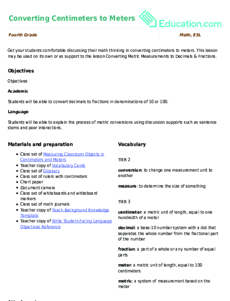
Converting Centimeters to Meters
Lesson Plan
Converting Centimeters to Meters
Fourth Grade
Decimals
Get your students comfortable discussing their math thinking in converting centimeters to meters. This lesson may be used on its own or as support to the lesson Converting Metric Measurements to Decimals & Fractions.
Lesson Plan
Converting Centimeters to Meters
Lesson Plan
Converting Centimeters to Meters
Get your students comfortable discussing their math thinking in converting centimeters to meters. This lesson may be used on its own or as support to the lesson Converting Metric Measurements to Decimals & Fractions.
Fourth Grade
Decimals
Lesson Plan
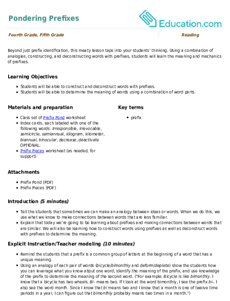
Pondering Prefixes
Lesson Plan
Pondering Prefixes
Fourth Grade
Beyond just prefix identification, this meaty lesson taps into your students’ thinking. Using a combination of analogies, constructing, and deconstructing words with prefixes, students will learn the meaning and mechanics of prefixes.
Lesson Plan
Pondering Prefixes
Lesson Plan
Pondering Prefixes
Beyond just prefix identification, this meaty lesson taps into your students’ thinking. Using a combination of analogies, constructing, and deconstructing words with prefixes, students will learn the meaning and mechanics of prefixes.
Fourth Grade
Lesson Plan
How Did You Solve the Puzzle?
Lesson Plan
How Did You Solve the Puzzle?
Fourth Grade
Grid puzzles are a terrific way to practice thinking about math! In this lesson, students are asked to solve addition grid puzzles and compare processes. Use it on its own or as support for the lesson Solving KenKen Puzzles.
Lesson Plan
How Did You Solve the Puzzle?
Lesson Plan
How Did You Solve the Puzzle?
Grid puzzles are a terrific way to practice thinking about math! In this lesson, students are asked to solve addition grid puzzles and compare processes. Use it on its own or as support for the lesson Solving KenKen Puzzles.
Fourth Grade
Lesson Plan
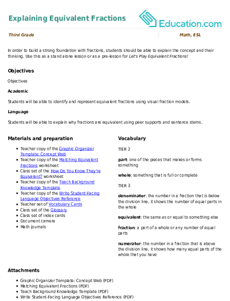
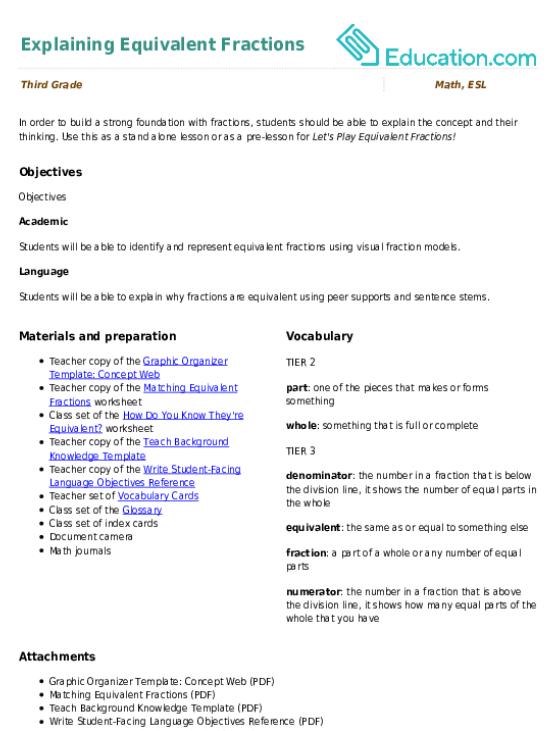
Explaining Equivalent Fractions
Lesson Plan
Explaining Equivalent Fractions
Third Grade
In order to build a strong foundation with fractions, students should be able to explain the concept and their thinking. Use this as a stand alone lesson or as a pre-lesson for
Let's Play Equivalent Fractions!
Lesson Plan
Explaining Equivalent Fractions
Lesson Plan
Explaining Equivalent Fractions
In order to build a strong foundation with fractions, students should be able to explain the concept and their thinking. Use this as a stand alone lesson or as a pre-lesson for
Let's Play Equivalent Fractions!
Third Grade
Lesson Plan
Compare and Contrast Texts on the Same Topic
Lesson Plan
Compare and Contrast Texts on the Same Topic
Fourth Grade
Vocabulary
Did you know that comparative tasks improve comprehension and help students develop higher order thinking skills? In this lesson, students will compare nonfiction texts on the same topic using Venn diagrams and performance!
Lesson Plan
Compare and Contrast Texts on the Same Topic
Lesson Plan
Compare and Contrast Texts on the Same Topic
Did you know that comparative tasks improve comprehension and help students develop higher order thinking skills? In this lesson, students will compare nonfiction texts on the same topic using Venn diagrams and performance!
Fourth Grade
Vocabulary
Lesson Plan
Writing Questions for Multi-Step Word Problems
Lesson Plan
Writing Questions for Multi-Step Word Problems
Fourth Grade
Get your students thinking like mathematicians with this lesson that has them crafting questions for multi-step word problems. It may be taught independently or as support for the lesson Multi-Step Word Problems? No Problem!
Lesson Plan
Writing Questions for Multi-Step Word Problems
Lesson Plan
Writing Questions for Multi-Step Word Problems
Get your students thinking like mathematicians with this lesson that has them crafting questions for multi-step word problems. It may be taught independently or as support for the lesson Multi-Step Word Problems? No Problem!
Fourth Grade
Lesson Plan
Justifying the Distributive Property
Lesson Plan
Justifying the Distributive Property
Fourth Grade
Let's talk about the distributive property! Give students a chance to explain their thinking of how and why this property of multiplication works. This lesson may be taught as a standalone or as support to the lesson Distributive Property.
Lesson Plan
Justifying the Distributive Property
Lesson Plan
Justifying the Distributive Property
Let's talk about the distributive property! Give students a chance to explain their thinking of how and why this property of multiplication works. This lesson may be taught as a standalone or as support to the lesson Distributive Property.
Fourth Grade
Lesson Plan
Let's Shake on It!
Lesson Plan
Let's Shake on It!
Fourth Grade
Grammar and Mechanics
Students will enjoy thinking about subject and verbs as two parts that must work together to form a clear idea. Students will create mixed-up sentences as a class, then write funny stories that peers can revise.
Lesson Plan
Let's Shake on It!
Lesson Plan
Let's Shake on It!
Students will enjoy thinking about subject and verbs as two parts that must work together to form a clear idea. Students will create mixed-up sentences as a class, then write funny stories that peers can revise.
Fourth Grade
Grammar and Mechanics
Lesson Plan
Who Was Amelia Boynton Robinson?
Lesson Plan
Who Was Amelia Boynton Robinson?
Fourth Grade
Reading
Take your fourth and fifth graders on a deep dive into the civil rights movement with this lesson on Amelia Boynton Robinson. A key activist in the movement, Amelia played a critical role in organizing the Selma to Montgomery march. Your students will read, annotate, and analyze her biography through multiple reads, before discussing the text with their classmates.
Lesson Plan
Who Was Amelia Boynton Robinson?
Lesson Plan
Who Was Amelia Boynton Robinson?
Take your fourth and fifth graders on a deep dive into the civil rights movement with this lesson on Amelia Boynton Robinson. A key activist in the movement, Amelia played a critical role in organizing the Selma to Montgomery march. Your students will read, annotate, and analyze her biography through multiple reads, before discussing the text with their classmates.
Fourth Grade
Reading
Lesson Plan
Learning About Mindful Listening
Lesson Plan
Learning About Mindful Listening
Fourth Grade
Kids often need to bew taught that listening isn't just hearing someone -- it's thinking about what they have to say, too. In this lesson students will become introduced to the circle process and help put together guidelines for community building, and learn how to listen to their classmatesnot just quietly, but respectfully.
Lesson Plan
Learning About Mindful Listening
Lesson Plan
Learning About Mindful Listening
Kids often need to bew taught that listening isn't just hearing someone -- it's thinking about what they have to say, too. In this lesson students will become introduced to the circle process and help put together guidelines for community building, and learn how to listen to their classmatesnot just quietly, but respectfully.
Fourth Grade
Lesson Plan
Factor Friend or Foe?
Lesson Plan
Factor Friend or Foe?
Fourth Grade
Multiplication
Which number doesn't belong? This lesson requires students to think critically as they determine which number is not a factor of a particular number. Teach it on its own or as support for the lesson Factors Over the Rainbow.
Lesson Plan
Factor Friend or Foe?
Lesson Plan
Factor Friend or Foe?
Which number doesn't belong? This lesson requires students to think critically as they determine which number is not a factor of a particular number. Teach it on its own or as support for the lesson Factors Over the Rainbow.
Fourth Grade
Multiplication
Lesson Plan
Making Predictions Lesson
Lesson Plan
Making Predictions Lesson
Third Grade
This lesson thoughtfully scaffolds the reading skill of predicting. Students are introduced to the concept and get to practice making predictions. They will apply what they have learned during a focused independent reading activity.
Lesson Plan
Making Predictions Lesson
Lesson Plan
Making Predictions Lesson
This lesson thoughtfully scaffolds the reading skill of predicting. Students are introduced to the concept and get to practice making predictions. They will apply what they have learned during a focused independent reading activity.
Third Grade
Lesson Plan
Missing Numbers: Math Review
Lesson Plan
Missing Numbers: Math Review
Third Grade
Multiplication
Help! The numbers in our equations have run away and left their answers alone! In this lesson, students will review their math facts and knowledge to solve Ken Ken like puzzles and bring the numbers back to their places.
Lesson Plan
Missing Numbers: Math Review
Lesson Plan
Missing Numbers: Math Review
Help! The numbers in our equations have run away and left their answers alone! In this lesson, students will review their math facts and knowledge to solve Ken Ken like puzzles and bring the numbers back to their places.
Third Grade
Multiplication
Lesson Plan
1
2
3
4
…
9