SKIP TO CONTENT
Worksheet Generator
Subjects
Grades
Worksheets
Games
Build a Worksheet
More Resources
Roly Recommends
Subjects
Grades
Worksheets
Games
Build a Worksheet
More Resources
Roly Recommends
All Subjects
English Language Arts
Subtopics:
Phonics
Reading
Writing
Grammar and Mechanics
Vocabulary
Show Less
Filters
Search for: stem, and, leaf, plot
✕
English Language Arts
✕
Lesson Plans
✕
3rd and 4th Grade
✕
Subjects
Math
English Language Arts
Science
Grade Level
Pre-K
K
1st
2nd
3rd
4th
5th
6th
7th
8th
Early Childhood
Elementary School
Middle School
Resource Type
Worksheets
Lesson Plans
Activities
Teacher Resources
Common Core
Yes
English Language Support
Yes
See More
Clear All
View 46 results
Showing Results for stem and leaf plot
46 results
Search for: stem, and, leaf, plot
✕
English Language Arts
✕
Lesson Plans
✕
3rd and 4th Grade
✕
Clear All
Sort by:
Relevance
Most recent
Most popular
Alphabetical A-Z
Alphabetical Z-A
All filters
46 results
Sort by:
Relevance
Most recent
Most popular
Alphabetical A-Z
Alphabetical Z-A
Reading the Clues, Understanding Plot Lesson Part II
Lesson Plan
Reading the Clues, Understanding Plot Lesson Part II
Fourth Grade
Writing
Have you ever wished that books, like movies, would state their conflict and genres on the cover? With the help of an Education.com workbook, students will learn to find the clues and read like a writer.
Lesson Plan
Reading the Clues, Understanding Plot Lesson Part II
Lesson Plan
Reading the Clues, Understanding Plot Lesson Part II
Have you ever wished that books, like movies, would state their conflict and genres on the cover? With the help of an Education.com workbook, students will learn to find the clues and read like a writer.
Fourth Grade
Writing
Lesson Plan
Compare and Contrast Story Elements
Lesson Plan
Compare and Contrast Story Elements
Fourth Grade
Reading
By fourth grade, most students are familiar with story elements such as setting, characters, and plot. In this lesson, students will compare and contrast the elements in two stories with similar themes.
Lesson Plan
Compare and Contrast Story Elements
Lesson Plan
Compare and Contrast Story Elements
By fourth grade, most students are familiar with story elements such as setting, characters, and plot. In this lesson, students will compare and contrast the elements in two stories with similar themes.
Fourth Grade
Reading
Lesson Plan
Compare and Contrast Short Stories
Lesson Plan
Compare and Contrast Short Stories
Fourth Grade
Reading
By fourth grade, most students are familiar with story elements such as setting, characters, and plot. In this lesson, students will compare and contrast the elements in two stories with similar themes.
Lesson Plan
Compare and Contrast Short Stories
Lesson Plan
Compare and Contrast Short Stories
By fourth grade, most students are familiar with story elements such as setting, characters, and plot. In this lesson, students will compare and contrast the elements in two stories with similar themes.
Fourth Grade
Reading
Lesson Plan
Character Comparisons
Lesson Plan
Character Comparisons
Fourth Grade
Reading
Use this lesson to help your ELs compare and contrast supporting characters from excerpted texts. It can be a stand-alone lesson or support the lesson Understanding Character Traits, Understanding Plot Lesson Part III.
Lesson Plan
Character Comparisons
Lesson Plan
Character Comparisons
Use this lesson to help your ELs compare and contrast supporting characters from excerpted texts. It can be a stand-alone lesson or support the lesson Understanding Character Traits, Understanding Plot Lesson Part III.
Fourth Grade
Reading
Lesson Plan
Traditional Literature: Story Mapping
Lesson Plan
Traditional Literature: Story Mapping
Second Grade
Reading
Students will learn how to identify story elements and create a short and sweet summary. They will fill out a graphic organizer and solidify their understanding by creating illustrations to show major plot points that they find themselves!
Lesson Plan
Traditional Literature: Story Mapping
Lesson Plan
Traditional Literature: Story Mapping
Students will learn how to identify story elements and create a short and sweet summary. They will fill out a graphic organizer and solidify their understanding by creating illustrations to show major plot points that they find themselves!
Second Grade
Reading
Lesson Plan
Author Study: Jacqueline Woodson
Lesson Plan
Author Study: Jacqueline Woodson
Third Grade
Reading
Students will use their understanding of plot, theme, and comparing and contrasting in this lesson that teaches about an award-winning African American author, Jacqueline Woodson. Students will read some of her fiction books and compare and contrast the stories. They'll also discuss what they think makes Jacqueline Woodson an award-winning author.
Lesson Plan
Author Study: Jacqueline Woodson
Lesson Plan
Author Study: Jacqueline Woodson
Students will use their understanding of plot, theme, and comparing and contrasting in this lesson that teaches about an award-winning African American author, Jacqueline Woodson. Students will read some of her fiction books and compare and contrast the stories. They'll also discuss what they think makes Jacqueline Woodson an award-winning author.
Third Grade
Reading
Lesson Plan
Native American Legends
Lesson Plan
Native American Legends
Fourth Grade
Writing
Social studies, reading comprehension, and writing come together in this high-engagement lesson about Native American legends!
Lesson Plan
Native American Legends
Lesson Plan
Native American Legends
Social studies, reading comprehension, and writing come together in this high-engagement lesson about Native American legends!
Fourth Grade
Writing
Lesson Plan
Summer Drama
Lesson Plan
Summer Drama
Fourth Grade
Vocabulary
You won't strike out with this lesson on finding the theme of a script. Use this lesson to help your students identify the elements of a script and find the theme.
Lesson Plan
Summer Drama
Lesson Plan
Summer Drama
You won't strike out with this lesson on finding the theme of a script. Use this lesson to help your students identify the elements of a script and find the theme.
Fourth Grade
Vocabulary
Lesson Plan
What's the Big Idea? Summarizing Nonfiction Texts
Lesson Plan
What's the Big Idea? Summarizing Nonfiction Texts
Fourth Grade
Reading
Understanding the big idea of a nonfiction text and being able to write a succinct summary are key fourth grade skills. This lesson focuses on summarizing a nonfiction passage in three to four sentences.
Lesson Plan
What's the Big Idea? Summarizing Nonfiction Texts
Lesson Plan
What's the Big Idea? Summarizing Nonfiction Texts
Understanding the big idea of a nonfiction text and being able to write a succinct summary are key fourth grade skills. This lesson focuses on summarizing a nonfiction passage in three to four sentences.
Fourth Grade
Reading
Lesson Plan
Using Story Elements to Compare and Contrast Fiction Texts
Lesson Plan
Using Story Elements to Compare and Contrast Fiction Texts
Fourth Grade
Reading
All fictional stories have story elements but they sure can differ between stories. In this lesson, students will compare and contrast the story elements of two fictional stories and document their findings in a graphic organizer.
Lesson Plan
Using Story Elements to Compare and Contrast Fiction Texts
Lesson Plan
Using Story Elements to Compare and Contrast Fiction Texts
All fictional stories have story elements but they sure can differ between stories. In this lesson, students will compare and contrast the story elements of two fictional stories and document their findings in a graphic organizer.
Fourth Grade
Reading
Lesson Plan
Multiplying with Arrays
Lesson Plan
Multiplying with Arrays
Fourth Grade
Writing
Making mistakes helps us learn! Your students will flex their analytical muscles to pinpoint errors in multiplication problems using arrays. Use the lesson on its own or as support to Base Ten Arrays for Multi-Digit Multiplication.
Lesson Plan
Multiplying with Arrays
Lesson Plan
Multiplying with Arrays
Making mistakes helps us learn! Your students will flex their analytical muscles to pinpoint errors in multiplication problems using arrays. Use the lesson on its own or as support to Base Ten Arrays for Multi-Digit Multiplication.
Fourth Grade
Writing
Lesson Plan
Introduction to Charts and Diagrams
Lesson Plan
Introduction to Charts and Diagrams
Fourth Grade
Reading
Charts, graphs, and diagrams are complex text features for students to decipher. Use this lesson to familiarize students with these features. It can be taught on its own or before the lesson Charts and Graphs and Diagrams, Oh My!
Lesson Plan
Introduction to Charts and Diagrams
Lesson Plan
Introduction to Charts and Diagrams
Charts, graphs, and diagrams are complex text features for students to decipher. Use this lesson to familiarize students with these features. It can be taught on its own or before the lesson Charts and Graphs and Diagrams, Oh My!
Fourth Grade
Reading
Lesson Plan
Charts and Graphs and Diagrams, Oh My!
Lesson Plan
Charts and Graphs and Diagrams, Oh My!
Fourth Grade
Reading
Students will learn about three nonfiction text features: charts, graphs, and diagrams. They will analyze and interpret the information represented in these visual forms and discover how they aid in the comprehension of nonfiction texts.
Lesson Plan
Charts and Graphs and Diagrams, Oh My!
Lesson Plan
Charts and Graphs and Diagrams, Oh My!
Students will learn about three nonfiction text features: charts, graphs, and diagrams. They will analyze and interpret the information represented in these visual forms and discover how they aid in the comprehension of nonfiction texts.
Fourth Grade
Reading
Lesson Plan
Math Meanings with Synonyms & Antonyms
Lesson Plan
Math Meanings with Synonyms & Antonyms
Fourth Grade
Vocabulary
Use this lesson to increase your students’ understanding of math vocabulary by completing a Frayer Model. This model focuses on finding antonyms, synonyms, and meanings for the key vocabulary term.
Lesson Plan
Math Meanings with Synonyms & Antonyms
Lesson Plan
Math Meanings with Synonyms & Antonyms
Use this lesson to increase your students’ understanding of math vocabulary by completing a Frayer Model. This model focuses on finding antonyms, synonyms, and meanings for the key vocabulary term.
Fourth Grade
Vocabulary
Lesson Plan
Using Adjectives and Verbs to Make Writing Come to Life
Lesson Plan
Using Adjectives and Verbs to Make Writing Come to Life
Fourth Grade
Writing
Imagery is one of the most important tools in a narrative writer's arsenal. In this lesson, students will will learn to craft vivid scenes by selecting powerful verbs and adjectives, as well as to critique descriptive writing using the same criteria.
Lesson Plan
Using Adjectives and Verbs to Make Writing Come to Life
Lesson Plan
Using Adjectives and Verbs to Make Writing Come to Life
Imagery is one of the most important tools in a narrative writer's arsenal. In this lesson, students will will learn to craft vivid scenes by selecting powerful verbs and adjectives, as well as to critique descriptive writing using the same criteria.
Fourth Grade
Writing
Lesson Plan
Reading Comprehension and Evidence-Based Terms
Lesson Plan
Reading Comprehension and Evidence-Based Terms
Third Grade
Vocabulary
The proof is in the pudding! Use this lesson to teach your students how to use text evidence as proof when answering questions after reading. They will use evidence-based terms as they answer basic comprehension questions.
Lesson Plan
Reading Comprehension and Evidence-Based Terms
Lesson Plan
Reading Comprehension and Evidence-Based Terms
The proof is in the pudding! Use this lesson to teach your students how to use text evidence as proof when answering questions after reading. They will use evidence-based terms as they answer basic comprehension questions.
Third Grade
Vocabulary
Lesson Plan
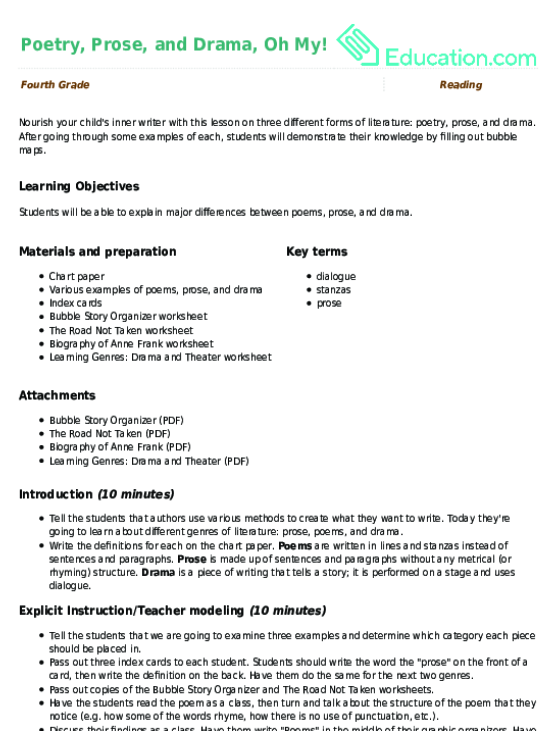
Poetry, Prose, and Drama, Oh My!
Lesson Plan
Poetry, Prose, and Drama, Oh My!
Fourth Grade
Reading
Nourish your child's inner writer with this lesson on three different forms of literature: poetry, prose, and drama. After going through some examples of each, students will demonstrate their knowledge by filling out bubble maps.
Lesson Plan
Poetry, Prose, and Drama, Oh My!
Lesson Plan
Poetry, Prose, and Drama, Oh My!
Nourish your child's inner writer with this lesson on three different forms of literature: poetry, prose, and drama. After going through some examples of each, students will demonstrate their knowledge by filling out bubble maps.
Fourth Grade
Reading
Lesson Plan
Questions that Gauge Comprehension
Lesson Plan
Questions that Gauge Comprehension
Third Grade
Vocabulary
Use this lesson to gauge your students’ basic comprehension of fiction text. If they can answer who, what, when, where, why, and how questions, you know they have a handle on it and it’s time to get into more critical thinking!
Lesson Plan
Questions that Gauge Comprehension
Lesson Plan
Questions that Gauge Comprehension
Use this lesson to gauge your students’ basic comprehension of fiction text. If they can answer who, what, when, where, why, and how questions, you know they have a handle on it and it’s time to get into more critical thinking!
Third Grade
Vocabulary
Lesson Plan
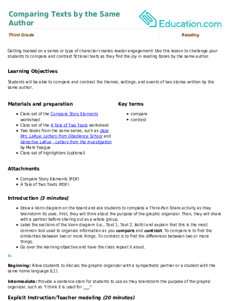
Comparing Texts by the Same Author
Lesson Plan
Comparing Texts by the Same Author
Third Grade
Reading
Getting hooked on a series or type of character creates reader engagement! Use this lesson to challenge your students to compare and contrast fictional texts as they find the joy in reading books by the same author.
Lesson Plan
Comparing Texts by the Same Author
Lesson Plan
Comparing Texts by the Same Author
Getting hooked on a series or type of character creates reader engagement! Use this lesson to challenge your students to compare and contrast fictional texts as they find the joy in reading books by the same author.
Third Grade
Reading
Lesson Plan
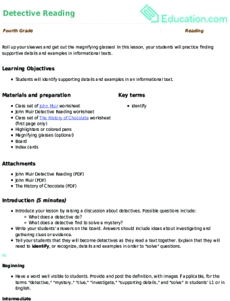
Detective Reading
Lesson Plan
Detective Reading
Fourth Grade
Reading
Roll up your sleeves and get out the magnifying glasses! In this lesson, your students will practice finding supportive details and examples in informational texts.
Lesson Plan
Detective Reading
Lesson Plan
Detective Reading
Roll up your sleeves and get out the magnifying glasses! In this lesson, your students will practice finding supportive details and examples in informational texts.
Fourth Grade
Reading
Lesson Plan
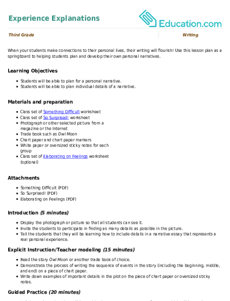
Experience Explanations
Lesson Plan
Experience Explanations
Third Grade
Writing
When your students make connections to their personal lives, their writing will flourish! Use this lesson plan as a springboard to helping students plan and develop their own personal narratives.
Lesson Plan
Experience Explanations
Lesson Plan
Experience Explanations
When your students make connections to their personal lives, their writing will flourish! Use this lesson plan as a springboard to helping students plan and develop their own personal narratives.
Third Grade
Writing
Lesson Plan
What's in a Name?
Lesson Plan
What's in a Name?
Fourth Grade
Writing
Every name has a story behind it. This lesson allows students to share the story of their name with their classmates. Not only is it fun, it's ideal for establishing a respectful classroom community.
Lesson Plan
What's in a Name?
Lesson Plan
What's in a Name?
Every name has a story behind it. This lesson allows students to share the story of their name with their classmates. Not only is it fun, it's ideal for establishing a respectful classroom community.
Fourth Grade
Writing
Lesson Plan
Author's Purpose: Easy as PIE
Lesson Plan
Author's Purpose: Easy as PIE
Fourth Grade
Reading
Give your class the "write" tools they need to become excellent authors. In this literary lesson, students use their knowledge of author's purpose to successfully write pieces that persuade, inform, and entertain.
Lesson Plan
Author's Purpose: Easy as PIE
Lesson Plan
Author's Purpose: Easy as PIE
Give your class the "write" tools they need to become excellent authors. In this literary lesson, students use their knowledge of author's purpose to successfully write pieces that persuade, inform, and entertain.
Fourth Grade
Reading
Lesson Plan
Fact or Opinion: Part 1
Lesson Plan
Fact or Opinion: Part 1
Second Grade
Vocabulary
Cats are the best! Pizza is better! My teacher rules! In Fact or Opinion: Part 1, your students will combine reading and writing to learn about the differences between facts and opinions and how those differences are communicated.
Lesson Plan
Fact or Opinion: Part 1
Lesson Plan
Fact or Opinion: Part 1
Cats are the best! Pizza is better! My teacher rules! In Fact or Opinion: Part 1, your students will combine reading and writing to learn about the differences between facts and opinions and how those differences are communicated.
Second Grade
Vocabulary
Lesson Plan
Fiction vs. Nonfiction
Lesson Plan
Fiction vs. Nonfiction
Fourth Grade
Reading
Kids will love learning some fun facts about elephants while developing their reading comprehension skills. Using T-charts and Venn diagrams, they'll analyze stories and explore different characteristics of fiction and nonfiction.
Lesson Plan
Fiction vs. Nonfiction
Lesson Plan
Fiction vs. Nonfiction
Kids will love learning some fun facts about elephants while developing their reading comprehension skills. Using T-charts and Venn diagrams, they'll analyze stories and explore different characteristics of fiction and nonfiction.
Fourth Grade
Reading
Lesson Plan
What's the Big Idea? Summarizing Nonfiction Texts
Lesson Plan
What's the Big Idea? Summarizing Nonfiction Texts
Fourth Grade
Writing
Understanding the big idea of a nonfiction text and being able to write a succinct summary are key fourth grade skills. This lesson focuses on summarizing a nonfiction passage in 3-4 sentences.
Lesson Plan
What's the Big Idea? Summarizing Nonfiction Texts
Lesson Plan
What's the Big Idea? Summarizing Nonfiction Texts
Understanding the big idea of a nonfiction text and being able to write a succinct summary are key fourth grade skills. This lesson focuses on summarizing a nonfiction passage in 3-4 sentences.
Fourth Grade
Writing
Lesson Plan
Pop Rocks Matter
Lesson Plan
Pop Rocks Matter
Fourth Grade
Writing
This experiment is a fun lesson that captures the ears, eyes, and minds of students! It combines writing, reasoning, predictions, and teamwork with candies and soda to produce a memorable lesson on chemical reactions and energy.
Lesson Plan
Pop Rocks Matter
Lesson Plan
Pop Rocks Matter
This experiment is a fun lesson that captures the ears, eyes, and minds of students! It combines writing, reasoning, predictions, and teamwork with candies and soda to produce a memorable lesson on chemical reactions and energy.
Fourth Grade
Writing
Lesson Plan
Red Light, Green Light Questions
Lesson Plan
Red Light, Green Light Questions
Third Grade
Statistics
Teach your students to ask and differentiate between recall questions and inferential questions. This lesson will help build a classroom culture around asking deep, inferential questions.
Lesson Plan
Red Light, Green Light Questions
Lesson Plan
Red Light, Green Light Questions
Teach your students to ask and differentiate between recall questions and inferential questions. This lesson will help build a classroom culture around asking deep, inferential questions.
Third Grade
Statistics
Lesson Plan
Personal Timeline
Lesson Plan
Personal Timeline
Fourth Grade
Writing
Use this lesson to help your ELs strengthen their vocabulary and learn how to create a personal timeline. Teach this lesson as a standalone lesson or use it as support for the lesson Timelines and Nonfiction Text.
Lesson Plan
Personal Timeline
Lesson Plan
Personal Timeline
Use this lesson to help your ELs strengthen their vocabulary and learn how to create a personal timeline. Teach this lesson as a standalone lesson or use it as support for the lesson Timelines and Nonfiction Text.
Fourth Grade
Writing
Lesson Plan
Simple Summaries
Lesson Plan
Simple Summaries
Third Grade
Reading
Keep it simple! Teach your students to write a summary using the Somebody-Wanted-But-So-Then frame for analyzing a story.
Lesson Plan
Simple Summaries
Lesson Plan
Simple Summaries
Keep it simple! Teach your students to write a summary using the Somebody-Wanted-But-So-Then frame for analyzing a story.
Third Grade
Reading
Lesson Plan
1
2