SKIP TO CONTENT
Worksheet Generator
Subjects
Grades
Worksheets
Games
Build a Worksheet
More Resources
Roly Recommends
Summer Boost
Subjects
Grades
Worksheets
Games
Build a Worksheet
More Resources
Roly Recommends
Summer Boost
Showing Results for literary analysis
Filters
18 results
Search for: literary, analysis
✕
Lesson Plans
✕
4th Grade
✕
Clear all
18 results
Filters
Search for: literary, analysis
✕
Lesson Plans
✕
4th Grade
✕
Subjects
English Language Arts
Grade Level
Pre-K
K
1st
2nd
3rd
4th
5th
6th
7th
8th
Early Childhood
Elementary School
Middle School
Resource Type
Worksheets
Lesson Plans
Interactive Worksheets
Workbooks
Activities
Offline Games
Guided Lessons
Teacher Resources
Common Core
Yes
English Language Support
Yes
Clear all
View 18 results
Showing Results for literary analysis
Filters
18 results
Search for: literary, analysis
✕
Lesson Plans
✕
4th Grade
✕
Clear all
18 results
Literary Argument Writing: Defining Your Topic
Lesson Plan
Literary Argument Writing: Defining Your Topic
Fourth Grade
Writing
This lesson will help your young writers develop a claim, or thesis, and construct an argument around it. You may have students complete the essay by continuing the process with the lesson Literary Argument Writing: Drafting Your Essay.
Lesson Plan
Literary Argument Writing: Defining Your Topic
Lesson Plan
Literary Argument Writing: Defining Your Topic
This lesson will help your young writers develop a claim, or thesis, and construct an argument around it. You may have students complete the essay by continuing the process with the lesson Literary Argument Writing: Drafting Your Essay.
Fourth Grade
Writing
Lesson Plan
Literary Argument: Drafting Your Essay
Lesson Plan
Literary Argument: Drafting Your Essay
Fourth Grade
Writing
Once students have selected a topic related to a piece of literature they have read and mapped out their argument, this lesson will help them turn their prewriting into an essay.
Lesson Plan
Literary Argument: Drafting Your Essay
Lesson Plan
Literary Argument: Drafting Your Essay
Once students have selected a topic related to a piece of literature they have read and mapped out their argument, this lesson will help them turn their prewriting into an essay.
Fourth Grade
Writing
Lesson Plan
Literary Vocabulary, Understanding Plot Lesson Part I
Lesson Plan
Literary Vocabulary, Understanding Plot Lesson Part I
Fourth Grade
Have you ever imagined the action and imagery used in conflict during fantasy fiction novels? Using an Education.com workbook, students will learn the vocabulary of literature and complete a crossword puzzle.
Lesson Plan
Literary Vocabulary, Understanding Plot Lesson Part I
Lesson Plan
Literary Vocabulary, Understanding Plot Lesson Part I
Have you ever imagined the action and imagery used in conflict during fantasy fiction novels? Using an Education.com workbook, students will learn the vocabulary of literature and complete a crossword puzzle.
Fourth Grade
Lesson Plan
It’s All in the Personality: Character Traits
Lesson Plan
It’s All in the Personality: Character Traits
Third Grade
Reading
In this lesson, students will use their creativity, a graphic organizer, and a fun story to learn about character analysis.
Lesson Plan
It’s All in the Personality: Character Traits
Lesson Plan
It’s All in the Personality: Character Traits
In this lesson, students will use their creativity, a graphic organizer, and a fun story to learn about character analysis.
Third Grade
Reading
Lesson Plan
Similes, Metaphors, and Idioms of Figurative Language
Lesson Plan
Similes, Metaphors, and Idioms of Figurative Language
Fourth Grade
Writing
Similes, metaphors, and idioms are some of the most widely used literary devices in both speaking and writing. Students will review each of these and practice creating some of their own.
Lesson Plan
Similes, Metaphors, and Idioms of Figurative Language
Lesson Plan
Similes, Metaphors, and Idioms of Figurative Language
Similes, metaphors, and idioms are some of the most widely used literary devices in both speaking and writing. Students will review each of these and practice creating some of their own.
Fourth Grade
Writing
Lesson Plan
Head to Head Fiction Reflections
Lesson Plan
Head to Head Fiction Reflections
Fourth Grade
Reading reflection topics like theme, problems, and solutions can be challenging concepts for young readers. Help your students make sense of these literary elements using dynamic organizers that draw comparisons between fiction texts.
Lesson Plan
Head to Head Fiction Reflections
Lesson Plan
Head to Head Fiction Reflections
Reading reflection topics like theme, problems, and solutions can be challenging concepts for young readers. Help your students make sense of these literary elements using dynamic organizers that draw comparisons between fiction texts.
Fourth Grade
Lesson Plan
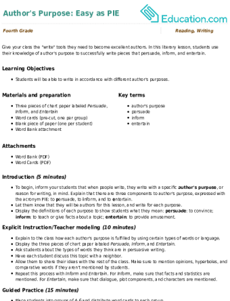
Author's Purpose: Easy as PIE
Lesson Plan
Author's Purpose: Easy as PIE
Fourth Grade
Reading
Give your class the "write" tools they need to become excellent authors. In this literary lesson, students use their knowledge of author's purpose to successfully write pieces that persuade, inform, and entertain.
Lesson Plan
Author's Purpose: Easy as PIE
Lesson Plan
Author's Purpose: Easy as PIE
Give your class the "write" tools they need to become excellent authors. In this literary lesson, students use their knowledge of author's purpose to successfully write pieces that persuade, inform, and entertain.
Fourth Grade
Reading
Lesson Plan
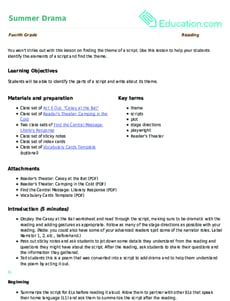
Summer Drama
Lesson Plan
Summer Drama
Fourth Grade
Vocabulary
You won't strike out with this lesson on finding the theme of a script. Use this lesson to help your students identify the elements of a script and find the theme.
Lesson Plan
Summer Drama
Lesson Plan
Summer Drama
You won't strike out with this lesson on finding the theme of a script. Use this lesson to help your students identify the elements of a script and find the theme.
Fourth Grade
Vocabulary
Lesson Plan
Where Am I?, Understanding Plot Lesson Part IIII
Lesson Plan
Where Am I?, Understanding Plot Lesson Part IIII
Fourth Grade
Sometimes authors choose to describe their setting for readers to imagine, but don't actually tell them where the story is set! In this lesson, students will learn to deduce settings from context.
Lesson Plan
Where Am I?, Understanding Plot Lesson Part IIII
Lesson Plan
Where Am I?, Understanding Plot Lesson Part IIII
Sometimes authors choose to describe their setting for readers to imagine, but don't actually tell them where the story is set! In this lesson, students will learn to deduce settings from context.
Fourth Grade
Lesson Plan
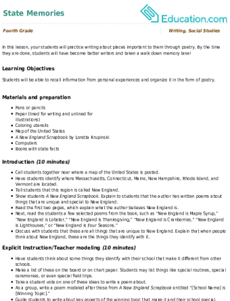
State Memories
Lesson Plan
State Memories
Fourth Grade
Reading
In this lesson, your students will practice writing about places important to them through poetry. By the time they are done, students will have become better writers and taken a walk down memory lane!
Lesson Plan
State Memories
Lesson Plan
State Memories
In this lesson, your students will practice writing about places important to them through poetry. By the time they are done, students will have become better writers and taken a walk down memory lane!
Fourth Grade
Reading
Lesson Plan
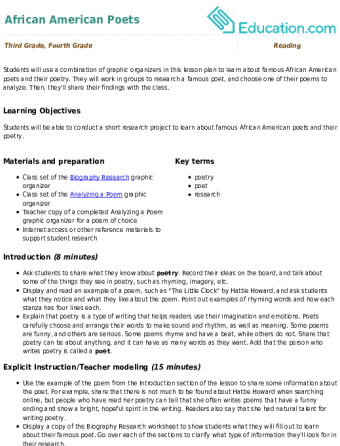
African American Poets
Lesson Plan
African American Poets
Third Grade
Students will use a combination of graphic organizers in this lesson plan to learn about famous African American poets and their poetry. They will work in groups to research a famous poet, and choose one of their poems to analyze. Then, they'll share their findings with the class.
Lesson Plan
African American Poets
Lesson Plan
African American Poets
Students will use a combination of graphic organizers in this lesson plan to learn about famous African American poets and their poetry. They will work in groups to research a famous poet, and choose one of their poems to analyze. Then, they'll share their findings with the class.
Third Grade
Lesson Plan
Battle of the Texts: Print vs. Electronics
Lesson Plan
Battle of the Texts: Print vs. Electronics
Fourth Grade
Are you a page turner or a mouse clicker? In this lesson, students compare and contrast text features in two types of nonfictions texts: print and electronic.
Lesson Plan
Battle of the Texts: Print vs. Electronics
Lesson Plan
Battle of the Texts: Print vs. Electronics
Are you a page turner or a mouse clicker? In this lesson, students compare and contrast text features in two types of nonfictions texts: print and electronic.
Fourth Grade
Lesson Plan
What's So Different? Comparing Characters
Lesson Plan
What's So Different? Comparing Characters
Fourth Grade
Using your acting skills and a great book by Chris Van Allsburg, you will lead your students on an adventure to compare characters and events throughout a book.
Lesson Plan
What's So Different? Comparing Characters
Lesson Plan
What's So Different? Comparing Characters
Using your acting skills and a great book by Chris Van Allsburg, you will lead your students on an adventure to compare characters and events throughout a book.
Fourth Grade
Lesson Plan
EL
Discovering Character Traits
Lesson Plan
Discovering Character Traits
Fourth Grade
Writing
This lesson will have your EL students exploring characters' dialogue and actions to determine their personality traits! Use it on its own or as a support lesson.
Lesson Plan
EL
Discovering Character Traits
Lesson Plan
Discovering Character Traits
This lesson will have your EL students exploring characters' dialogue and actions to determine their personality traits! Use it on its own or as a support lesson.
Fourth Grade
Writing
Lesson Plan
Reading Response Letters
Lesson Plan
Reading Response Letters
Fourth Grade
Grammar and Mechanics
How can you
see
what your students are thinking while they read? Try reading response letters in your class. Students will practice formatting letters and learn to discuss their thinking about literature in writing.
Lesson Plan
Reading Response Letters
Lesson Plan
Reading Response Letters
How can you
see
what your students are thinking while they read? Try reading response letters in your class. Students will practice formatting letters and learn to discuss their thinking about literature in writing.
Fourth Grade
Grammar and Mechanics
Lesson Plan
He Said/She Said, I Said/You Said
Lesson Plan
He Said/She Said, I Said/You Said
Fourth Grade
In this engaging lesson, students compare and contrast a firsthand account and a secondhand account of the same historical event: the sinking of the Titanic.
Lesson Plan
He Said/She Said, I Said/You Said
Lesson Plan
He Said/She Said, I Said/You Said
In this engaging lesson, students compare and contrast a firsthand account and a secondhand account of the same historical event: the sinking of the Titanic.
Fourth Grade
Lesson Plan
EL
Multiplying with Arrays
Lesson Plan
Multiplying with Arrays
Fourth Grade
Writing
Making mistakes helps us learn! Your students will flex their analytical muscles to pinpoint errors in multiplication problems using arrays. Use the lesson on its own or as support to Base Ten Arrays for Multi-Digit Multiplication.
Lesson Plan
EL
Multiplying with Arrays
Lesson Plan
Multiplying with Arrays
Making mistakes helps us learn! Your students will flex their analytical muscles to pinpoint errors in multiplication problems using arrays. Use the lesson on its own or as support to Base Ten Arrays for Multi-Digit Multiplication.
Fourth Grade
Writing
Lesson Plan
EL
Writing Decimal Subtraction Problems
Lesson Plan
Writing Decimal Subtraction Problems
Fourth Grade
Empower your students with the opportunity to design decimal subtraction problems with a given difference (answer). Use this lesson on its own or as support for the lesson Step By Step Decimal Subtraction.
Lesson Plan
EL
Writing Decimal Subtraction Problems
Lesson Plan
Writing Decimal Subtraction Problems
Empower your students with the opportunity to design decimal subtraction problems with a given difference (answer). Use this lesson on its own or as support for the lesson Step By Step Decimal Subtraction.
Fourth Grade
Lesson Plan
1