SKIP TO CONTENT
Worksheet Generator
Subjects
Grades
Worksheets
Games
Build a Worksheet
More Resources
Roly Recommends
Subjects
Grades
Worksheets
Games
Build a Worksheet
More Resources
Roly Recommends
Kindergarten - 4th Grade Lesson Plans : Page 11
Filters
2,097 results
Lesson Plans
✕
Kindergarten - 4th Grade
✕
Clear all
2,097 results
Filters
Lesson Plans
✕
Kindergarten - 4th Grade
✕
Subjects
Math
English Language Arts
Science
Social Studies
Technology
Grade Level
Pre-K
K
1st
2nd
3rd
4th
5th
6th
7th
8th
Early Childhood
Elementary School
Middle School
Resource Type
Worksheets
Games
Lesson Plans
Interactive Worksheets
Workbooks
Activities
Exercises
Stories
Songs
Offline Games
Guided Lessons
Teacher Resources
Teacher Editions
Occasion
Back to School
Common Core
Yes
Roly Recommends
Social Emotional Learning
Arts & Crafts
Paper & Glue Crafts
English Language Support
Yes
Clear all
View 2,097 results
Kindergarten - 4th Grade Lesson Plans : Page 11
Filters
2,097 results
Lesson Plans
✕
Kindergarten - 4th Grade
✕
Clear all
2,097 results
Moira's Birthday: Graphing
Lesson Plan
Moira's Birthday: Graphing
First Grade
In this lesson, your students will collect and use real data to create a simple bar graph. They will read a story and visually represent data before finding information on their own.
Lesson Plan
Moira's Birthday: Graphing
Lesson Plan
Moira's Birthday: Graphing
In this lesson, your students will collect and use real data to create a simple bar graph. They will read a story and visually represent data before finding information on their own.
First Grade
Lesson Plan
Researching the Past Using Primary Sources
Lesson Plan
Researching the Past Using Primary Sources
Fourth Grade
Reading
Knock, knock! It’s the U.S. Census Bureau! In this lesson plan, students analyze primary sources in the form of census data to do research that helps them answer questions about famous people and the time period during which they lived.
Lesson Plan
Researching the Past Using Primary Sources
Lesson Plan
Researching the Past Using Primary Sources
Knock, knock! It’s the U.S. Census Bureau! In this lesson plan, students analyze primary sources in the form of census data to do research that helps them answer questions about famous people and the time period during which they lived.
Fourth Grade
Reading
Lesson Plan
Let’s Get Irregular
Lesson Plan
Let’s Get Irregular
Second Grade
Second graders know about plural nouns, but things get trickier when they are introduced to irregular forms. In this lesson, students will receive an introduction to irregular plural nouns.
Lesson Plan
Let’s Get Irregular
Lesson Plan
Let’s Get Irregular
Second graders know about plural nouns, but things get trickier when they are introduced to irregular forms. In this lesson, students will receive an introduction to irregular plural nouns.
Second Grade
Lesson Plan
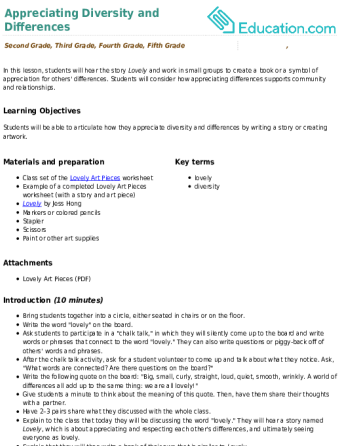
Appreciating Diversity and Differences
Lesson Plan
Appreciating Diversity and Differences
Second Grade
In this lesson, students will hear the story
Lovely
and work in small groups to create a book or a symbol of appreciation for others' differences. Students will consider how appreciating differences supports community and relationships.
Lesson Plan
Appreciating Diversity and Differences
Lesson Plan
Appreciating Diversity and Differences
In this lesson, students will hear the story
Lovely
and work in small groups to create a book or a symbol of appreciation for others' differences. Students will consider how appreciating differences supports community and relationships.
Second Grade
Lesson Plan
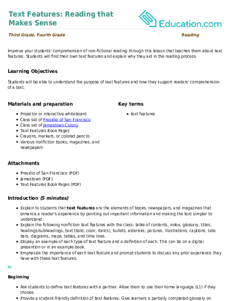
Text Features: Reading that Makes Sense
Lesson Plan
Text Features: Reading that Makes Sense
Third Grade
Reading
Improve your students' comprehension of non-fictional reading through this lesson that teaches them about text features. Students will find their own text features and explain why they aid in the reading process.
Lesson Plan
Text Features: Reading that Makes Sense
Lesson Plan
Text Features: Reading that Makes Sense
Improve your students' comprehension of non-fictional reading through this lesson that teaches them about text features. Students will find their own text features and explain why they aid in the reading process.
Third Grade
Reading
Lesson Plan
Southeast and Gulf State Weather
Lesson Plan
Southeast and Gulf State Weather
Fourth Grade
Reading
Whoa, weather! Using technology as an aid, students will put their research skills to the test while learning about hurricanes.
Lesson Plan
Southeast and Gulf State Weather
Lesson Plan
Southeast and Gulf State Weather
Whoa, weather! Using technology as an aid, students will put their research skills to the test while learning about hurricanes.
Fourth Grade
Reading
Lesson Plan
EL
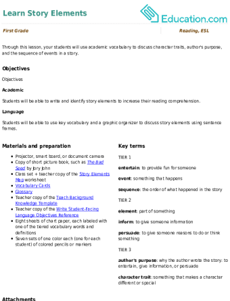
Learn Story Elements
Lesson Plan
Learn Story Elements
First Grade
Reading
Through this lesson, your students will use academic vocabulary to discuss character traits, author's purpose, and the sequence of events in a story.
Lesson Plan
EL
Learn Story Elements
Lesson Plan
Learn Story Elements
Through this lesson, your students will use academic vocabulary to discuss character traits, author's purpose, and the sequence of events in a story.
First Grade
Reading
Lesson Plan
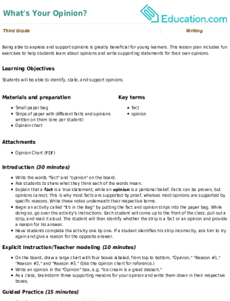
What's Your Opinion?
Lesson Plan
What's Your Opinion?
Third Grade
Writing
Being able to express and support opinions is greatly beneficial for young learners. This lesson plan includes fun exercises to help students learn about opinions and write supporting statements for their own opinions.
Lesson Plan
What's Your Opinion?
Lesson Plan
What's Your Opinion?
Being able to express and support opinions is greatly beneficial for young learners. This lesson plan includes fun exercises to help students learn about opinions and write supporting statements for their own opinions.
Third Grade
Writing
Lesson Plan
Running On: Copy Editing for Run-on Sentences
Lesson Plan
Running On: Copy Editing for Run-on Sentences
Third Grade
Writing
Equip your students to stop run-on sentences with punctuation and capitalization! In this lesson, your students will explore copyediting symbols for capitalization and punctuation and use these symbols as they edit writing.
Lesson Plan
Running On: Copy Editing for Run-on Sentences
Lesson Plan
Running On: Copy Editing for Run-on Sentences
Equip your students to stop run-on sentences with punctuation and capitalization! In this lesson, your students will explore copyediting symbols for capitalization and punctuation and use these symbols as they edit writing.
Third Grade
Writing
Lesson Plan
My Teacher for President!
Lesson Plan
My Teacher for President!
Second Grade
Writing
Need a promotion? Then have your students participate in a writing lesson that will have them voting for you! Give students the opportunity to place teachers in the spotlight, as they persuade others why teachers make the best presidents.
Lesson Plan
My Teacher for President!
Lesson Plan
My Teacher for President!
Need a promotion? Then have your students participate in a writing lesson that will have them voting for you! Give students the opportunity to place teachers in the spotlight, as they persuade others why teachers make the best presidents.
Second Grade
Writing
Lesson Plan
Pondering the Purpose, Aiming for an Audience
Lesson Plan
Pondering the Purpose, Aiming for an Audience
Third Grade
Help your students plan with a purpose! With instruction on both audience and purpose, your students will be equipped to strategically write for specific audiences.
Lesson Plan
Pondering the Purpose, Aiming for an Audience
Lesson Plan
Pondering the Purpose, Aiming for an Audience
Help your students plan with a purpose! With instruction on both audience and purpose, your students will be equipped to strategically write for specific audiences.
Third Grade
Lesson Plan
Reviewing the Research Process
Lesson Plan
Reviewing the Research Process
Fourth Grade
Writing a research paper is a huge undertaking. Getting curious about your topic and breaking it down into steps makes it more inviting and doable. Use this lesson to review the research process.
Lesson Plan
Reviewing the Research Process
Lesson Plan
Reviewing the Research Process
Writing a research paper is a huge undertaking. Getting curious about your topic and breaking it down into steps makes it more inviting and doable. Use this lesson to review the research process.
Fourth Grade
Lesson Plan
Onomatopoeia: Bing, Bam, Boom!
Lesson Plan
Onomatopoeia: Bing, Bam, Boom!
Third Grade
Bing! Bam! Boom! In this bombastic lesson, students will learn about onomatopoeia and create word art to describe the sounds these words make.
Lesson Plan
Onomatopoeia: Bing, Bam, Boom!
Lesson Plan
Onomatopoeia: Bing, Bam, Boom!
Bing! Bam! Boom! In this bombastic lesson, students will learn about onomatopoeia and create word art to describe the sounds these words make.
Third Grade
Lesson Plan
What's Your Phase?
Lesson Plan
What's Your Phase?
Third Grade
Earth and Space Science
This lesson engages students in activity to help them understand the phases of the Moon, and why they occur. Students read literature, analyze it, and then apply it to the small group performance of one cycle of the Moon’s phases.
Lesson Plan
What's Your Phase?
Lesson Plan
What's Your Phase?
This lesson engages students in activity to help them understand the phases of the Moon, and why they occur. Students read literature, analyze it, and then apply it to the small group performance of one cycle of the Moon’s phases.
Third Grade
Earth and Space Science
Lesson Plan
Idiom Pictionary and Charades
Lesson Plan
Idiom Pictionary and Charades
Fourth Grade
Idioms can be a pain in the neck to understand! Help your students become acquainted with many of the English language's funny and confusing idioms in this lesson that has them using their creativity to act out or illustrate idioms.
Lesson Plan
Idiom Pictionary and Charades
Lesson Plan
Idiom Pictionary and Charades
Idioms can be a pain in the neck to understand! Help your students become acquainted with many of the English language's funny and confusing idioms in this lesson that has them using their creativity to act out or illustrate idioms.
Fourth Grade
Lesson Plan
Homophone Posters
Lesson Plan
Homophone Posters
Fourth Grade
Homophones are frequently misused in student writing. This lesson teaches students about many of the commonly misused homophones through the creation of a poster on one set of homophones.
Lesson Plan
Homophone Posters
Lesson Plan
Homophone Posters
Homophones are frequently misused in student writing. This lesson teaches students about many of the commonly misused homophones through the creation of a poster on one set of homophones.
Fourth Grade
Lesson Plan
Same Sounds: Homophones
Lesson Plan
Same Sounds: Homophones
Third Grade
Can you hear the words here? Help your students distinguish homophones with this lesson. They'll be identifying the correct words in no time!
Lesson Plan
Same Sounds: Homophones
Lesson Plan
Same Sounds: Homophones
Can you hear the words here? Help your students distinguish homophones with this lesson. They'll be identifying the correct words in no time!
Third Grade
Lesson Plan
Literary Argument Writing: Defining Your Topic
Lesson Plan
Literary Argument Writing: Defining Your Topic
Fourth Grade
Writing
This lesson will help your young writers develop a claim, or thesis, and construct an argument around it. You may have students complete the essay by continuing the process with the lesson Literary Argument Writing: Drafting Your Essay.
Lesson Plan
Literary Argument Writing: Defining Your Topic
Lesson Plan
Literary Argument Writing: Defining Your Topic
This lesson will help your young writers develop a claim, or thesis, and construct an argument around it. You may have students complete the essay by continuing the process with the lesson Literary Argument Writing: Drafting Your Essay.
Fourth Grade
Writing
Lesson Plan
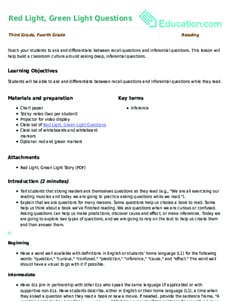
Red Light, Green Light Questions
Lesson Plan
Red Light, Green Light Questions
Third Grade
Statistics
Teach your students to ask and differentiate between recall questions and inferential questions. This lesson will help build a classroom culture around asking deep, inferential questions.
Lesson Plan
Red Light, Green Light Questions
Lesson Plan
Red Light, Green Light Questions
Teach your students to ask and differentiate between recall questions and inferential questions. This lesson will help build a classroom culture around asking deep, inferential questions.
Third Grade
Statistics
Lesson Plan
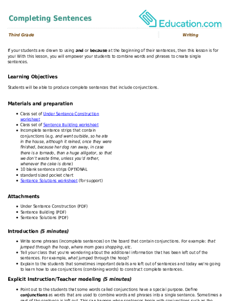
Completing Sentences
Lesson Plan
Completing Sentences
Third Grade
If your students are drawn to using
and
or
because
at the beginning of their sentences, then this lesson is for you! With this lesson, you will empower your students to combine words and phrases to create single sentences.
Lesson Plan
Completing Sentences
Lesson Plan
Completing Sentences
If your students are drawn to using
and
or
because
at the beginning of their sentences, then this lesson is for you! With this lesson, you will empower your students to combine words and phrases to create single sentences.
Third Grade
Lesson Plan
EL
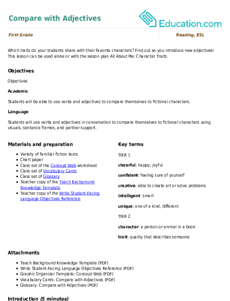
Compare with Adjectives
Lesson Plan
Compare with Adjectives
First Grade
Which traits do your students share with their favorite characters? Find out as you introduce new adjectives! This lesson can be used alone or with the lesson plan All About Me: Character Traits.
Lesson Plan
EL
Compare with Adjectives
Lesson Plan
Compare with Adjectives
Which traits do your students share with their favorite characters? Find out as you introduce new adjectives! This lesson can be used alone or with the lesson plan All About Me: Character Traits.
First Grade
Lesson Plan
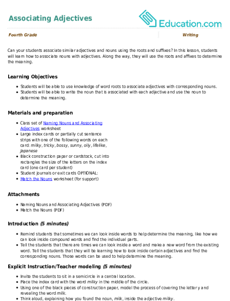
Associating Adjectives
Lesson Plan
Associating Adjectives
Fourth Grade
Can your students associate similar adjectives and nouns using the roots and suffixes? In this lesson, students will learn how to associate nouns with adjectives. Along the way, they will use the roots and affixes to determine the meaning.
Lesson Plan
Associating Adjectives
Lesson Plan
Associating Adjectives
Can your students associate similar adjectives and nouns using the roots and suffixes? In this lesson, students will learn how to associate nouns with adjectives. Along the way, they will use the roots and affixes to determine the meaning.
Fourth Grade
Lesson Plan
Does the Subject Agree with the Verb?
Lesson Plan
Does the Subject Agree with the Verb?
Third Grade
In this lesson, your students will learn that subject-verb agreement is very important, and without it, readers can get confused. By the end of this lesson, your students will be able to generate sentences that make sense!
Lesson Plan
Does the Subject Agree with the Verb?
Lesson Plan
Does the Subject Agree with the Verb?
In this lesson, your students will learn that subject-verb agreement is very important, and without it, readers can get confused. By the end of this lesson, your students will be able to generate sentences that make sense!
Third Grade
Lesson Plan
Fiction vs. Nonfiction
Lesson Plan
Fiction vs. Nonfiction
Fourth Grade
Reading
Kids will love learning some fun facts about elephants while developing their reading comprehension skills. Using T-charts and Venn diagrams, they'll analyze stories and explore different characteristics of fiction and nonfiction.
Lesson Plan
Fiction vs. Nonfiction
Lesson Plan
Fiction vs. Nonfiction
Kids will love learning some fun facts about elephants while developing their reading comprehension skills. Using T-charts and Venn diagrams, they'll analyze stories and explore different characteristics of fiction and nonfiction.
Fourth Grade
Reading
Lesson Plan
All About Me: Character Traits
Lesson Plan
All About Me: Character Traits
First Grade
It's all about me! In this lesson, students will identify character traits in a story and decide if they have the same traits. This lesson incorporates literature, writing, comparison skills, and social skills.
Lesson Plan
All About Me: Character Traits
Lesson Plan
All About Me: Character Traits
It's all about me! In this lesson, students will identify character traits in a story and decide if they have the same traits. This lesson incorporates literature, writing, comparison skills, and social skills.
First Grade
Lesson Plan
Chemistry Is Marie Curie
Lesson Plan
Chemistry Is Marie Curie
Fourth Grade
Reading
Marie Curie’s monumental achievements in chemistry and physics are remarkable. In this lesson, your students will read two accounts of her life, integrate the details, and assess the importance of having more than one source of information.
Lesson Plan
Chemistry Is Marie Curie
Lesson Plan
Chemistry Is Marie Curie
Marie Curie’s monumental achievements in chemistry and physics are remarkable. In this lesson, your students will read two accounts of her life, integrate the details, and assess the importance of having more than one source of information.
Fourth Grade
Reading
Lesson Plan
Partnering Addition and Multiplication
Lesson Plan
Partnering Addition and Multiplication
Third Grade
Multiplication is no longer a mystery when it is partnered with addition! Help your students make connections between multiplication and repeated addition with this hands-on lesson that includes several types of concrete examples.
Lesson Plan
Partnering Addition and Multiplication
Lesson Plan
Partnering Addition and Multiplication
Multiplication is no longer a mystery when it is partnered with addition! Help your students make connections between multiplication and repeated addition with this hands-on lesson that includes several types of concrete examples.
Third Grade
Lesson Plan
Grab & Go Sentences!
Lesson Plan
Grab & Go Sentences!
Second Grade
Grammar and Mechanics
It’s time to make some sentences! In this lesson, students will review parts of speech and simple vs. complex sentences. They will then use their knowledge to create word grab bags to use when forming sentences.
Lesson Plan
Grab & Go Sentences!
Lesson Plan
Grab & Go Sentences!
It’s time to make some sentences! In this lesson, students will review parts of speech and simple vs. complex sentences. They will then use their knowledge to create word grab bags to use when forming sentences.
Second Grade
Grammar and Mechanics
Lesson Plan
Sentence Menu
Lesson Plan
Sentence Menu
Second Grade
Grammar and Mechanics
We write sentences to tell thoughts, but what happens when we add some parameters? In this lesson, students dissect the words they find in sentences then follow directions to create their own wacky sentences.
Lesson Plan
Sentence Menu
Lesson Plan
Sentence Menu
We write sentences to tell thoughts, but what happens when we add some parameters? In this lesson, students dissect the words they find in sentences then follow directions to create their own wacky sentences.
Second Grade
Grammar and Mechanics
Lesson Plan
EL
Discovering Character Traits
Lesson Plan
Discovering Character Traits
Fourth Grade
Writing
This lesson will have your EL students exploring characters' dialogue and actions to determine their personality traits! Use it on its own or as a support lesson.
Lesson Plan
EL
Discovering Character Traits
Lesson Plan
Discovering Character Traits
This lesson will have your EL students exploring characters' dialogue and actions to determine their personality traits! Use it on its own or as a support lesson.
Fourth Grade
Writing
Lesson Plan
1
…
10
11
12
…
70