SKIP TO CONTENT
Worksheet Generator
Subjects
Grades
Worksheets
Games
Build a Worksheet
More Resources
Roly Recommends
Summer Boost
Subjects
Grades
Worksheets
Games
Build a Worksheet
More Resources
Roly Recommends
Summer Boost
Showing Results for circle : Page 64
Filters
2,031 results
Search for: circle
✕
Clear all
2,031 results
Filters
Search for: circle
✕
Subjects
Math
English Language Arts
Science
Social Studies
Foreign Language
Technology
Grade Level
Pre-K
K
1st
2nd
3rd
4th
5th
6th
7th
8th
Early Childhood
Elementary School
Middle School
Resource Type
Worksheets
Games
Lesson Plans
Interactive Worksheets
Workbooks
Activities
Exercises
Stories
Offline Games
Teacher Resources
See more
Occasion
Birthdays
Women's History Month
St. Patrick's Day
Ramadan
Passover
Spring
Easter
Earth Day
Cinco de Mayo
Mother's Day
Memorial Day
Summer
Father's Day
Independence Day
Back to School
Fall
Halloween
Veterans Day
Winter
Holidays
Thanksgiving
Christmas
Hanukkah
Kwanzaa
Martin Luther King Jr. Day
Lunar New Year
Valentine's Day
Presidents' Day
Black History Month
See more
Common Core
Yes
Roly Recommends
Social Emotional Learning
Game Type
Mazes
Ball Games
Crossword
Fitness & Exercise
Group Games
Outdoor Games
Printable Board Games
Puzzles & Sudoku
Travel Games
Word Puzzles
Word Search
See more
Arts & Crafts
Arts & Crafts
Fabric Projects
Beads & Jewelry
Paper & Glue Crafts
Construction & Sculpture
Painting & Drawing
Recycled Crafts
Coloring
Yes
Recipes
Snacks
Mains
Sides
English Language Support
Yes
Clear all
View 2,031 results
Showing Results for circle : Page 64
Filters
2,031 results
Search for: circle
✕
Clear all
2,031 results
Adding with Dominoes and Playing Cards
Lesson Plan
Adding with Dominoes and Playing Cards
First Grade
Addition
Double dominoes! Get your students excited to add with dominoes and playing cards. This lesson is a fun way to help your students continue to learn to add.
Lesson Plan
Adding with Dominoes and Playing Cards
Lesson Plan
Adding with Dominoes and Playing Cards
Double dominoes! Get your students excited to add with dominoes and playing cards. This lesson is a fun way to help your students continue to learn to add.
First Grade
Addition
Lesson Plan
Regular vs. Irregular Verbs
Lesson Plan
Regular vs. Irregular Verbs
Second Grade
Are you a rule-follower or a rule-breaker? Irregular verbs break all the rules! Use this lesson to teach your students how to use the correct past tense form of regular and irregular verbs.
Lesson Plan
Regular vs. Irregular Verbs
Lesson Plan
Regular vs. Irregular Verbs
Are you a rule-follower or a rule-breaker? Irregular verbs break all the rules! Use this lesson to teach your students how to use the correct past tense form of regular and irregular verbs.
Second Grade
Lesson Plan
EL
Focus on the Differences
Lesson Plan
Focus on the Differences
Third Grade
Reading
Use this lesson with your students to teach them to describe the differences between stories with contrasting conjunctions. This lesson can stand-alone or be used as a pre-lesson for the
Finding Similarities and Differences
lesson.
Lesson Plan
EL
Focus on the Differences
Lesson Plan
Focus on the Differences
Use this lesson with your students to teach them to describe the differences between stories with contrasting conjunctions. This lesson can stand-alone or be used as a pre-lesson for the
Finding Similarities and Differences
lesson.
Third Grade
Reading
Lesson Plan
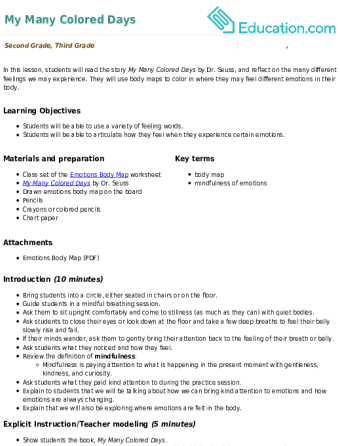
My Many Colored Days
Lesson Plan
My Many Colored Days
Second Grade
In this lesson, students will read the story
My Many Colored Days
by Dr. Seuss, and reflect on the many different feelings we may experience. They will use body maps to color in where they may feel different emotions in their body.
Lesson Plan
My Many Colored Days
Lesson Plan
My Many Colored Days
In this lesson, students will read the story
My Many Colored Days
by Dr. Seuss, and reflect on the many different feelings we may experience. They will use body maps to color in where they may feel different emotions in their body.
Second Grade
Lesson Plan
Fact or Assumption
Lesson Plan
Fact or Assumption
Second Grade
Distinguishing between facts and assumptions is an important life skill. In this lesson, students will articulate the difference between assumptions and facts through class discussion and a poster activity.
Lesson Plan
Fact or Assumption
Lesson Plan
Fact or Assumption
Distinguishing between facts and assumptions is an important life skill. In this lesson, students will articulate the difference between assumptions and facts through class discussion and a poster activity.
Second Grade
Lesson Plan
Use an Action Verb
Lesson Plan
Use an Action Verb
Third Grade
Show me some action! Use this grammar lesson with your students to teach them how to identify and use action verbs in sentences.
Lesson Plan
Use an Action Verb
Lesson Plan
Use an Action Verb
Show me some action! Use this grammar lesson with your students to teach them how to identify and use action verbs in sentences.
Third Grade
Lesson Plan
What is a Region?
Lesson Plan
What is a Region?
Fourth Grade
Geography
Through examples and non-examples, students will learn what qualifies as a region. Creativity and problem solving skills will be put to the test as students determine the necessary elements that make up a region.
Lesson Plan
What is a Region?
Lesson Plan
What is a Region?
Through examples and non-examples, students will learn what qualifies as a region. Creativity and problem solving skills will be put to the test as students determine the necessary elements that make up a region.
Fourth Grade
Geography
Lesson Plan
EL
Vocabulary in Context
Lesson Plan
Vocabulary in Context
Fourth Grade
In this lesson, students will improve their skills in using context clues to determine the meaning of difficult words. Use it as a stand-alone lesson or as support to the lesson Journey on the Underground Railroad.
Lesson Plan
EL
Vocabulary in Context
Lesson Plan
Vocabulary in Context
In this lesson, students will improve their skills in using context clues to determine the meaning of difficult words. Use it as a stand-alone lesson or as support to the lesson Journey on the Underground Railroad.
Fourth Grade
Lesson Plan
EL
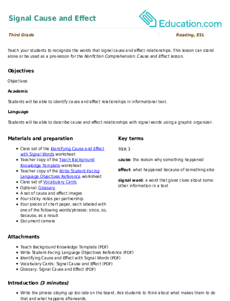
Signal Cause and Effect
Lesson Plan
Signal Cause and Effect
Third Grade
Teach your students to recognize the words that signal cause and effect relationships. This lesson can stand alone or be used as a pre-lesson for the
Nonfiction Comprehension: Cause and Effect
lesson.
Lesson Plan
EL
Signal Cause and Effect
Lesson Plan
Signal Cause and Effect
Teach your students to recognize the words that signal cause and effect relationships. This lesson can stand alone or be used as a pre-lesson for the
Nonfiction Comprehension: Cause and Effect
lesson.
Third Grade
Lesson Plan
Strengthening Our Brains With Mindfulness
Lesson Plan
Strengthening Our Brains With Mindfulness
Kindergarten
In this lesson, students will use Daniel Siegel’s “hand model of the brain” to identify how their brains work. They will learn the term “prefrontal cortex" (PFC) and about how their brains can grow when they learn new things.
Lesson Plan
Strengthening Our Brains With Mindfulness
Lesson Plan
Strengthening Our Brains With Mindfulness
In this lesson, students will use Daniel Siegel’s “hand model of the brain” to identify how their brains work. They will learn the term “prefrontal cortex" (PFC) and about how their brains can grow when they learn new things.
Kindergarten
Lesson Plan
Skip Counting to Understand Multiplication
Lesson Plan
Skip Counting to Understand Multiplication
Third Grade
Teach your students to use skip counting as a strategy to multiply two single-digit factors.
Lesson Plan
Skip Counting to Understand Multiplication
Lesson Plan
Skip Counting to Understand Multiplication
Teach your students to use skip counting as a strategy to multiply two single-digit factors.
Third Grade
Lesson Plan
My Community and I
Lesson Plan
My Community and I
Second Grade
Community and Culture
In this lesson, students will develop an understanding of communities and will learn how to locate their communities on a map.
Lesson Plan
My Community and I
Lesson Plan
My Community and I
In this lesson, students will develop an understanding of communities and will learn how to locate their communities on a map.
Second Grade
Community and Culture
Lesson Plan
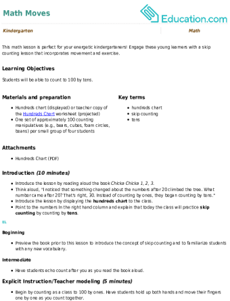
Math Moves
Lesson Plan
Math Moves
Kindergarten
This math lesson is perfect for your energetic kindergarteners! Engage these young learners with a skip counting lesson that incorporates movement and exercise.
Lesson Plan
Math Moves
Lesson Plan
Math Moves
This math lesson is perfect for your energetic kindergarteners! Engage these young learners with a skip counting lesson that incorporates movement and exercise.
Kindergarten
Lesson Plan
Superhero Senses
Lesson Plan
Superhero Senses
Kindergarten
In this lesson, students will learn about their superpower sense of listening and speaking by listening and responding to questions with kindness, attention, and mindfulness.
Lesson Plan
Superhero Senses
Lesson Plan
Superhero Senses
In this lesson, students will learn about their superpower sense of listening and speaking by listening and responding to questions with kindness, attention, and mindfulness.
Kindergarten
Lesson Plan
Increasing Reading Stamina and Comprehension
Lesson Plan
Increasing Reading Stamina and Comprehension
Second Grade
Reading
This lesson provides teachers with an opportunity to teach students about reading stamina and assess student comprehension during independent reading.
Lesson Plan
Increasing Reading Stamina and Comprehension
Lesson Plan
Increasing Reading Stamina and Comprehension
This lesson provides teachers with an opportunity to teach students about reading stamina and assess student comprehension during independent reading.
Second Grade
Reading
Lesson Plan
EL
Nonfiction Main Idea
Lesson Plan
Nonfiction Main Idea
Fourth Grade
Reading
Let's get reading! In this lesson, students will identify the main idea and details of a nonfiction text. Use this on its own or as support for the lesson Connecting the Coasts: Effects of the Transcontinental Railroad.
Lesson Plan
EL
Nonfiction Main Idea
Lesson Plan
Nonfiction Main Idea
Let's get reading! In this lesson, students will identify the main idea and details of a nonfiction text. Use this on its own or as support for the lesson Connecting the Coasts: Effects of the Transcontinental Railroad.
Fourth Grade
Reading
Lesson Plan
Regrouping with Popsicle Sticks: Double-Digit Subtraction
Lesson Plan
Regrouping with Popsicle Sticks: Double-Digit Subtraction
Third Grade
Can you break a ten? An everyday exchange of money can help students think about regrouping to subtract. Students will use bundled popsicle sticks to see how values grouped into tens can be regrouped into ones to allow us to subtract.
Lesson Plan
Regrouping with Popsicle Sticks: Double-Digit Subtraction
Lesson Plan
Regrouping with Popsicle Sticks: Double-Digit Subtraction
Can you break a ten? An everyday exchange of money can help students think about regrouping to subtract. Students will use bundled popsicle sticks to see how values grouped into tens can be regrouped into ones to allow us to subtract.
Third Grade
Lesson Plan
EL
What Are Equivalent Fractions?
Lesson Plan
What Are Equivalent Fractions?
Third Grade
Get your students to think deeply about fractions as they discuss which pictures show equivalence. Use this as a stand alone lesson or a pre-lesson for the
Equivalent Fractions: Are They Equal?
lesson.
Lesson Plan
EL
What Are Equivalent Fractions?
Lesson Plan
What Are Equivalent Fractions?
Get your students to think deeply about fractions as they discuss which pictures show equivalence. Use this as a stand alone lesson or a pre-lesson for the
Equivalent Fractions: Are They Equal?
lesson.
Third Grade
Lesson Plan
EL
Using Adjectives and Similes to Describe
Lesson Plan
Using Adjectives and Similes to Describe
Third Grade
Vocabulary
Use this lesson to help your ELs explore adjectives and how we can use them to describe things. This lesson can stand alone or be used as a pre-lesson for the
Similes that Describe ME!
lesson.
Lesson Plan
EL
Using Adjectives and Similes to Describe
Lesson Plan
Using Adjectives and Similes to Describe
Use this lesson to help your ELs explore adjectives and how we can use them to describe things. This lesson can stand alone or be used as a pre-lesson for the
Similes that Describe ME!
lesson.
Third Grade
Vocabulary
Lesson Plan
EL
Character Actions and Emotions
Lesson Plan
Character Actions and Emotions
Fourth Grade
Use this lesson to help your ELs describe a character’s emotion based on actions. It can be a stand-alone lesson or used as support to the lesson Close Reading: Reading Through Character Emotion.
Lesson Plan
EL
Character Actions and Emotions
Lesson Plan
Character Actions and Emotions
Use this lesson to help your ELs describe a character’s emotion based on actions. It can be a stand-alone lesson or used as support to the lesson Close Reading: Reading Through Character Emotion.
Fourth Grade
Lesson Plan
EL
Two Perspectives
Lesson Plan
Two Perspectives
Fifth Grade
Reading
Use this lesson to help your ELs understand how to use conjunctions when contrasting information from two different characters’ perspectives. It can be a stand-alone lesson or used as support to the Whose Point Is It Anyway? lesson.
Lesson Plan
EL
Two Perspectives
Lesson Plan
Two Perspectives
Use this lesson to help your ELs understand how to use conjunctions when contrasting information from two different characters’ perspectives. It can be a stand-alone lesson or used as support to the Whose Point Is It Anyway? lesson.
Fifth Grade
Reading
Lesson Plan
My View as an Ant
Lesson Plan
My View as an Ant
Third Grade
Vocabulary
Give students a chance to experience a different point of view! This fANTastic lesson on narrative style turns young readers into characters of Chris Van Allsburg's Two Bad Ants.
Lesson Plan
My View as an Ant
Lesson Plan
My View as an Ant
Give students a chance to experience a different point of view! This fANTastic lesson on narrative style turns young readers into characters of Chris Van Allsburg's Two Bad Ants.
Third Grade
Vocabulary
Lesson Plan
EL
Match Author's Point with Evidence
Lesson Plan
Match Author's Point with Evidence
Fifth Grade
Writing
Use this lesson to help your ELs identify and discuss the author's point and the information that supports it. It can be a stand-alone lesson or used as support for the What’s the Point? lesson.
Lesson Plan
EL
Match Author's Point with Evidence
Lesson Plan
Match Author's Point with Evidence
Use this lesson to help your ELs identify and discuss the author's point and the information that supports it. It can be a stand-alone lesson or used as support for the What’s the Point? lesson.
Fifth Grade
Writing
Lesson Plan
EL
Characters and Dialogue
Lesson Plan
Characters and Dialogue
Third Grade
Writing
Help your ELs identify the characters and their dialogue in a story. This lesson can stand alone or be used as a pre-lesson for the
Action! Students Create Reader’s Theater
lesson.
Lesson Plan
EL
Characters and Dialogue
Lesson Plan
Characters and Dialogue
Help your ELs identify the characters and their dialogue in a story. This lesson can stand alone or be used as a pre-lesson for the
Action! Students Create Reader’s Theater
lesson.
Third Grade
Writing
Lesson Plan
EL
Elections and Conditions
Lesson Plan
Elections and Conditions
Fifth Grade
Reading
Use this lesson to help your ELs understand details in a sentence by identifying conditional phrases. It can be a stand-alone lesson or used as support to the lesson Comparing Primary and Secondary Sources.
Lesson Plan
EL
Elections and Conditions
Lesson Plan
Elections and Conditions
Use this lesson to help your ELs understand details in a sentence by identifying conditional phrases. It can be a stand-alone lesson or used as support to the lesson Comparing Primary and Secondary Sources.
Fifth Grade
Reading
Lesson Plan
EL
Evidence as a Statement
Lesson Plan
Evidence as a Statement
Third Grade
Teach your students to explain details in a text by using declarative sentences. This lesson can stand alone or be used as a pre-lesson for the
Color Coding Nonfiction Text
lesson.
Lesson Plan
EL
Evidence as a Statement
Lesson Plan
Evidence as a Statement
Teach your students to explain details in a text by using declarative sentences. This lesson can stand alone or be used as a pre-lesson for the
Color Coding Nonfiction Text
lesson.
Third Grade
Lesson Plan
EL
Inferences and Introductory Phrases
Lesson Plan
Inferences and Introductory Phrases
Fourth Grade
In this lesson, students are asked to cite the text for evidence as they make an inference in a nonfiction text. It can be taught on its own or used as a pre-lesson to Inferences in Nonfiction Texts: Cesar Chavez and Farmworker Rights.
Lesson Plan
EL
Inferences and Introductory Phrases
Lesson Plan
Inferences and Introductory Phrases
In this lesson, students are asked to cite the text for evidence as they make an inference in a nonfiction text. It can be taught on its own or used as a pre-lesson to Inferences in Nonfiction Texts: Cesar Chavez and Farmworker Rights.
Fourth Grade
Lesson Plan
Learning About Cause and Effect!
Lesson Plan
Learning About Cause and Effect!
Second Grade
Help your students understand what cause and effect looks like in everyday situations! This hands-on, engaging lesson plan allows students to examine cause and effect in their own lives as well as fictional text!
Lesson Plan
Learning About Cause and Effect!
Lesson Plan
Learning About Cause and Effect!
Help your students understand what cause and effect looks like in everyday situations! This hands-on, engaging lesson plan allows students to examine cause and effect in their own lives as well as fictional text!
Second Grade
Lesson Plan
Introducing the Number Three!
Lesson Plan
Introducing the Number Three!
Pre-K
In this introductory math lesson, students will become familiar with the concept of counting and representing numbers with concrete materials. Your students will enjoy using their creativity as they practice representing the number three on their very own!
Lesson Plan
Introducing the Number Three!
Lesson Plan
Introducing the Number Three!
In this introductory math lesson, students will become familiar with the concept of counting and representing numbers with concrete materials. Your students will enjoy using their creativity as they practice representing the number three on their very own!
Pre-K
Lesson Plan
EL
Main Idea and Details in Nonfiction
Lesson Plan
Main Idea and Details in Nonfiction
Fourth Grade
Reading
In this lesson, students will identify nouns and pronouns as they distinguish between the main idea and supporting details. It may be taught on its own or used as support for the lesson Compare and Contrast Texts on the Same Topic.
Lesson Plan
EL
Main Idea and Details in Nonfiction
Lesson Plan
Main Idea and Details in Nonfiction
In this lesson, students will identify nouns and pronouns as they distinguish between the main idea and supporting details. It may be taught on its own or used as support for the lesson Compare and Contrast Texts on the Same Topic.
Fourth Grade
Reading
Lesson Plan
1
…
63
64
65
…
68