SKIP TO CONTENT
Worksheet Generator
Subjects
Grades
Worksheets
Games
Build a Worksheet
More Resources
Roly Recommends
Reading Month
Subjects
Grades
Worksheets
Games
Build a Worksheet
More Resources
Roly Recommends
Reading Month
Filters
Search for: non-fiction-text-examples
✕
Lesson Plans
✕
2nd and 3rd Grade
✕
Subjects
Math
English Language Arts
Science
Social Studies
Grade Level
Pre-K
K
1st
2nd
3rd
4th
5th
6th
7th
8th
Early Childhood
Elementary School
Middle School
Resource Type
Worksheets
Games
Lesson Plans
Interactive Worksheets
Workbooks
Activities
Exercises
Stories
Songs
Offline Games
Guided Lessons
Teacher Resources
Common Core
Yes
Roly Recommends
Social Emotional Learning
English Language Support
Yes
See More
Clear All
View 532 results
Showing Results for non-fiction-text-examples
532 results
Search for: non-fiction-text-examples
✕
Lesson Plans
✕
2nd and 3rd Grade
✕
Clear All
Sort by:
Relevance
Most recent
Most popular
Alphabetical A-Z
Alphabetical Z-A
All filters
532 results
Sort by:
Relevance
Most recent
Most popular
Alphabetical A-Z
Alphabetical Z-A
Summarize a Nonfiction Text
Lesson Plan
Summarize a Nonfiction Text
Second Grade
Writing
Use this lesson to help your ELs understand how to write effective nonfiction text summaries. It can be a stand-alone lesson or a support lesson to the Create a Non-fiction Text Summary lesson plan.
Lesson Plan
Summarize a Nonfiction Text
Lesson Plan
Summarize a Nonfiction Text
Use this lesson to help your ELs understand how to write effective nonfiction text summaries. It can be a stand-alone lesson or a support lesson to the Create a Non-fiction Text Summary lesson plan.
Second Grade
Writing
Lesson Plan
Author’s Purpose in Fiction Texts
Lesson Plan
Author’s Purpose in Fiction Texts
Second Grade
Introduce the concept of author’s purpose in fiction texts with this fun reading lesson! Students will discuss three examples of fictional texts to determine the purpose of each.
Lesson Plan
Author’s Purpose in Fiction Texts
Lesson Plan
Author’s Purpose in Fiction Texts
Introduce the concept of author’s purpose in fiction texts with this fun reading lesson! Students will discuss three examples of fictional texts to determine the purpose of each.
Second Grade
Lesson Plan
Summary Raceway: Summarizing Fiction
Lesson Plan
Summary Raceway: Summarizing Fiction
Third Grade
Writing
Start Your Engines! It's time to teach your students how to summarize fiction text as you race down Summary Raceway.
Lesson Plan
Summary Raceway: Summarizing Fiction
Lesson Plan
Summary Raceway: Summarizing Fiction
Start Your Engines! It's time to teach your students how to summarize fiction text as you race down Summary Raceway.
Third Grade
Writing
Lesson Plan
Text Features: Reading that Makes Sense
Lesson Plan
Text Features: Reading that Makes Sense
Third Grade
Reading
Improve your students' comprehension of non-fictional reading through this lesson that teaches them about text features. Students will find their own text features and explain why they aid in the reading process.
Lesson Plan
Text Features: Reading that Makes Sense
Lesson Plan
Text Features: Reading that Makes Sense
Improve your students' comprehension of non-fictional reading through this lesson that teaches them about text features. Students will find their own text features and explain why they aid in the reading process.
Third Grade
Reading
Lesson Plan
The Purpose of Fiction Texts
Lesson Plan
The Purpose of Fiction Texts
Second Grade
Why does someone write a story? Give your students the tools to find out the author's purpose! Use this as a stand-alone lesson or as an introduction to the Author’s Purpose in Fiction Texts lesson plan.
Lesson Plan
The Purpose of Fiction Texts
Lesson Plan
The Purpose of Fiction Texts
Why does someone write a story? Give your students the tools to find out the author's purpose! Use this as a stand-alone lesson or as an introduction to the Author’s Purpose in Fiction Texts lesson plan.
Second Grade
Lesson Plan
Renewable and Non-Renewable Energy
Lesson Plan
Renewable and Non-Renewable Energy
Second Grade
Physical Science
Energy is an essential part of our daily lives, but the resources that power the Earth are being threatened. In this lesson, students learn about renewable and non-renewable resources, including those that need protection.
Lesson Plan
Renewable and Non-Renewable Energy
Lesson Plan
Renewable and Non-Renewable Energy
Energy is an essential part of our daily lives, but the resources that power the Earth are being threatened. In this lesson, students learn about renewable and non-renewable resources, including those that need protection.
Second Grade
Physical Science
Lesson Plan
Learning About Text Features
Lesson Plan
Learning About Text Features
Second Grade
In this lesson, students will read text features and discuss how each text feature relates to the main idea of a nonfiction text. Use a stand alone activity or a support for the Examining the Author's Purpose in a Nonfiction Text lesson.
Lesson Plan
Learning About Text Features
Lesson Plan
Learning About Text Features
In this lesson, students will read text features and discuss how each text feature relates to the main idea of a nonfiction text. Use a stand alone activity or a support for the Examining the Author's Purpose in a Nonfiction Text lesson.
Second Grade
Lesson Plan
Nonfiction Text Features
Lesson Plan
Nonfiction Text Features
Second Grade
Students will be able to use and identify nonfiction text features. It can be a stand-alone lesson or a support lesson to the How Many Features? lesson plan.
Lesson Plan
Nonfiction Text Features
Lesson Plan
Nonfiction Text Features
Students will be able to use and identify nonfiction text features. It can be a stand-alone lesson or a support lesson to the How Many Features? lesson plan.
Second Grade
Lesson Plan
Using Text Features for Comprehension
Lesson Plan
Using Text Features for Comprehension
Third Grade
Use this lesson to help your ELs use information from text features to better understand the text. It can be a stand-alone lesson or a support lesson for the Text Features: Reading that Makes Sense lesson.
Lesson Plan
Using Text Features for Comprehension
Lesson Plan
Using Text Features for Comprehension
Use this lesson to help your ELs use information from text features to better understand the text. It can be a stand-alone lesson or a support lesson for the Text Features: Reading that Makes Sense lesson.
Third Grade
Lesson Plan
The Elements of Fiction: Creating a Story Map
Lesson Plan
The Elements of Fiction: Creating a Story Map
Second Grade
Writing
Give your students a chance to hone their reading comprehension skills as they learn about the characters, setting, and plot of their favorite fiction books by creating a story map.
Lesson Plan
The Elements of Fiction: Creating a Story Map
Lesson Plan
The Elements of Fiction: Creating a Story Map
Give your students a chance to hone their reading comprehension skills as they learn about the characters, setting, and plot of their favorite fiction books by creating a story map.
Second Grade
Writing
Lesson Plan
Exploring Fictional Text
Lesson Plan
Exploring Fictional Text
Second Grade
This lesson will provide your EL students with support as they explore the elements of fictional text and learn about verbs in the present participle tense. This lesson can be used as a stand alone activity or a support lesson.
Lesson Plan
Exploring Fictional Text
Lesson Plan
Exploring Fictional Text
This lesson will provide your EL students with support as they explore the elements of fictional text and learn about verbs in the present participle tense. This lesson can be used as a stand alone activity or a support lesson.
Second Grade
Lesson Plan
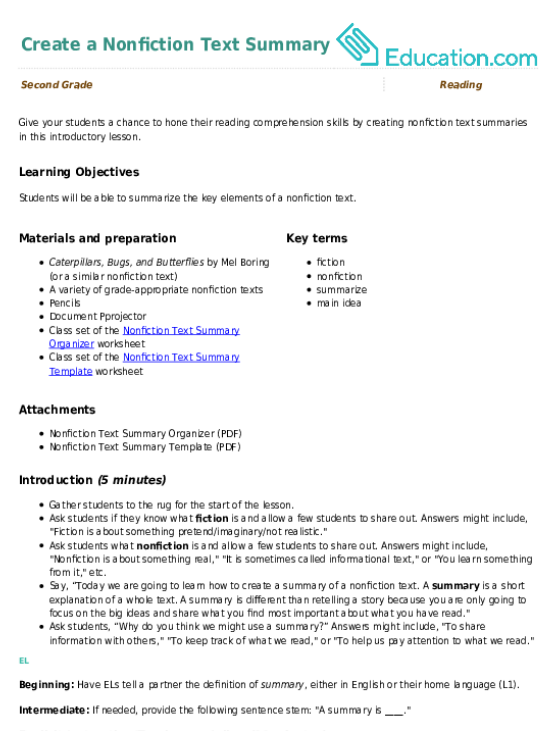
Create a Nonfiction Text Summary
Lesson Plan
Create a Nonfiction Text Summary
Second Grade
Writing
Give your students a chance to hone their reading comprehension skills by creating nonfiction text summaries in this introductory lesson.
Lesson Plan
Create a Nonfiction Text Summary
Lesson Plan
Create a Nonfiction Text Summary
Give your students a chance to hone their reading comprehension skills by creating nonfiction text summaries in this introductory lesson.
Second Grade
Writing
Lesson Plan
Fiction Comprehension: Problem and Solution
Lesson Plan
Fiction Comprehension: Problem and Solution
Third Grade
If you've ever had something go wrong, you know how it feels to search for a solution! Use this lesson to teach your students to identify problems and solutions in fictional text.
Lesson Plan
Fiction Comprehension: Problem and Solution
Lesson Plan
Fiction Comprehension: Problem and Solution
If you've ever had something go wrong, you know how it feels to search for a solution! Use this lesson to teach your students to identify problems and solutions in fictional text.
Third Grade
Lesson Plan
Color Coding Nonfiction Text
Lesson Plan
Color Coding Nonfiction Text
Third Grade
Jazz up your nonfiction reading and add a little color! Use this lesson with your students to teach them to cite text evidence as they answer questions by color coding.
Lesson Plan
Color Coding Nonfiction Text
Lesson Plan
Color Coding Nonfiction Text
Jazz up your nonfiction reading and add a little color! Use this lesson with your students to teach them to cite text evidence as they answer questions by color coding.
Third Grade
Lesson Plan
Fiction Comprehension: Cause and Effect
Lesson Plan
Fiction Comprehension: Cause and Effect
Third Grade
Improve reading comprehension with a lesson on cause and effect! In this lesson, students will use a T-chart to identify examples of cause and effect in and by the end, you’ll all be singing along to the cause and effect song!
Lesson Plan
Fiction Comprehension: Cause and Effect
Lesson Plan
Fiction Comprehension: Cause and Effect
Improve reading comprehension with a lesson on cause and effect! In this lesson, students will use a T-chart to identify examples of cause and effect in and by the end, you’ll all be singing along to the cause and effect song!
Third Grade
Lesson Plan
Examining Author's Purpose in a Nonfiction Text
Lesson Plan
Examining Author's Purpose in a Nonfiction Text
Second Grade
Reading
This lesson will help students identify the author's point of view and purpose for writing an informational text.
Lesson Plan
Examining Author's Purpose in a Nonfiction Text
Lesson Plan
Examining Author's Purpose in a Nonfiction Text
This lesson will help students identify the author's point of view and purpose for writing an informational text.
Second Grade
Reading
Lesson Plan
The Key Elements of Fictional Text
Lesson Plan
The Key Elements of Fictional Text
Second Grade
Vocabulary
This lesson will provide your ELs with support as they learn about the key elements of fictional text, including characters, setting, and plot. Use as a stand alone activity or a support lesson.
Lesson Plan
The Key Elements of Fictional Text
Lesson Plan
The Key Elements of Fictional Text
This lesson will provide your ELs with support as they learn about the key elements of fictional text, including characters, setting, and plot. Use as a stand alone activity or a support lesson.
Second Grade
Vocabulary
Lesson Plan
Informational Text: Citing Evidence Like a Detective
Lesson Plan
Informational Text: Citing Evidence Like a Detective
Third Grade
Vocabulary
Get your magnifying glasses—it’s time to play text detective. In this lesson, students will learn the importance of reading comprehension and making inferences while learning to correctly label the 5 Ws within a text.
Lesson Plan
Informational Text: Citing Evidence Like a Detective
Lesson Plan
Informational Text: Citing Evidence Like a Detective
Get your magnifying glasses—it’s time to play text detective. In this lesson, students will learn the importance of reading comprehension and making inferences while learning to correctly label the 5 Ws within a text.
Third Grade
Vocabulary
Lesson Plan
Examining Author's Purpose in a Fictional Text
Lesson Plan
Examining Author's Purpose in a Fictional Text
Second Grade
Reading
Students will read a short fictional story and discuss why the author included certain details and words. Use this lesson to help your students navigate parts of fictional text to determine the author's purpose!
Lesson Plan
Examining Author's Purpose in a Fictional Text
Lesson Plan
Examining Author's Purpose in a Fictional Text
Students will read a short fictional story and discuss why the author included certain details and words. Use this lesson to help your students navigate parts of fictional text to determine the author's purpose!
Second Grade
Reading
Lesson Plan
Main Idea and Details in Nonfiction Text
Lesson Plan
Main Idea and Details in Nonfiction Text
Second Grade
Writing
Use this lesson to help your students learn how to find the main idea and details in a nonfiction text using a graphic organizer for support.
Lesson Plan
Main Idea and Details in Nonfiction Text
Lesson Plan
Main Idea and Details in Nonfiction Text
Use this lesson to help your students learn how to find the main idea and details in a nonfiction text using a graphic organizer for support.
Second Grade
Writing
Lesson Plan
Understanding Academic Vocabulary in a Nonfiction Text
Lesson Plan
Understanding Academic Vocabulary in a Nonfiction Text
Second Grade
Grammar and Mechanics
This lesson will provide students with an opportunity to become more comfortable with identifying and defining academic vocabulary words in a nonfiction text about a chicken's life cycle to support comprehension.
Lesson Plan
Understanding Academic Vocabulary in a Nonfiction Text
Lesson Plan
Understanding Academic Vocabulary in a Nonfiction Text
This lesson will provide students with an opportunity to become more comfortable with identifying and defining academic vocabulary words in a nonfiction text about a chicken's life cycle to support comprehension.
Second Grade
Grammar and Mechanics
Lesson Plan
Using Sentence Level Context to Decode Text
Lesson Plan
Using Sentence Level Context to Decode Text
Second Grade
Reading
Use this lesson to reinforce using sentence level context clues to decode challenging words in a nonfiction text. This can be used as a stand alone activity or a support the Using Context Clues to Understand Word Meanings lesson.
Lesson Plan
Using Sentence Level Context to Decode Text
Lesson Plan
Using Sentence Level Context to Decode Text
Use this lesson to reinforce using sentence level context clues to decode challenging words in a nonfiction text. This can be used as a stand alone activity or a support the Using Context Clues to Understand Word Meanings lesson.
Second Grade
Reading
Lesson Plan
Main ideas and Details
Lesson Plan
Main ideas and Details
Third Grade
Writing
Use this lesson to help your ELs understand main idea and supporting details. They'll analyze non-fiction word, sentence, and paragraph structures. It can be a stand-alone lesson or a support lesson to the In Search of Main Ideas lesson.
Lesson Plan
Main ideas and Details
Lesson Plan
Main ideas and Details
Use this lesson to help your ELs understand main idea and supporting details. They'll analyze non-fiction word, sentence, and paragraph structures. It can be a stand-alone lesson or a support lesson to the In Search of Main Ideas lesson.
Third Grade
Writing
Lesson Plan
Fairy Tales: Identifying Story Elements
Lesson Plan
Fairy Tales: Identifying Story Elements
Second Grade
Reading
Story elements help to bring beloved fairy tales to life in this literacy lesson. Your students will learn to identify the title, author, setting, characters, problem, and solution in a fiction text.
Lesson Plan
Fairy Tales: Identifying Story Elements
Lesson Plan
Fairy Tales: Identifying Story Elements
Story elements help to bring beloved fairy tales to life in this literacy lesson. Your students will learn to identify the title, author, setting, characters, problem, and solution in a fiction text.
Second Grade
Reading
Lesson Plan
Questions that Gauge Comprehension
Lesson Plan
Questions that Gauge Comprehension
Third Grade
Vocabulary
Use this lesson to gauge your students’ basic comprehension of fiction text. If they can answer who, what, when, where, why, and how questions, you know they have a handle on it and it’s time to get into more critical thinking!
Lesson Plan
Questions that Gauge Comprehension
Lesson Plan
Questions that Gauge Comprehension
Use this lesson to gauge your students’ basic comprehension of fiction text. If they can answer who, what, when, where, why, and how questions, you know they have a handle on it and it’s time to get into more critical thinking!
Third Grade
Vocabulary
Lesson Plan
Nonfiction Comprehension: Cause and Effect
Lesson Plan
Nonfiction Comprehension: Cause and Effect
Third Grade
What is the cause, and what is the effect? Use this resource to teach your students how to identify examples of cause and effect in nonfiction text.
Lesson Plan
Nonfiction Comprehension: Cause and Effect
Lesson Plan
Nonfiction Comprehension: Cause and Effect
What is the cause, and what is the effect? Use this resource to teach your students how to identify examples of cause and effect in nonfiction text.
Third Grade
Lesson Plan
Finding Similarities and Differences
Lesson Plan
Finding Similarities and Differences
Third Grade
Reading
Good readers analyze texts by looking at similarities and differences. Use this lesson to teach your students to compare and contrast the story elements of two fiction texts.
Lesson Plan
Finding Similarities and Differences
Lesson Plan
Finding Similarities and Differences
Good readers analyze texts by looking at similarities and differences. Use this lesson to teach your students to compare and contrast the story elements of two fiction texts.
Third Grade
Reading
Lesson Plan
Story Mapping Group Work
Lesson Plan
Story Mapping Group Work
Second Grade
Reading
Use this story map and your choice of short fiction passages to develop your students’ reading comprehension skills with this group reading lesson.
Lesson Plan
Story Mapping Group Work
Lesson Plan
Story Mapping Group Work
Use this story map and your choice of short fiction passages to develop your students’ reading comprehension skills with this group reading lesson.
Second Grade
Reading
Lesson Plan
We’ve Got a Problem!
Lesson Plan
We’ve Got a Problem!
Third Grade
What’s the problem? Teach your students to identify the problem and solution in a piece of fiction.
Lesson Plan
We’ve Got a Problem!
Lesson Plan
We’ve Got a Problem!
What’s the problem? Teach your students to identify the problem and solution in a piece of fiction.
Third Grade
Lesson Plan
How Many Features?
Lesson Plan
How Many Features?
Second Grade
Reading
What’s the deal with all of those text features? Use this handy lesson plan to help your second graders answer that very question.
Lesson Plan
How Many Features?
Lesson Plan
How Many Features?
What’s the deal with all of those text features? Use this handy lesson plan to help your second graders answer that very question.
Second Grade
Reading
Lesson Plan
1
2
3
4
…
18