SKIP TO CONTENT
Worksheet Generator
Subjects
Grades
Worksheets
Games
Build a Worksheet
More Resources
Roly Recommends
Subjects
Grades
Worksheets
Games
Build a Worksheet
More Resources
Roly Recommends
Filters
Search for: decoding, regular, words
✕
2nd - 5th Grade
✕
Lesson Plans
✕
Subjects
Math
English Language Arts
Science
Social Studies
Grade Level
Pre-K
K
1st
2nd
3rd
4th
5th
6th
7th
8th
Early Childhood
Elementary School
Middle School
Resource Type
Worksheets
Games
Lesson Plans
Interactive Worksheets
Workbooks
Activities
Exercises
Stories
Songs
Offline Games
Guided Lessons
Teacher Resources
Common Core
Yes
Roly Recommends
Social Emotional Learning
English Language Support
Yes
See More
Clear All
View 995 results
Showing Results for decoding regular words : Page 4
995 results
Search for: decoding, regular, words
✕
2nd - 5th Grade
✕
Lesson Plans
✕
Clear All
Sort by:
Relevance
Most recent
Most popular
Alphabetical A-Z
Alphabetical Z-A
All filters
995 results
Sort by:
Relevance
Most recent
Most popular
Alphabetical A-Z
Alphabetical Z-A
Paint a Word Picture
Lesson Plan
Paint a Word Picture
Fourth Grade
Writing
Students become word artists as they use ordinary pictures to practice creating detailed descriptions. This technique helps your class learn how to paint a picture with words.
Lesson Plan
Paint a Word Picture
Lesson Plan
Paint a Word Picture
Students become word artists as they use ordinary pictures to practice creating detailed descriptions. This technique helps your class learn how to paint a picture with words.
Fourth Grade
Writing
Lesson Plan
Contraction Actions
Lesson Plan
Contraction Actions
Third Grade
Help your students spring into action with contractions! With this lesson, your students will create contractions from the words will, not, and have. With a focus on spelling and word structure, they will be empowered to use contractions.
Lesson Plan
Contraction Actions
Lesson Plan
Contraction Actions
Help your students spring into action with contractions! With this lesson, your students will create contractions from the words will, not, and have. With a focus on spelling and word structure, they will be empowered to use contractions.
Third Grade
Lesson Plan
Transitioning to Intermediate Directions
Lesson Plan
Transitioning to Intermediate Directions
Third Grade
Geography
This lesson will introduce students to intermediate map directions northwest, northeast, southwest, and southeast. It also offers practice writing functional texts using transitional words as well as both cardinal and intermediate directions.
Lesson Plan
Transitioning to Intermediate Directions
Lesson Plan
Transitioning to Intermediate Directions
This lesson will introduce students to intermediate map directions northwest, northeast, southwest, and southeast. It also offers practice writing functional texts using transitional words as well as both cardinal and intermediate directions.
Third Grade
Geography
Lesson Plan
Linking the Logic
Lesson Plan
Linking the Logic
Fifth Grade
Are your students’ persuasive essays seamless and connected? In this persuasive writing lesson, students will learn how to write for a specific audience, linking opinions with reasons. Transition words are the missing links!
Lesson Plan
Linking the Logic
Lesson Plan
Linking the Logic
Are your students’ persuasive essays seamless and connected? In this persuasive writing lesson, students will learn how to write for a specific audience, linking opinions with reasons. Transition words are the missing links!
Fifth Grade
Lesson Plan
Searching for Suffixes
Lesson Plan
Searching for Suffixes
Fourth Grade
Invite your students to join the search for suffixes! In this lesson students will locate similar words that have gone through a suffix transformation. In addition to the mechanics, students will explore the meaning behind each word!
Lesson Plan
Searching for Suffixes
Lesson Plan
Searching for Suffixes
Invite your students to join the search for suffixes! In this lesson students will locate similar words that have gone through a suffix transformation. In addition to the mechanics, students will explore the meaning behind each word!
Fourth Grade
Lesson Plan
Mad, Sad, Happy, Glad: Character Feelings
Lesson Plan
Mad, Sad, Happy, Glad: Character Feelings
First Grade
Your students will have loads of fun discovering new words and using them describe the feelings of different characters. Featuring No, David! by David Shannon, this lesson will help kids practice reading and writing.
Lesson Plan
Mad, Sad, Happy, Glad: Character Feelings
Lesson Plan
Mad, Sad, Happy, Glad: Character Feelings
Your students will have loads of fun discovering new words and using them describe the feelings of different characters. Featuring No, David! by David Shannon, this lesson will help kids practice reading and writing.
First Grade
Lesson Plan
Jumping Into Geometry!
Lesson Plan
Jumping Into Geometry!
Second Grade
This lesson helps students understand the difference between polygons. It focuses on the root words of these terms to help students make connections to their prior knowledge, making it especially beneficial for ESLs.
Lesson Plan
Jumping Into Geometry!
Lesson Plan
Jumping Into Geometry!
This lesson helps students understand the difference between polygons. It focuses on the root words of these terms to help students make connections to their prior knowledge, making it especially beneficial for ESLs.
Second Grade
Lesson Plan
Giving Directions: Tell Me How
Lesson Plan
Giving Directions: Tell Me How
Fourth Grade
Students will have fun engaging in activities that develop their ability to write sequential step-by-step directions. This lesson helps young learners with being detailed and using transition words in their writing.
Lesson Plan
Giving Directions: Tell Me How
Lesson Plan
Giving Directions: Tell Me How
Students will have fun engaging in activities that develop their ability to write sequential step-by-step directions. This lesson helps young learners with being detailed and using transition words in their writing.
Fourth Grade
Lesson Plan
Sentence Menu
Lesson Plan
Sentence Menu
Second Grade
Grammar and Mechanics
We write sentences to tell thoughts, but what happens when we add some parameters? In this lesson, students dissect the words they find in sentences then follow directions to create their own wacky sentences.
Lesson Plan
Sentence Menu
Lesson Plan
Sentence Menu
We write sentences to tell thoughts, but what happens when we add some parameters? In this lesson, students dissect the words they find in sentences then follow directions to create their own wacky sentences.
Second Grade
Grammar and Mechanics
Lesson Plan
Sentence Cafe
Lesson Plan
Sentence Cafe
First Grade
Grammar and Mechanics
It’s time to make sentences! At the Sentence Cafe, words come together to build stories. Get ready to learn about different parts of speech such as conjunctions, possessive pronouns, articles, and more in this hands-on lesson.
Lesson Plan
Sentence Cafe
Lesson Plan
Sentence Cafe
It’s time to make sentences! At the Sentence Cafe, words come together to build stories. Get ready to learn about different parts of speech such as conjunctions, possessive pronouns, articles, and more in this hands-on lesson.
First Grade
Grammar and Mechanics
Lesson Plan
Vocabulary in Context
Lesson Plan
Vocabulary in Context
Fourth Grade
In this lesson, students will improve their skills in using context clues to determine the meaning of difficult words. Use it as a stand-alone lesson or as support to the lesson Journey on the Underground Railroad.
Lesson Plan
Vocabulary in Context
Lesson Plan
Vocabulary in Context
In this lesson, students will improve their skills in using context clues to determine the meaning of difficult words. Use it as a stand-alone lesson or as support to the lesson Journey on the Underground Railroad.
Fourth Grade
Lesson Plan
Synonyms: Using Shades of Meaning
Lesson Plan
Synonyms: Using Shades of Meaning
Second Grade
Why walk when you can mosey? In this lesson, students will learn how to use synonyms to express shades of meaning in their writing. Introduce the topic with a book, then brainstorm descriptive options for overused words.
Lesson Plan
Synonyms: Using Shades of Meaning
Lesson Plan
Synonyms: Using Shades of Meaning
Why walk when you can mosey? In this lesson, students will learn how to use synonyms to express shades of meaning in their writing. Introduce the topic with a book, then brainstorm descriptive options for overused words.
Second Grade
Lesson Plan
Can You Find the -er, -ir, -ur Sound?
Lesson Plan
Can You Find the -er, -ir, -ur Sound?
Second Grade
Poetry? Scavenger hunts? Use this lesson to teach your students about the R-controlled vowels that say “er” using both! Your students will be reading those pesky er/ir/ur words in no time!
Lesson Plan
Can You Find the -er, -ir, -ur Sound?
Lesson Plan
Can You Find the -er, -ir, -ur Sound?
Poetry? Scavenger hunts? Use this lesson to teach your students about the R-controlled vowels that say “er” using both! Your students will be reading those pesky er/ir/ur words in no time!
Second Grade
Lesson Plan
Examining Author's Purpose in a Fictional Text
Lesson Plan
Examining Author's Purpose in a Fictional Text
Second Grade
Reading
Students will read a short fictional story and discuss why the author included certain details and words. Use this lesson to help your students navigate parts of fictional text to determine the author's purpose!
Lesson Plan
Examining Author's Purpose in a Fictional Text
Lesson Plan
Examining Author's Purpose in a Fictional Text
Students will read a short fictional story and discuss why the author included certain details and words. Use this lesson to help your students navigate parts of fictional text to determine the author's purpose!
Second Grade
Reading
Lesson Plan
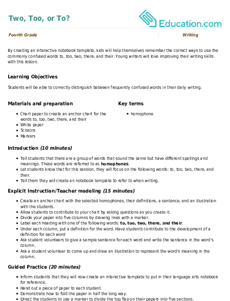
Two, Too, or To?
Lesson Plan
Two, Too, or To?
Fourth Grade
Vocabulary
By creating an interactive notebook template, kids will help themselves remember the correct ways to use the commonly confused words to, too, two, there, and their. Young writers will love improving their writing skills with this lesson.
Lesson Plan
Two, Too, or To?
Lesson Plan
Two, Too, or To?
By creating an interactive notebook template, kids will help themselves remember the correct ways to use the commonly confused words to, too, two, there, and their. Young writers will love improving their writing skills with this lesson.
Fourth Grade
Vocabulary
Lesson Plan
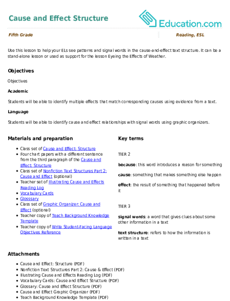
Cause and Effect Structure
Lesson Plan
Cause and Effect Structure
Fifth Grade
Use this lesson to help your ELs see patterns and signal words in the cause-and-effect text structure. It can be a stand-alone lesson or used as support for the lesson Eyeing the Effects of Weather.
Lesson Plan
Cause and Effect Structure
Lesson Plan
Cause and Effect Structure
Use this lesson to help your ELs see patterns and signal words in the cause-and-effect text structure. It can be a stand-alone lesson or used as support for the lesson Eyeing the Effects of Weather.
Fifth Grade
Lesson Plan
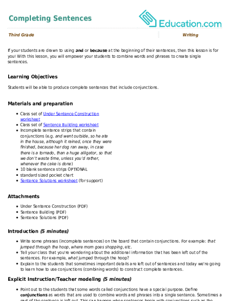
Completing Sentences
Lesson Plan
Completing Sentences
Third Grade
If your students are drawn to using
and
or
because
at the beginning of their sentences, then this lesson is for you! With this lesson, you will empower your students to combine words and phrases to create single sentences.
Lesson Plan
Completing Sentences
Lesson Plan
Completing Sentences
If your students are drawn to using
and
or
because
at the beginning of their sentences, then this lesson is for you! With this lesson, you will empower your students to combine words and phrases to create single sentences.
Third Grade
Lesson Plan
Details of Division
Lesson Plan
Details of Division
Third Grade
Teach your students the vocabulary words to accurately discuss division equations, and then challenge them to write their own word problems! Use this lesson independently or as a pre-lesson for
Divide it Up!
Lesson Plan
Details of Division
Lesson Plan
Details of Division
Teach your students the vocabulary words to accurately discuss division equations, and then challenge them to write their own word problems! Use this lesson independently or as a pre-lesson for
Divide it Up!
Third Grade
Lesson Plan
Vocabulary Builders: Synonyms and Antonyms
Lesson Plan
Vocabulary Builders: Synonyms and Antonyms
Fifth Grade
Vocabulary
In this engaging vocabulary lesson plan, students will learn to use a thesaurus to generate interesting synonyms and antonyms for several target words. Then, they will get up and
mingle
with their classmates with a synonym matching game!
Lesson Plan
Vocabulary Builders: Synonyms and Antonyms
Lesson Plan
Vocabulary Builders: Synonyms and Antonyms
In this engaging vocabulary lesson plan, students will learn to use a thesaurus to generate interesting synonyms and antonyms for several target words. Then, they will get up and
mingle
with their classmates with a synonym matching game!
Fifth Grade
Vocabulary
Lesson Plan
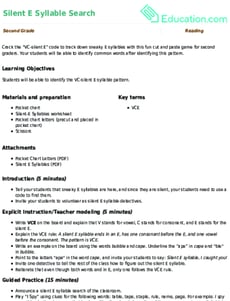
Silent E Syllable Search
Lesson Plan
Silent E Syllable Search
Second Grade
Crack the “VC-silent E” code to track down sneaky E syllables with this fun cut and paste game for second graders. Your students will be able to identify common words after identifying this pattern.
Lesson Plan
Silent E Syllable Search
Lesson Plan
Silent E Syllable Search
Crack the “VC-silent E” code to track down sneaky E syllables with this fun cut and paste game for second graders. Your students will be able to identify common words after identifying this pattern.
Second Grade
Lesson Plan
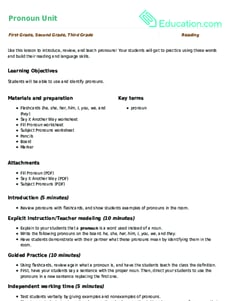
Pronoun Unit
Lesson Plan
Pronoun Unit
First Grade
Grammar and Mechanics
Use this lesson to introduce, review, and teach pronouns! Your students will get to practice using these words and build their reading and language skills.
Lesson Plan
Pronoun Unit
Lesson Plan
Pronoun Unit
Use this lesson to introduce, review, and teach pronouns! Your students will get to practice using these words and build their reading and language skills.
First Grade
Grammar and Mechanics
Lesson Plan
Myths and Man
Lesson Plan
Myths and Man
Fourth Grade
Reading
Popular fiction throughout the ages colors the way people speak. In this short lesson, students will read a myth and non-fiction paragraph in order to identify and define words that come from mythology.
Lesson Plan
Myths and Man
Lesson Plan
Myths and Man
Popular fiction throughout the ages colors the way people speak. In this short lesson, students will read a myth and non-fiction paragraph in order to identify and define words that come from mythology.
Fourth Grade
Reading
Lesson Plan
Retelling with Paragraph Frames
Lesson Plan
Retelling with Paragraph Frames
Second Grade
Help your EL students retell a story using a paragraph frame and transition words. This lesson can be used as a stand alone activity to reinforce comprehension of texts or used as a support lesson for Read and Retell a Classic.
Lesson Plan
Retelling with Paragraph Frames
Lesson Plan
Retelling with Paragraph Frames
Help your EL students retell a story using a paragraph frame and transition words. This lesson can be used as a stand alone activity to reinforce comprehension of texts or used as a support lesson for Read and Retell a Classic.
Second Grade
Lesson Plan
Onomatopoeia Zoo
Lesson Plan
Onomatopoeia Zoo
Third Grade
Oink! Bark! Crash! Onomatopoeia help students write in richer, more descriptive ways. This lesson teaches students how to incorporate sound words into their vocabulary.
Lesson Plan
Onomatopoeia Zoo
Lesson Plan
Onomatopoeia Zoo
Oink! Bark! Crash! Onomatopoeia help students write in richer, more descriptive ways. This lesson teaches students how to incorporate sound words into their vocabulary.
Third Grade
Lesson Plan
Explaining Illustrations with Declarative Sentences
Lesson Plan
Explaining Illustrations with Declarative Sentences
Fourth Grade
In this lesson, students will examine illustrations and write about them using declarative sentences. This can be used on its own or as support for the lesson A Picture Is Worth a Thousand Words: Connecting Text and Illustrations.
Lesson Plan
Explaining Illustrations with Declarative Sentences
Lesson Plan
Explaining Illustrations with Declarative Sentences
In this lesson, students will examine illustrations and write about them using declarative sentences. This can be used on its own or as support for the lesson A Picture Is Worth a Thousand Words: Connecting Text and Illustrations.
Fourth Grade
Lesson Plan
Problem and Solution Practice
Lesson Plan
Problem and Solution Practice
Fifth Grade
Vocabulary
Help your ELs learn how to identify the problem and solution in a fictional text by using transition words as a foundation for their understanding. It can be a stand-alone lesson or support to the lesson There’s No I in Theme-work!
Lesson Plan
Problem and Solution Practice
Lesson Plan
Problem and Solution Practice
Help your ELs learn how to identify the problem and solution in a fictional text by using transition words as a foundation for their understanding. It can be a stand-alone lesson or support to the lesson There’s No I in Theme-work!
Fifth Grade
Vocabulary
Lesson Plan
Using Sentence Level Context to Decode Text
Lesson Plan
Using Sentence Level Context to Decode Text
Second Grade
Reading
Use this lesson to reinforce using sentence level context clues to decode challenging words in a nonfiction text. This can be used as a stand alone activity or a support the Using Context Clues to Understand Word Meanings lesson.
Lesson Plan
Using Sentence Level Context to Decode Text
Lesson Plan
Using Sentence Level Context to Decode Text
Use this lesson to reinforce using sentence level context clues to decode challenging words in a nonfiction text. This can be used as a stand alone activity or a support the Using Context Clues to Understand Word Meanings lesson.
Second Grade
Reading
Lesson Plan
See It, Don't Say It!
Lesson Plan
See It, Don't Say It!
Fourth Grade
You know the expression, “Say it, don’t spray it!” In this lesson, we don’t want you to say it or spray it, we just want you to see it! Students will practice identifying, reading, and creating words with silent letters.
Lesson Plan
See It, Don't Say It!
Lesson Plan
See It, Don't Say It!
You know the expression, “Say it, don’t spray it!” In this lesson, we don’t want you to say it or spray it, we just want you to see it! Students will practice identifying, reading, and creating words with silent letters.
Fourth Grade
Lesson Plan
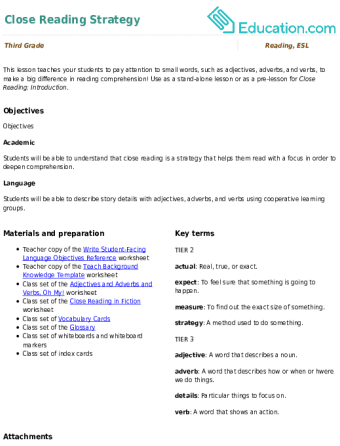
Close Reading Strategy
Lesson Plan
Close Reading Strategy
Third Grade
Grammar and Mechanics
This lesson teaches your students to pay attention to small words, such as adjectives, adverbs, and verbs, to make a big difference in reading comprehension! Use as a stand-alone lesson or as a pre-lesson for
Close Reading: Introduction
.
Lesson Plan
Close Reading Strategy
Lesson Plan
Close Reading Strategy
This lesson teaches your students to pay attention to small words, such as adjectives, adverbs, and verbs, to make a big difference in reading comprehension! Use as a stand-alone lesson or as a pre-lesson for
Close Reading: Introduction
.
Third Grade
Grammar and Mechanics
Lesson Plan
Evidence of Character Changes
Lesson Plan
Evidence of Character Changes
Third Grade
Writing
Create conversations about character changes! Use this lesson plan as a stand-alone lesson for practicing sequencing words in evidenced-based claims about a character, or before the Characters Change Just Like We Do lesson.
Lesson Plan
Evidence of Character Changes
Lesson Plan
Evidence of Character Changes
Create conversations about character changes! Use this lesson plan as a stand-alone lesson for practicing sequencing words in evidenced-based claims about a character, or before the Characters Change Just Like We Do lesson.
Third Grade
Writing
Lesson Plan
1
2
3
4
5
…
34