SKIP TO CONTENT
Worksheet Generator
Subjects
Grades
Worksheets
Games
Build a Worksheet
More Resources
Roly Recommends
Reading Month
Subjects
Grades
Worksheets
Games
Build a Worksheet
More Resources
Roly Recommends
Reading Month
Filters
Search for: conditional, statements
✕
3rd and 4th Grade
✕
Common Core
✕
Subjects
Math
English Language Arts
Social Studies
Grade Level
Pre-K
K
1st
2nd
3rd
4th
5th
6th
7th
8th
Early Childhood
Elementary School
Middle School
Resource Type
Worksheets
Lesson Plans
Interactive Worksheets
Exercises
Occasion
Women's History Month
Winter
Black History Month
Common Core
Yes
Roly Recommends
Social Emotional Learning
English Language Support
Yes
See More
Clear All
View 66 results
Showing Results for conditional statements : Page 2
66 results
Search for: conditional, statements
✕
3rd and 4th Grade
✕
Common Core
✕
Clear All
Sort by:
Relevance
Most recent
Most popular
Alphabetical A-Z
Alphabetical Z-A
All filters
66 results
Sort by:
Relevance
Most recent
Most popular
Alphabetical A-Z
Alphabetical Z-A
Fact or Opinion: Part 3
Lesson Plan
Fact or Opinion: Part 3
Second Grade
In Fact or Opinion: Part 3, your students will take what they learned from the previous lessons and apply it by writing their own personal opinion essays.
Lesson Plan
Fact or Opinion: Part 3
Lesson Plan
Fact or Opinion: Part 3
In Fact or Opinion: Part 3, your students will take what they learned from the previous lessons and apply it by writing their own personal opinion essays.
Second Grade
Lesson Plan
Geometry Vocabulary: Lines
Lesson Plan
Geometry Vocabulary: Lines
Fourth Grade
Geometry
Perpendicular, intersect, parallel! In this lesson, students work in teams to complete a Frayer Model on each of these terms to become masters of geometry vocabulary. Teach this lesson on its own or as support to the lesson What's My Line?
Lesson Plan
Geometry Vocabulary: Lines
Lesson Plan
Geometry Vocabulary: Lines
Perpendicular, intersect, parallel! In this lesson, students work in teams to complete a Frayer Model on each of these terms to become masters of geometry vocabulary. Teach this lesson on its own or as support to the lesson What's My Line?
Fourth Grade
Geometry
Lesson Plan
Fact or Opinion: Part 2
Lesson Plan
Fact or Opinion: Part 2
Second Grade
My dog is better! In this lesson, your students will combine reading, writing, and movement to practice distinguishing and supporting facts and opinions.
Lesson Plan
Fact or Opinion: Part 2
Lesson Plan
Fact or Opinion: Part 2
My dog is better! In this lesson, your students will combine reading, writing, and movement to practice distinguishing and supporting facts and opinions.
Second Grade
Lesson Plan
Question or Exclamation?
Lesson Plan
Question or Exclamation?
Third Grade
Let's use exclamation points! Help your students become more expressive, efficient readers and writers by teaching them about this special punctuation mark.
Lesson Plan
Question or Exclamation?
Lesson Plan
Question or Exclamation?
Let's use exclamation points! Help your students become more expressive, efficient readers and writers by teaching them about this special punctuation mark.
Third Grade
Lesson Plan
Charts and Graphs and Diagrams, Oh My!
Lesson Plan
Charts and Graphs and Diagrams, Oh My!
Fourth Grade
Reading
Students will learn about three nonfiction text features: charts, graphs, and diagrams. They will analyze and interpret the information represented in these visual forms and discover how they aid in the comprehension of nonfiction texts.
Lesson Plan
Charts and Graphs and Diagrams, Oh My!
Lesson Plan
Charts and Graphs and Diagrams, Oh My!
Students will learn about three nonfiction text features: charts, graphs, and diagrams. They will analyze and interpret the information represented in these visual forms and discover how they aid in the comprehension of nonfiction texts.
Fourth Grade
Reading
Lesson Plan
Evidence as a Statement
Lesson Plan
Evidence as a Statement
Third Grade
Teach your students to explain details in a text by using declarative sentences. This lesson can stand alone or be used as a pre-lesson for the
Color Coding Nonfiction Text
lesson.
Lesson Plan
Evidence as a Statement
Lesson Plan
Evidence as a Statement
Teach your students to explain details in a text by using declarative sentences. This lesson can stand alone or be used as a pre-lesson for the
Color Coding Nonfiction Text
lesson.
Third Grade
Lesson Plan
Tell Me About It! Writing Opinion Essays
Lesson Plan
Tell Me About It! Writing Opinion Essays
Third Grade
Writing
Do your students have strong opinions? This lesson, which features a bunch of fun essay-building exercises, provides an outlet for young writers to express their opinions.
Lesson Plan
Tell Me About It! Writing Opinion Essays
Lesson Plan
Tell Me About It! Writing Opinion Essays
Do your students have strong opinions? This lesson, which features a bunch of fun essay-building exercises, provides an outlet for young writers to express their opinions.
Third Grade
Writing
Lesson Plan
Just a Minute
Lesson Plan
Just a Minute
Third Grade
Help your students learn how long a minute is with this lesson that shows them how the length of a minute can appear to change depending on the activity, all while putting their time estimation skills to the test.
Lesson Plan
Just a Minute
Lesson Plan
Just a Minute
Help your students learn how long a minute is with this lesson that shows them how the length of a minute can appear to change depending on the activity, all while putting their time estimation skills to the test.
Third Grade
Lesson Plan
Literary Argument Writing: Defining Your Topic
Lesson Plan
Literary Argument Writing: Defining Your Topic
Fourth Grade
Writing
This lesson will help your young writers develop a claim, or thesis, and construct an argument around it. You may have students complete the essay by continuing the process with the lesson Literary Argument Writing: Drafting Your Essay.
Lesson Plan
Literary Argument Writing: Defining Your Topic
Lesson Plan
Literary Argument Writing: Defining Your Topic
This lesson will help your young writers develop a claim, or thesis, and construct an argument around it. You may have students complete the essay by continuing the process with the lesson Literary Argument Writing: Drafting Your Essay.
Fourth Grade
Writing
Lesson Plan
Order of Operations with Fractions and Decimals
Lesson Plan
Order of Operations with Fractions and Decimals
Fourth Grade
Mixed Operations
This lesson is designed for fourth graders to practice their skills with the order of operations along with multiplying fractions and adding or subtracting decimals.
Lesson Plan
Order of Operations with Fractions and Decimals
Lesson Plan
Order of Operations with Fractions and Decimals
This lesson is designed for fourth graders to practice their skills with the order of operations along with multiplying fractions and adding or subtracting decimals.
Fourth Grade
Mixed Operations
Lesson Plan
Conversations About Chronology
Lesson Plan
Conversations About Chronology
Fourth Grade
Have students justify their thought process in this lesson about order of events. This lesson is a great way to start discussing the importance of understanding causal relationships to fully understand chronology in fictional texts.
Lesson Plan
Conversations About Chronology
Lesson Plan
Conversations About Chronology
Have students justify their thought process in this lesson about order of events. This lesson is a great way to start discussing the importance of understanding causal relationships to fully understand chronology in fictional texts.
Fourth Grade
Lesson Plan
Connecting the Coasts: Effects of the Transcontinental Railroad
Lesson Plan
Connecting the Coasts: Effects of the Transcontinental Railroad
Fourth Grade
Reading
Look at history! In this lesson, guide students through an exploration of the context, causes, and effects of the Transcontinental Railroad, and help them practice identifying the main idea and supporting details in a nonfiction text.
Lesson Plan
Connecting the Coasts: Effects of the Transcontinental Railroad
Lesson Plan
Connecting the Coasts: Effects of the Transcontinental Railroad
Look at history! In this lesson, guide students through an exploration of the context, causes, and effects of the Transcontinental Railroad, and help them practice identifying the main idea and supporting details in a nonfiction text.
Fourth Grade
Reading
Lesson Plan
Wacky Paragraphs with Prepositional Phrases!
Lesson Plan
Wacky Paragraphs with Prepositional Phrases!
Fourth Grade
Want to help your students write more juicy details in their stories? This lesson will teach your class to identify and form prepositional phrases in their own writing while reinforcing the importance of prepositions.
Lesson Plan
Wacky Paragraphs with Prepositional Phrases!
Lesson Plan
Wacky Paragraphs with Prepositional Phrases!
Want to help your students write more juicy details in their stories? This lesson will teach your class to identify and form prepositional phrases in their own writing while reinforcing the importance of prepositions.
Fourth Grade
Lesson Plan
Asking and Answering Questions about Line Plots and Bar Graphs
Lesson Plan
Asking and Answering Questions about Line Plots and Bar Graphs
Third Grade
Take students’ understanding of bar graphs and line plots to the next level. This lesson will encourage students to think about how graphs are designed and the questions we can ask and answer about data presented in graphs.
Lesson Plan
Asking and Answering Questions about Line Plots and Bar Graphs
Lesson Plan
Asking and Answering Questions about Line Plots and Bar Graphs
Take students’ understanding of bar graphs and line plots to the next level. This lesson will encourage students to think about how graphs are designed and the questions we can ask and answer about data presented in graphs.
Third Grade
Lesson Plan
Fact or Opinion: Part 1
Lesson Plan
Fact or Opinion: Part 1
Second Grade
Vocabulary
Cats are the best! Pizza is better! My teacher rules! In Fact or Opinion: Part 1, your students will combine reading and writing to learn about the differences between facts and opinions and how those differences are communicated.
Lesson Plan
Fact or Opinion: Part 1
Lesson Plan
Fact or Opinion: Part 1
Cats are the best! Pizza is better! My teacher rules! In Fact or Opinion: Part 1, your students will combine reading and writing to learn about the differences between facts and opinions and how those differences are communicated.
Second Grade
Vocabulary
Lesson Plan
Curiosity vs. Judgment
Lesson Plan
Curiosity vs. Judgment
Fourth Grade
Curiosity can be a powerful way to work with our judgments. In this lesson, students will explore curiosity and judgment. They'll participate in an outdoor activity to practice mindfulness of senses and attentiveness to the present moment.
Lesson Plan
Curiosity vs. Judgment
Lesson Plan
Curiosity vs. Judgment
Curiosity can be a powerful way to work with our judgments. In this lesson, students will explore curiosity and judgment. They'll participate in an outdoor activity to practice mindfulness of senses and attentiveness to the present moment.
Fourth Grade
Lesson Plan
Mindful Eating: Remembering Our Interconnections
Lesson Plan
Mindful Eating: Remembering Our Interconnections
Fourth Grade
In this lesson, students will discuss "interconnections," practice mindful eating and gratitude for the food we eat, and put together poems that illustrate interconnections and gratitude.
Lesson Plan
Mindful Eating: Remembering Our Interconnections
Lesson Plan
Mindful Eating: Remembering Our Interconnections
In this lesson, students will discuss "interconnections," practice mindful eating and gratitude for the food we eat, and put together poems that illustrate interconnections and gratitude.
Fourth Grade
Lesson Plan
Can You Prove It? Facts and Opinions!
Lesson Plan
Can You Prove It? Facts and Opinions!
Third Grade
This lesson introduces students to the differences between facts and opinions in an interactive way. Education.com worksheets are used to reinforce the concepts taught in this lesson.
Lesson Plan
Can You Prove It? Facts and Opinions!
Lesson Plan
Can You Prove It? Facts and Opinions!
This lesson introduces students to the differences between facts and opinions in an interactive way. Education.com worksheets are used to reinforce the concepts taught in this lesson.
Third Grade
Lesson Plan
Interpreting Line Plots, Bar Graphs and Picture Graphs: Word Problems
Lesson Plan
Interpreting Line Plots, Bar Graphs and Picture Graphs: Word Problems
Third Grade
Graphs bring data to life and help us draw conclusions about the information. In this lesson, students will engage with three different kinds of graphs by asking and answering interpretive questions.
Lesson Plan
Interpreting Line Plots, Bar Graphs and Picture Graphs: Word Problems
Lesson Plan
Interpreting Line Plots, Bar Graphs and Picture Graphs: Word Problems
Graphs bring data to life and help us draw conclusions about the information. In this lesson, students will engage with three different kinds of graphs by asking and answering interpretive questions.
Third Grade
Lesson Plan
A Picture Is Worth a Thousand Words: Connecting Text and Illustrations
Lesson Plan
A Picture Is Worth a Thousand Words: Connecting Text and Illustrations
Fourth Grade
By analzying picture books, students will make connections between the text and the illustrations of a story. They will compare and contrast the text and the illustrations and reflect upon how they impact their comprehension of a text.
Lesson Plan
A Picture Is Worth a Thousand Words: Connecting Text and Illustrations
Lesson Plan
A Picture Is Worth a Thousand Words: Connecting Text and Illustrations
By analzying picture books, students will make connections between the text and the illustrations of a story. They will compare and contrast the text and the illustrations and reflect upon how they impact their comprehension of a text.
Fourth Grade
Lesson Plan
Similes and Metaphors: Comparisons Done Right
Lesson Plan
Similes and Metaphors: Comparisons Done Right
Fourth Grade
Reading
Your little poets will love how their creative writing abilities will grow with this lesson about similes and metaphors. Students engage in fun activities to learn about similes and metaphors and write comparisons as directed.
Lesson Plan
Similes and Metaphors: Comparisons Done Right
Lesson Plan
Similes and Metaphors: Comparisons Done Right
Your little poets will love how their creative writing abilities will grow with this lesson about similes and metaphors. Students engage in fun activities to learn about similes and metaphors and write comparisons as directed.
Fourth Grade
Reading
Lesson Plan
Welcoming All Feelings
Lesson Plan
Welcoming All Feelings
Fourth Grade
In this lesson students will be guided through a session of reflecting on their day and their emotions. They will also practice ways they can welcome and befriend their emotions with kindness and curiosity.
Lesson Plan
Welcoming All Feelings
Lesson Plan
Welcoming All Feelings
In this lesson students will be guided through a session of reflecting on their day and their emotions. They will also practice ways they can welcome and befriend their emotions with kindness and curiosity.
Fourth Grade
Lesson Plan
The Declaration's Purpose
Lesson Plan
The Declaration's Purpose
Third Grade
July 4, 1776, was an important day in U.S. history because an important document was signed. Use this civics lesson to help young historians learn about the purpose of the Declaration of Independence.
Lesson Plan
The Declaration's Purpose
Lesson Plan
The Declaration's Purpose
July 4, 1776, was an important day in U.S. history because an important document was signed. Use this civics lesson to help young historians learn about the purpose of the Declaration of Independence.
Third Grade
Lesson Plan
Understand African American Spirituals
Lesson Plan
Understand African American Spirituals
Fourth Grade
Statistics
Spirituals have a long history in the United States, and often serve to strengthen and motivate people. Students will compare three types of spirituals from different time periods and share their understanding with their peers.
Lesson Plan
Understand African American Spirituals
Lesson Plan
Understand African American Spirituals
Spirituals have a long history in the United States, and often serve to strengthen and motivate people. Students will compare three types of spirituals from different time periods and share their understanding with their peers.
Fourth Grade
Statistics
Lesson Plan
Understanding Communities and Differences
Lesson Plan
Understanding Communities and Differences
Fourth Grade
In this lesson students will complete an activity called "Raise Your Hand If You..." and be able to define the word “assumption.” This lesson supports the practice of compassion for oneself and others.
Lesson Plan
Understanding Communities and Differences
Lesson Plan
Understanding Communities and Differences
In this lesson students will complete an activity called "Raise Your Hand If You..." and be able to define the word “assumption.” This lesson supports the practice of compassion for oneself and others.
Fourth Grade
Lesson Plan
What Do You Love About Them?
Lesson Plan
What Do You Love About Them?
Fourth Grade
In this lesson, students will express their love for someone they deeply care for. They will complete a guided mindfulness practice to send kind wishes and will make a craft that represents their love for this person.
Lesson Plan
What Do You Love About Them?
Lesson Plan
What Do You Love About Them?
In this lesson, students will express their love for someone they deeply care for. They will complete a guided mindfulness practice to send kind wishes and will make a craft that represents their love for this person.
Fourth Grade
Lesson Plan
Asking Deeper Questions
Lesson Plan
Asking Deeper Questions
Third Grade
Use this lesson to help your ELs ask different types of questions as they read. Students will analyze a story and ask questions based on the text. This lesson could be used on its own or used as support to the Red Light, Green Light lesson.
Lesson Plan
Asking Deeper Questions
Lesson Plan
Asking Deeper Questions
Use this lesson to help your ELs ask different types of questions as they read. Students will analyze a story and ask questions based on the text. This lesson could be used on its own or used as support to the Red Light, Green Light lesson.
Third Grade
Lesson Plan
Main Idea: It's in the Bag!
Lesson Plan
Main Idea: It's in the Bag!
Second Grade
Writing
Help your class grasp the concept of "main idea" with this fun, hands-on lesson. Students will dive into mystery bags full of supportive detail clues to determine the main idea of each bag.
Lesson Plan
Main Idea: It's in the Bag!
Lesson Plan
Main Idea: It's in the Bag!
Help your class grasp the concept of "main idea" with this fun, hands-on lesson. Students will dive into mystery bags full of supportive detail clues to determine the main idea of each bag.
Second Grade
Writing
Lesson Plan
Writing Opinions About Sor Juana Inés de la Cruz
Lesson Plan
Writing Opinions About Sor Juana Inés de la Cruz
Fourth Grade
Reading
Sor Juana Inés de la Cruz was a 17th century writer and philosopher who today is considered one of the first documented feminists and advocates for women’s education. In this lesson, students will read two nonfiction texts about Sor Juana and discuss her life and accomplishments before writing an opinion piece about her.
Lesson Plan
Writing Opinions About Sor Juana Inés de la Cruz
Lesson Plan
Writing Opinions About Sor Juana Inés de la Cruz
Sor Juana Inés de la Cruz was a 17th century writer and philosopher who today is considered one of the first documented feminists and advocates for women’s education. In this lesson, students will read two nonfiction texts about Sor Juana and discuss her life and accomplishments before writing an opinion piece about her.
Fourth Grade
Reading
Lesson Plan
Researching the Past Using Primary Sources
Lesson Plan
Researching the Past Using Primary Sources
Fourth Grade
Reading
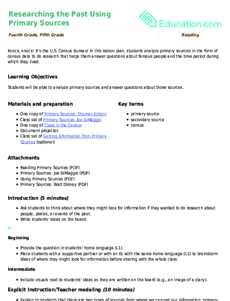
Knock, knock! It’s the U.S. Census Bureau! In this lesson plan, students analyze primary sources in the form of census data to do research that helps them answer questions about famous people and the time period during which they lived.
Lesson Plan
Researching the Past Using Primary Sources
Lesson Plan
Researching the Past Using Primary Sources
Knock, knock! It’s the U.S. Census Bureau! In this lesson plan, students analyze primary sources in the form of census data to do research that helps them answer questions about famous people and the time period during which they lived.
Fourth Grade
Reading
Lesson Plan
1
2
3