SKIP TO CONTENT
Worksheet Generator
Subjects
Grades
Worksheets
Games
Build a Worksheet
More Resources
Roly Recommends
Subjects
Grades
Worksheets
Games
Build a Worksheet
More Resources
Roly Recommends
All Subjects
English Language Arts
Writing
Subtopics:
Writing Types
Writing Process
Writing Organization
Writing Strategies
Show Less
Filters
Search for: identify...
✕
English Language Arts
✕
Lesson Plans
✕
4th and 5th Grade
✕
Subjects
Math
English Language Arts
Science
Social Studies
Grade Level
Pre-K
K
1st
2nd
3rd
4th
5th
6th
7th
8th
Early Childhood
Elementary School
Middle School
Resource Type
Worksheets
Lesson Plans
Interactive Worksheets
Activities
Common Core
Yes
English Language Support
Yes
See More
Clear All
View 48 results
Showing Results for identify...
48 results

Search for: identify...
✕
English Language Arts
✕
Lesson Plans
✕
4th and 5th Grade
✕
Clear All
Sort by:
Relevance
Most recent
Most popular
Alphabetical A-Z
Alphabetical Z-A
All filters
48 results
Sort by:
Relevance
Most recent
Most popular
Alphabetical A-Z
Alphabetical Z-A
Nonfiction Main Idea
Lesson Plan
Nonfiction Main Idea
Fourth Grade
Reading
Let's get reading! In this lesson, students will identify the main idea and details of a nonfiction text. Use this on its own or as support for the lesson Connecting the Coasts: Effects of the Transcontinental Railroad.
Lesson Plan
Nonfiction Main Idea
Lesson Plan
Nonfiction Main Idea
Let's get reading! In this lesson, students will identify the main idea and details of a nonfiction text. Use this on its own or as support for the lesson Connecting the Coasts: Effects of the Transcontinental Railroad.
Fourth Grade
Reading
Lesson Plan
Match Author's Point with Evidence
Lesson Plan
Match Author's Point with Evidence
Fifth Grade
Writing
Use this lesson to help your ELs identify and discuss the author's point and the information that supports it. It can be a stand-alone lesson or used as support for the What’s the Point? lesson.
Lesson Plan
Match Author's Point with Evidence
Lesson Plan
Match Author's Point with Evidence
Use this lesson to help your ELs identify and discuss the author's point and the information that supports it. It can be a stand-alone lesson or used as support for the What’s the Point? lesson.
Fifth Grade
Writing
Lesson Plan
Compound Sentences in Nonfiction
Lesson Plan
Compound Sentences in Nonfiction
Fourth Grade
Writing
This lesson helps your ELs identify the role of coordinating conjunctions and compound sentences in nonfiction texts. Use it as a stand-alone lesson or as a pre-lesson to Nonfiction Genres.
Lesson Plan
Compound Sentences in Nonfiction
Lesson Plan
Compound Sentences in Nonfiction
This lesson helps your ELs identify the role of coordinating conjunctions and compound sentences in nonfiction texts. Use it as a stand-alone lesson or as a pre-lesson to Nonfiction Genres.
Fourth Grade
Writing
Lesson Plan
Main Idea and Details in Nonfiction
Lesson Plan
Main Idea and Details in Nonfiction
Fourth Grade
Reading
In this lesson, students will identify nouns and pronouns as they distinguish between the main idea and supporting details. It may be taught on its own or used as support for the lesson Compare and Contrast Texts on the Same Topic.
Lesson Plan
Main Idea and Details in Nonfiction
Lesson Plan
Main Idea and Details in Nonfiction
In this lesson, students will identify nouns and pronouns as they distinguish between the main idea and supporting details. It may be taught on its own or used as support for the lesson Compare and Contrast Texts on the Same Topic.
Fourth Grade
Reading
Lesson Plan
Main Idea and Supporting Details
Lesson Plan
Main Idea and Supporting Details
Fifth Grade
Writing
Help your ELs learn how to identify the main idea and supporting details in a nonfiction text by using nouns and pronouns as guide words. It can be a stand-alone lesson or used as support to the lesson Explorer Letters.
Lesson Plan
Main Idea and Supporting Details
Lesson Plan
Main Idea and Supporting Details
Help your ELs learn how to identify the main idea and supporting details in a nonfiction text by using nouns and pronouns as guide words. It can be a stand-alone lesson or used as support to the lesson Explorer Letters.
Fifth Grade
Writing
Lesson Plan
Argument Writing: Claim, Reasons, and Evidence
Lesson Plan
Argument Writing: Claim, Reasons, and Evidence
Fifth Grade
Writing
This lesson will help students map out their argument essay after they have identified a topic. Students will learn the three basic components of constructing an argument: stating a claim, listing reasons, and providing evidence.
Lesson Plan
Argument Writing: Claim, Reasons, and Evidence
Lesson Plan
Argument Writing: Claim, Reasons, and Evidence
This lesson will help students map out their argument essay after they have identified a topic. Students will learn the three basic components of constructing an argument: stating a claim, listing reasons, and providing evidence.
Fifth Grade
Writing
Lesson Plan
Main Idea and Details in Nonfiction Texts
Lesson Plan
Main Idea and Details in Nonfiction Texts
Fifth Grade
Writing
Support your EL students in understanding and identifying the main idea and supporting details in a nonfiction text. This can support the lesson Tip of the Iceberg: Nonfiction Summary Details.
Lesson Plan
Main Idea and Details in Nonfiction Texts
Lesson Plan
Main Idea and Details in Nonfiction Texts
Support your EL students in understanding and identifying the main idea and supporting details in a nonfiction text. This can support the lesson Tip of the Iceberg: Nonfiction Summary Details.
Fifth Grade
Writing
Lesson Plan
Connecting the Coasts: Effects of the Transcontinental Railroad
Lesson Plan
Connecting the Coasts: Effects of the Transcontinental Railroad
Fourth Grade
Reading
Look at history! In this lesson, guide students through an exploration of the context, causes, and effects of the Transcontinental Railroad, and help them practice identifying the main idea and supporting details in a nonfiction text.
Lesson Plan
Connecting the Coasts: Effects of the Transcontinental Railroad
Lesson Plan
Connecting the Coasts: Effects of the Transcontinental Railroad
Look at history! In this lesson, guide students through an exploration of the context, causes, and effects of the Transcontinental Railroad, and help them practice identifying the main idea and supporting details in a nonfiction text.
Fourth Grade
Reading
Lesson Plan
Hey! What’s the Big Idea?
Lesson Plan
Hey! What’s the Big Idea?
Fourth Grade
Writing
Your students will practice searching for clues to uncover the main idea and supporting details in nonfiction texts about John Muir and Day of the Dead traditions around the world.
Lesson Plan
Hey! What’s the Big Idea?
Lesson Plan
Hey! What’s the Big Idea?
Your students will practice searching for clues to uncover the main idea and supporting details in nonfiction texts about John Muir and Day of the Dead traditions around the world.
Fourth Grade
Writing
Lesson Plan
Detective Reading
Lesson Plan
Detective Reading
Fourth Grade
Reading
Roll up your sleeves and get out the magnifying glasses! In this lesson, your students will practice finding supportive details and examples in informational texts.
Lesson Plan
Detective Reading
Lesson Plan
Detective Reading
Roll up your sleeves and get out the magnifying glasses! In this lesson, your students will practice finding supportive details and examples in informational texts.
Fourth Grade
Reading
Lesson Plan
Formatting Nonfiction Text
Lesson Plan
Formatting Nonfiction Text
Fourth Grade
Writing
Text formatting can add a lot of richness to how information is explained. In this lesson students will explore the organization of nonfiction texts and go on a scavenger hunt for different kinds of text formatting features.
Lesson Plan
Formatting Nonfiction Text
Lesson Plan
Formatting Nonfiction Text
Text formatting can add a lot of richness to how information is explained. In this lesson students will explore the organization of nonfiction texts and go on a scavenger hunt for different kinds of text formatting features.
Fourth Grade
Writing
Lesson Plan
Super Survival Skills
Lesson Plan
Super Survival Skills
Fifth Grade
Writing
Hone your students' close reading skills by using this interesting and fun lesson that teaches your class survival skills in an informational text.
Lesson Plan
Super Survival Skills
Lesson Plan
Super Survival Skills
Hone your students' close reading skills by using this interesting and fun lesson that teaches your class survival skills in an informational text.
Fifth Grade
Writing
Lesson Plan
Prepositional Phrases as Key Details
Lesson Plan
Prepositional Phrases as Key Details
Fourth Grade
Writing
Help your ELs familiarize themselves with prepositional phrases as they search for supporting details in nonfiction texts. This lesson could stand alone or be taught prior to teaching the Detective Reading lesson.
Lesson Plan
Prepositional Phrases as Key Details
Lesson Plan
Prepositional Phrases as Key Details
Help your ELs familiarize themselves with prepositional phrases as they search for supporting details in nonfiction texts. This lesson could stand alone or be taught prior to teaching the Detective Reading lesson.
Fourth Grade
Writing
Lesson Plan
Native American Legends
Lesson Plan
Native American Legends
Fourth Grade
Writing
Social studies, reading comprehension, and writing come together in this high-engagement lesson about Native American legends!
Lesson Plan
Native American Legends
Lesson Plan
Native American Legends
Social studies, reading comprehension, and writing come together in this high-engagement lesson about Native American legends!
Fourth Grade
Writing
Lesson Plan
State Memories
Lesson Plan
State Memories
Fourth Grade
Reading
In this lesson, your students will practice writing about places important to them through poetry. By the time they are done, students will have become better writers and taken a walk down memory lane!
Lesson Plan
State Memories
Lesson Plan
State Memories
In this lesson, your students will practice writing about places important to them through poetry. By the time they are done, students will have become better writers and taken a walk down memory lane!
Fourth Grade
Reading
Lesson Plan
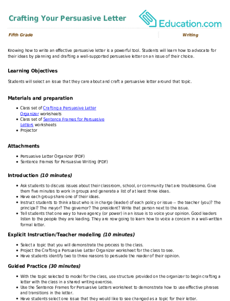
Crafting Your Persuasive Letter
Lesson Plan
Crafting Your Persuasive Letter
Fifth Grade
Writing
Knowing how to write an effective persuasive letter is a powerful tool. Students will learn how to advocate for their ideas by planning and drafting a well-supported persuasive letter on an issue of their choice.
Lesson Plan
Crafting Your Persuasive Letter
Lesson Plan
Crafting Your Persuasive Letter
Knowing how to write an effective persuasive letter is a powerful tool. Students will learn how to advocate for their ideas by planning and drafting a well-supported persuasive letter on an issue of their choice.
Fifth Grade
Writing
Lesson Plan
Two Points of View
Lesson Plan
Two Points of View
Fourth Grade
Writing
Are your students ready to see narratives from a different perspective? This reading lesson will get students excited about discovering first- and third-person points of view.
Lesson Plan
Two Points of View
Lesson Plan
Two Points of View
Are your students ready to see narratives from a different perspective? This reading lesson will get students excited about discovering first- and third-person points of view.
Fourth Grade
Writing
Lesson Plan
Literary Argument Writing: Defining Your Topic
Lesson Plan
Literary Argument Writing: Defining Your Topic
Fourth Grade
Writing
This lesson will help your young writers develop a claim, or thesis, and construct an argument around it. You may have students complete the essay by continuing the process with the lesson Literary Argument Writing: Drafting Your Essay.
Lesson Plan
Literary Argument Writing: Defining Your Topic
Lesson Plan
Literary Argument Writing: Defining Your Topic
This lesson will help your young writers develop a claim, or thesis, and construct an argument around it. You may have students complete the essay by continuing the process with the lesson Literary Argument Writing: Drafting Your Essay.
Fourth Grade
Writing
Lesson Plan
Pacing Strategies
Lesson Plan
Pacing Strategies
Fourth Grade
Writing
Teach young writers some commonly used strategies to pace their narrative writing. Students will learn to use formatting, dialogue, and description to speed up or slow down their piece.
Lesson Plan
Pacing Strategies
Lesson Plan
Pacing Strategies
Teach young writers some commonly used strategies to pace their narrative writing. Students will learn to use formatting, dialogue, and description to speed up or slow down their piece.
Fourth Grade
Writing
Lesson Plan
The New England Colonies: Economy
Lesson Plan
The New England Colonies: Economy
Fifth Grade
Writing
Use this lesson to teach your students how people survived in the New England colonies when they were first created.
Lesson Plan
The New England Colonies: Economy
Lesson Plan
The New England Colonies: Economy
Use this lesson to teach your students how people survived in the New England colonies when they were first created.
Fifth Grade
Writing
Lesson Plan
Reading the Clues, Understanding Plot Lesson Part II
Lesson Plan
Reading the Clues, Understanding Plot Lesson Part II
Fourth Grade
Writing
Have you ever wished that books, like movies, would state their conflict and genres on the cover? With the help of an Education.com workbook, students will learn to find the clues and read like a writer.
Lesson Plan
Reading the Clues, Understanding Plot Lesson Part II
Lesson Plan
Reading the Clues, Understanding Plot Lesson Part II
Have you ever wished that books, like movies, would state their conflict and genres on the cover? With the help of an Education.com workbook, students will learn to find the clues and read like a writer.
Fourth Grade
Writing
Lesson Plan
Text Features: Reading that Makes Sense
Lesson Plan
Text Features: Reading that Makes Sense
Third Grade
Reading
Improve your students' comprehension of non-fictional reading through this lesson that teaches them about text features. Students will find their own text features and explain why they aid in the reading process.
Lesson Plan
Text Features: Reading that Makes Sense
Lesson Plan
Text Features: Reading that Makes Sense
Improve your students' comprehension of non-fictional reading through this lesson that teaches them about text features. Students will find their own text features and explain why they aid in the reading process.
Third Grade
Reading
Lesson Plan
Discovering Character Traits
Lesson Plan
Discovering Character Traits
Fourth Grade
Writing
This lesson will have your EL students exploring characters' dialogue and actions to determine their personality traits! Use it on its own or as a support lesson.
Lesson Plan
Discovering Character Traits
Lesson Plan
Discovering Character Traits
This lesson will have your EL students exploring characters' dialogue and actions to determine their personality traits! Use it on its own or as a support lesson.
Fourth Grade
Writing
Lesson Plan
Reading to Find the Main Idea and Details
Lesson Plan
Reading to Find the Main Idea and Details
Fourth Grade
Writing
Informational texts isn't just found in textbooks. In this reading lesson, kids will examine the writing of a middle school student and use it to learn more about main ideas and supporting details.
Lesson Plan
Reading to Find the Main Idea and Details
Lesson Plan
Reading to Find the Main Idea and Details
Informational texts isn't just found in textbooks. In this reading lesson, kids will examine the writing of a middle school student and use it to learn more about main ideas and supporting details.
Fourth Grade
Writing
Lesson Plan
Similes, Metaphors, and Idioms of Figurative Language
Lesson Plan
Similes, Metaphors, and Idioms of Figurative Language
Fourth Grade
Writing
Similes, metaphors, and idioms are some of the most widely used literary devices in both speaking and writing. Students will review each of these and practice creating some of their own.
Lesson Plan
Similes, Metaphors, and Idioms of Figurative Language
Lesson Plan
Similes, Metaphors, and Idioms of Figurative Language
Similes, metaphors, and idioms are some of the most widely used literary devices in both speaking and writing. Students will review each of these and practice creating some of their own.
Fourth Grade
Writing
Lesson Plan
State Your Claim
Lesson Plan
State Your Claim
Fifth Grade
Writing
Help your students explain how an author uses reasons and evidence to support particular points in a text by giving them high-interest nonfiction texts to read.
Lesson Plan
State Your Claim
Lesson Plan
State Your Claim
Help your students explain how an author uses reasons and evidence to support particular points in a text by giving them high-interest nonfiction texts to read.
Fifth Grade
Writing
Lesson Plan
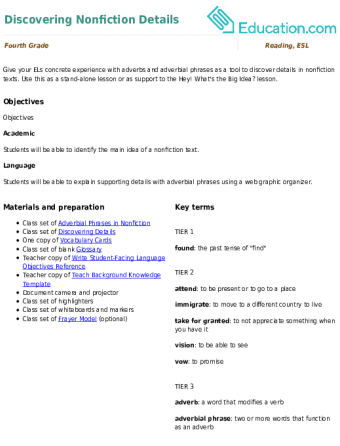
Discovering Nonfiction Details
Lesson Plan
Discovering Nonfiction Details
Fourth Grade
Writing
Give your ELs concrete experience with adverbs and adverbial phrases as a tool to discover details in nonfiction texts. Use this as a stand-alone lesson or as support to the Hey! What's the Big Idea? lesson.
Lesson Plan
Discovering Nonfiction Details
Lesson Plan
Discovering Nonfiction Details
Give your ELs concrete experience with adverbs and adverbial phrases as a tool to discover details in nonfiction texts. Use this as a stand-alone lesson or as support to the Hey! What's the Big Idea? lesson.
Fourth Grade
Writing
Lesson Plan
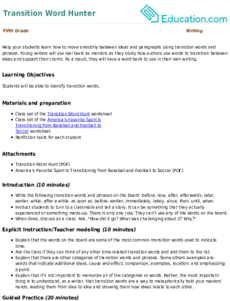
Transition Word Hunter
Lesson Plan
Transition Word Hunter
Fifth Grade
Writing
Help your students learn how to move smoothly between ideas and paragraphs using transition words and phrases. Young writers will use real texts as mentors as they study how authors use words to transition between ideas and support their claims. As a result, they will have a word bank to use in their own writing.
Lesson Plan
Transition Word Hunter
Lesson Plan
Transition Word Hunter
Help your students learn how to move smoothly between ideas and paragraphs using transition words and phrases. Young writers will use real texts as mentors as they study how authors use words to transition between ideas and support their claims. As a result, they will have a word bank to use in their own writing.
Fifth Grade
Writing
Lesson Plan
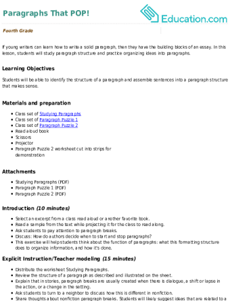
Paragraphs That POP!
Lesson Plan
Paragraphs That POP!
Fourth Grade
Writing
If young writers can learn how to write a solid paragraph, then they have the building blocks of an essay. In this lesson, students will study paragraph structure and practice organizing ideas into paragraphs.
Lesson Plan
Paragraphs That POP!
Lesson Plan
Paragraphs That POP!
If young writers can learn how to write a solid paragraph, then they have the building blocks of an essay. In this lesson, students will study paragraph structure and practice organizing ideas into paragraphs.
Fourth Grade
Writing
Lesson Plan
Using Adjectives and Verbs to Make Writing Come to Life
Lesson Plan
Using Adjectives and Verbs to Make Writing Come to Life
Fourth Grade
Writing
Imagery is one of the most important tools in a narrative writer's arsenal. In this lesson, students will will learn to craft vivid scenes by selecting powerful verbs and adjectives, as well as to critique descriptive writing using the same criteria.
Lesson Plan
Using Adjectives and Verbs to Make Writing Come to Life
Lesson Plan
Using Adjectives and Verbs to Make Writing Come to Life
Imagery is one of the most important tools in a narrative writer's arsenal. In this lesson, students will will learn to craft vivid scenes by selecting powerful verbs and adjectives, as well as to critique descriptive writing using the same criteria.
Fourth Grade
Writing
Lesson Plan
1
2