SKIP TO CONTENT
Worksheet Generator
Subjects
Grades
Worksheets
Games
Build a Worksheet
More Resources
Roly Recommends
Subjects
Grades
Worksheets
Games
Build a Worksheet
More Resources
Roly Recommends
Filters
Search for: summarizing, fiction, texts
✕
Lesson Plans
✕
4th Grade
✕
Subjects
Math
English Language Arts
Social Studies
Grade Level
Pre-K
K
1st
2nd
3rd
4th
5th
6th
7th
8th
Early Childhood
Elementary School
Middle School
Resource Type
Worksheets
Lesson Plans
Interactive Worksheets
Workbooks
Activities
Exercises
Teacher Resources
Common Core
Yes
English Language Support
Yes
See More
Clear All
View 103 results
Showing Results for summarizing fiction texts
103 results
Search for: summarizing, fiction, texts
✕
Lesson Plans
✕
4th Grade
✕
Clear All
Sort by:
Relevance
Most recent
Most popular
Alphabetical A-Z
Alphabetical Z-A
All filters
103 results
Sort by:
Relevance
Most recent
Most popular
Alphabetical A-Z
Alphabetical Z-A
Basic Fiction Summaries
Lesson Plan
Basic Fiction Summaries
Fourth Grade
This lesson gives students a structure to help them summarize fiction texts. When they are skilled at summarizing, they will be more capable of exploring various fiction genres. Use it as a precursor to Fiction Genres Library Exploration.
Lesson Plan
Basic Fiction Summaries
Lesson Plan
Basic Fiction Summaries
This lesson gives students a structure to help them summarize fiction texts. When they are skilled at summarizing, they will be more capable of exploring various fiction genres. Use it as a precursor to Fiction Genres Library Exploration.
Fourth Grade
Lesson Plan
Head to Head Fiction Reflections
Lesson Plan
Head to Head Fiction Reflections
Fourth Grade
Reading reflection topics like theme, problems, and solutions can be challenging concepts for young readers. Help your students make sense of these literary elements using dynamic organizers that draw comparisons between fiction texts.
Lesson Plan
Head to Head Fiction Reflections
Lesson Plan
Head to Head Fiction Reflections
Reading reflection topics like theme, problems, and solutions can be challenging concepts for young readers. Help your students make sense of these literary elements using dynamic organizers that draw comparisons between fiction texts.
Fourth Grade
Lesson Plan
Problems and Solutions in Fiction
Lesson Plan
Problems and Solutions in Fiction
Fourth Grade
Every story has a problem and every problem has a solution! Use this lesson to help students identify the problem and solution in fiction texts. Use it as a stand-alone lesson or as support to the lesson Compare and Contrast Short Stories.
Lesson Plan
Problems and Solutions in Fiction
Lesson Plan
Problems and Solutions in Fiction
Every story has a problem and every problem has a solution! Use this lesson to help students identify the problem and solution in fiction texts. Use it as a stand-alone lesson or as support to the lesson Compare and Contrast Short Stories.
Fourth Grade
Lesson Plan
Fiction vs. Nonfiction
Lesson Plan
Fiction vs. Nonfiction
Fourth Grade
Reading
Kids will love learning some fun facts about elephants while developing their reading comprehension skills. Using T-charts and Venn diagrams, they'll analyze stories and explore different characteristics of fiction and nonfiction.
Lesson Plan
Fiction vs. Nonfiction
Lesson Plan
Fiction vs. Nonfiction
Kids will love learning some fun facts about elephants while developing their reading comprehension skills. Using T-charts and Venn diagrams, they'll analyze stories and explore different characteristics of fiction and nonfiction.
Fourth Grade
Reading
Lesson Plan
What's the Big Idea? Summarizing Nonfiction Texts
Lesson Plan
What's the Big Idea? Summarizing Nonfiction Texts
Fourth Grade
Writing
Understanding the big idea of a nonfiction text and being able to write a succinct summary are key fourth grade skills. This lesson focuses on summarizing a nonfiction passage in 3-4 sentences.
Lesson Plan
What's the Big Idea? Summarizing Nonfiction Texts
Lesson Plan
What's the Big Idea? Summarizing Nonfiction Texts
Understanding the big idea of a nonfiction text and being able to write a succinct summary are key fourth grade skills. This lesson focuses on summarizing a nonfiction passage in 3-4 sentences.
Fourth Grade
Writing
Lesson Plan
Adjectives in Informational Texts
Lesson Plan
Adjectives in Informational Texts
Fourth Grade
Describe the facts! This lesson teaches your ELs to identify adjectives and their important role as key details in informational texts. Use it as a stand-alone lesson or as support to the lesson Summarizing Nonfiction Texts.
Lesson Plan
Adjectives in Informational Texts
Lesson Plan
Adjectives in Informational Texts
Describe the facts! This lesson teaches your ELs to identify adjectives and their important role as key details in informational texts. Use it as a stand-alone lesson or as support to the lesson Summarizing Nonfiction Texts.
Fourth Grade
Lesson Plan
What's the Big Idea? Summarizing Nonfiction Texts
Lesson Plan
What's the Big Idea? Summarizing Nonfiction Texts
Fourth Grade
Reading
Understanding the big idea of a nonfiction text and being able to write a succinct summary are key fourth grade skills. This lesson focuses on summarizing a nonfiction passage in three to four sentences.
Lesson Plan
What's the Big Idea? Summarizing Nonfiction Texts
Lesson Plan
What's the Big Idea? Summarizing Nonfiction Texts
Understanding the big idea of a nonfiction text and being able to write a succinct summary are key fourth grade skills. This lesson focuses on summarizing a nonfiction passage in three to four sentences.
Fourth Grade
Reading
Lesson Plan
Using Story Elements to Compare and Contrast Fiction Texts
Lesson Plan
Using Story Elements to Compare and Contrast Fiction Texts
Fourth Grade
Reading
All fictional stories have story elements but they sure can differ between stories. In this lesson, students will compare and contrast the story elements of two fictional stories and document their findings in a graphic organizer.
Lesson Plan
Using Story Elements to Compare and Contrast Fiction Texts
Lesson Plan
Using Story Elements to Compare and Contrast Fiction Texts
All fictional stories have story elements but they sure can differ between stories. In this lesson, students will compare and contrast the story elements of two fictional stories and document their findings in a graphic organizer.
Fourth Grade
Reading
Lesson Plan
Shifting Points of View
Lesson Plan
Shifting Points of View
Fourth Grade
Reading
This lesson gives students practice identifying first person and third person narration in fiction and nonfiction texts. It could be taught as a stand-alone lesson or as a precursor to the lesson Fiction vs. Nonfiction.
Lesson Plan
Shifting Points of View
Lesson Plan
Shifting Points of View
This lesson gives students practice identifying first person and third person narration in fiction and nonfiction texts. It could be taught as a stand-alone lesson or as a precursor to the lesson Fiction vs. Nonfiction.
Fourth Grade
Reading
Lesson Plan
Fiction Genres Library Exploration
Lesson Plan
Fiction Genres Library Exploration
Fourth Grade
How familiar are your fourth graders with the fictional genres available in their class or school libraries? This lesson introduces them to many genres of fictional books so they can get off to a terrific start of fourth grade reading.
Lesson Plan
Fiction Genres Library Exploration
Lesson Plan
Fiction Genres Library Exploration
How familiar are your fourth graders with the fictional genres available in their class or school libraries? This lesson introduces them to many genres of fictional books so they can get off to a terrific start of fourth grade reading.
Fourth Grade
Lesson Plan
Battle of the Texts: Print vs. Electronics
Lesson Plan
Battle of the Texts: Print vs. Electronics
Fourth Grade
Are you a page turner or a mouse clicker? In this lesson, students compare and contrast text features in two types of nonfictions texts: print and electronic.
Lesson Plan
Battle of the Texts: Print vs. Electronics
Lesson Plan
Battle of the Texts: Print vs. Electronics
Are you a page turner or a mouse clicker? In this lesson, students compare and contrast text features in two types of nonfictions texts: print and electronic.
Fourth Grade
Lesson Plan
Compare and Contrast Texts on the Same Topic
Lesson Plan
Compare and Contrast Texts on the Same Topic
Fourth Grade
Vocabulary
Did you know that comparative tasks improve comprehension and help students develop higher order thinking skills? In this lesson, students will compare nonfiction texts on the same topic using Venn diagrams and performance!
Lesson Plan
Compare and Contrast Texts on the Same Topic
Lesson Plan
Compare and Contrast Texts on the Same Topic
Did you know that comparative tasks improve comprehension and help students develop higher order thinking skills? In this lesson, students will compare nonfiction texts on the same topic using Venn diagrams and performance!
Fourth Grade
Vocabulary
Lesson Plan
Summarizing with Sequence Words
Lesson Plan
Summarizing with Sequence Words
Fourth Grade
This lesson helps students summarize fictional stories using sequence words. Students will have a chance to practice distinguishing the different parts of a story in this lesson, which can be taught as a precursor to Storyboard Superstars.
Lesson Plan
Summarizing with Sequence Words
Lesson Plan
Summarizing with Sequence Words
This lesson helps students summarize fictional stories using sequence words. Students will have a chance to practice distinguishing the different parts of a story in this lesson, which can be taught as a precursor to Storyboard Superstars.
Fourth Grade
Lesson Plan
Scary Story Elements
Lesson Plan
Scary Story Elements
Fourth Grade
Reading
In this lesson, students will use conjunctions to compare and contrast scary stories. It can be taught independently or used as a pre-lesson to Using Story Elements to Compare and Contrast Fiction Texts.
Lesson Plan
Scary Story Elements
Lesson Plan
Scary Story Elements
In this lesson, students will use conjunctions to compare and contrast scary stories. It can be taught independently or used as a pre-lesson to Using Story Elements to Compare and Contrast Fiction Texts.
Fourth Grade
Reading
Lesson Plan
Who Is Telling the Story?
Lesson Plan
Who Is Telling the Story?
Fourth Grade
Help your ELs see the connection between nouns and pronouns and the author's point of view, or perspective, in fiction and nonfiction texts. This lesson can be taught on its own or used as support for the lesson Two Points of View.
Lesson Plan
Who Is Telling the Story?
Lesson Plan
Who Is Telling the Story?
Help your ELs see the connection between nouns and pronouns and the author's point of view, or perspective, in fiction and nonfiction texts. This lesson can be taught on its own or used as support for the lesson Two Points of View.
Fourth Grade
Lesson Plan
Myths and Man
Lesson Plan
Myths and Man
Fourth Grade
Reading
Popular fiction throughout the ages colors the way people speak. In this short lesson, students will read a myth and non-fiction paragraph in order to identify and define words that come from mythology.
Lesson Plan
Myths and Man
Lesson Plan
Myths and Man
Popular fiction throughout the ages colors the way people speak. In this short lesson, students will read a myth and non-fiction paragraph in order to identify and define words that come from mythology.
Fourth Grade
Reading
Lesson Plan
Prefixes in Texts
Lesson Plan
Prefixes in Texts
Fourth Grade
It is not only important for students to recognize words with prefixes, but also be able to choose the right prefix for the base word. In this lesson, students will work in groups to come up with as many words as possible with particular prefixes.
Lesson Plan
Prefixes in Texts
Lesson Plan
Prefixes in Texts
It is not only important for students to recognize words with prefixes, but also be able to choose the right prefix for the base word. In this lesson, students will work in groups to come up with as many words as possible with particular prefixes.
Fourth Grade
Lesson Plan
We’ve Got a Problem!
Lesson Plan
We’ve Got a Problem!
Third Grade
What’s the problem? Teach your students to identify the problem and solution in a piece of fiction.
Lesson Plan
We’ve Got a Problem!
Lesson Plan
We’ve Got a Problem!
What’s the problem? Teach your students to identify the problem and solution in a piece of fiction.
Third Grade
Lesson Plan
Words That Show Cause and Effect
Lesson Plan
Words That Show Cause and Effect
Fourth Grade
This lesson helps students recognize cause-and-effect relationships in fiction and nonfiction writing by identifying clue words. It can be used on its own or as a precursor to Cause and Effect with Comic Strips.
Lesson Plan
Words That Show Cause and Effect
Lesson Plan
Words That Show Cause and Effect
This lesson helps students recognize cause-and-effect relationships in fiction and nonfiction writing by identifying clue words. It can be used on its own or as a precursor to Cause and Effect with Comic Strips.
Fourth Grade
Lesson Plan
Middle Atlantic State Migration
Lesson Plan
Middle Atlantic State Migration
Fourth Grade
Reading
In this lesson, your students will use guiding questions as a way to organize their thoughts about non-fiction reading. They will also gain an understanding of some of the factors that led to the colonization of the Middle Atlantic States.
Lesson Plan
Middle Atlantic State Migration
Lesson Plan
Middle Atlantic State Migration
In this lesson, your students will use guiding questions as a way to organize their thoughts about non-fiction reading. They will also gain an understanding of some of the factors that led to the colonization of the Middle Atlantic States.
Fourth Grade
Reading
Lesson Plan
Literary Vocabulary, Understanding Plot Lesson Part I
Lesson Plan
Literary Vocabulary, Understanding Plot Lesson Part I
Fourth Grade
Have you ever imagined the action and imagery used in conflict during fantasy fiction novels? Using an Education.com workbook, students will learn the vocabulary of literature and complete a crossword puzzle.
Lesson Plan
Literary Vocabulary, Understanding Plot Lesson Part I
Lesson Plan
Literary Vocabulary, Understanding Plot Lesson Part I
Have you ever imagined the action and imagery used in conflict during fantasy fiction novels? Using an Education.com workbook, students will learn the vocabulary of literature and complete a crossword puzzle.
Fourth Grade
Lesson Plan
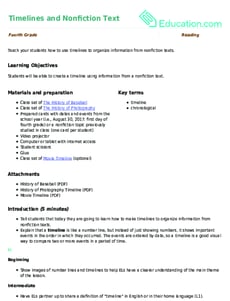
Timelines and Nonfiction Text
Lesson Plan
Timelines and Nonfiction Text
Fourth Grade
Teach your students how to use timelines to organize information from nonfiction texts.
Lesson Plan
Timelines and Nonfiction Text
Lesson Plan
Timelines and Nonfiction Text
Teach your students how to use timelines to organize information from nonfiction texts.
Fourth Grade
Lesson Plan
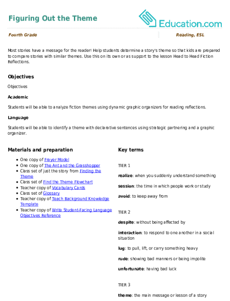
Figuring Out the Theme
Lesson Plan
Figuring Out the Theme
Fourth Grade
Most stories have a message for the reader! Help students determine a story's theme so that kids are prepared to compare stories with similar themes. Use this on its own or as support to the lesson Head to Head Fiction Reflections.
Lesson Plan
Figuring Out the Theme
Lesson Plan
Figuring Out the Theme
Most stories have a message for the reader! Help students determine a story's theme so that kids are prepared to compare stories with similar themes. Use this on its own or as support to the lesson Head to Head Fiction Reflections.
Fourth Grade
Lesson Plan
Inferences in Nonfiction Texts: Cesar Chavez and Farmworker Rights
Lesson Plan
Inferences in Nonfiction Texts: Cesar Chavez and Farmworker Rights
Fourth Grade
Vocabulary
Cesar Chavez is a perfect example of a champion for social justice. Students will refine inference skills by using background knowledge and evidence from the text, while also discovering an important American civil rights activist.
Lesson Plan
Inferences in Nonfiction Texts: Cesar Chavez and Farmworker Rights
Lesson Plan
Inferences in Nonfiction Texts: Cesar Chavez and Farmworker Rights
Cesar Chavez is a perfect example of a champion for social justice. Students will refine inference skills by using background knowledge and evidence from the text, while also discovering an important American civil rights activist.
Fourth Grade
Vocabulary
Lesson Plan
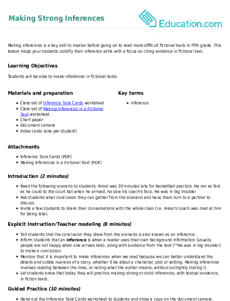
Making Strong Inferences
Lesson Plan
Making Strong Inferences
Fourth Grade
Making inferences is a key skill to master before going on to read more difficult fictional texts in fifth grade. This lesson helps your students solidify their inference skills with a focus on citing evidence in fictional text.
Lesson Plan
Making Strong Inferences
Lesson Plan
Making Strong Inferences
Making inferences is a key skill to master before going on to read more difficult fictional texts in fifth grade. This lesson helps your students solidify their inference skills with a focus on citing evidence in fictional text.
Fourth Grade
Lesson Plan
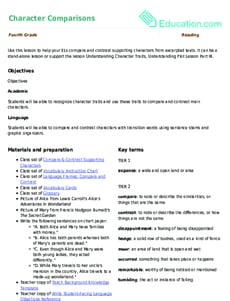
Character Comparisons
Lesson Plan
Character Comparisons
Fourth Grade
Reading
Use this lesson to help your ELs compare and contrast supporting characters from excerpted texts. It can be a stand-alone lesson or support the lesson Understanding Character Traits, Understanding Plot Lesson Part III.
Lesson Plan
Character Comparisons
Lesson Plan
Character Comparisons
Use this lesson to help your ELs compare and contrast supporting characters from excerpted texts. It can be a stand-alone lesson or support the lesson Understanding Character Traits, Understanding Plot Lesson Part III.
Fourth Grade
Reading
Lesson Plan
Storyboard Superstars
Lesson Plan
Storyboard Superstars
Fourth Grade
Help your students become super readers! In this lesson, your students will create storyboards to identify the beginning, middle, and end in fictional texts.
Lesson Plan
Storyboard Superstars
Lesson Plan
Storyboard Superstars
Help your students become super readers! In this lesson, your students will create storyboards to identify the beginning, middle, and end in fictional texts.
Fourth Grade
Lesson Plan
Papering the Plains States
Lesson Plan
Papering the Plains States
Fourth Grade
Writing
Making inferences from texts about the Plains States, your students will learn how to read with a purpose! In this lesson, your students will practice important skills while developing knowledge of various states.
Lesson Plan
Papering the Plains States
Lesson Plan
Papering the Plains States
Making inferences from texts about the Plains States, your students will learn how to read with a purpose! In this lesson, your students will practice important skills while developing knowledge of various states.
Fourth Grade
Writing
Lesson Plan
Nonfiction Genres
Lesson Plan
Nonfiction Genres
Fourth Grade
Writing
In this lesson, your students will explore the library in search of various genres of nonfiction texts. Teach this lesson at the beginning of the year to familiarize your students with the structure and organization of the library.
Lesson Plan
Nonfiction Genres
Lesson Plan
Nonfiction Genres
In this lesson, your students will explore the library in search of various genres of nonfiction texts. Teach this lesson at the beginning of the year to familiarize your students with the structure and organization of the library.
Fourth Grade
Writing
Lesson Plan
Charts and Graphs and Diagrams, Oh My!
Lesson Plan
Charts and Graphs and Diagrams, Oh My!
Fourth Grade
Reading
Students will learn about three nonfiction text features: charts, graphs, and diagrams. They will analyze and interpret the information represented in these visual forms and discover how they aid in the comprehension of nonfiction texts.
Lesson Plan
Charts and Graphs and Diagrams, Oh My!
Lesson Plan
Charts and Graphs and Diagrams, Oh My!
Students will learn about three nonfiction text features: charts, graphs, and diagrams. They will analyze and interpret the information represented in these visual forms and discover how they aid in the comprehension of nonfiction texts.
Fourth Grade
Reading
Lesson Plan
1
2
3
4