SKIP TO CONTENT
Worksheet Generator
Subjects
Grades
Worksheets
Games
Build a Worksheet
More Resources
Roly Recommends
Subjects
Grades
Worksheets
Games
Build a Worksheet
More Resources
Roly Recommends
2nd - 8th Grade Lesson Plans : Page 52
Filters
1,594 results
Lesson Plans
✕
2nd - 8th Grade
✕
Clear all
1,594 results
Filters
Lesson Plans
✕
2nd - 8th Grade
✕
Subjects
Math
English Language Arts
Science
Social Studies
Technology
Grade Level
Pre-K
K
1st
2nd
3rd
4th
5th
6th
7th
8th
Early Childhood
Elementary School
Middle School
Resource Type
Worksheets
Games
Lesson Plans
Interactive Worksheets
Workbooks
Activities
Exercises
Stories
Songs
Offline Games
Guided Lessons
Teacher Resources
Teacher Editions
Common Core
Yes
Roly Recommends
Social Emotional Learning
Arts & Crafts
Paper & Glue Crafts
English Language Support
Yes
Clear all
View 1,594 results
2nd - 8th Grade Lesson Plans : Page 52
Filters
1,594 results
Lesson Plans
✕
2nd - 8th Grade
✕
Clear all
1,594 results
EL
Let's Read It With Expression!
Lesson Plan
Let's Read It With Expression!
Third Grade
Teach your students about text clues that will help them read with expression. This lesson can stand alone or be used as a pre-lesson for the
Reader's Theater: Read the Script
lesson.
Lesson Plan
EL
Let's Read It With Expression!
Lesson Plan
Let's Read It With Expression!
Teach your students about text clues that will help them read with expression. This lesson can stand alone or be used as a pre-lesson for the
Reader's Theater: Read the Script
lesson.
Third Grade
Lesson Plan
EL
Differentiating Main Ideas from Details
Lesson Plan
Differentiating Main Ideas from Details
Fifth Grade
Writing
Use this lesson to help your ELs understand main idea and supporting details in the context of sentences and paragraphs. It can be a stand-alone lesson or a support lesson to the Power Reading lesson.
Lesson Plan
EL
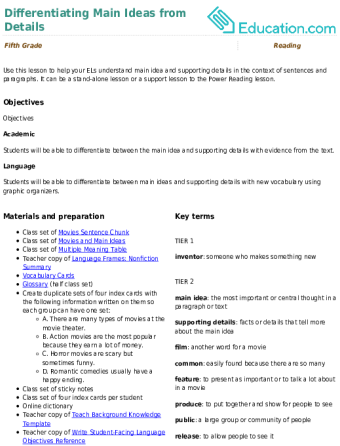
Differentiating Main Ideas from Details
Lesson Plan
Differentiating Main Ideas from Details
Use this lesson to help your ELs understand main idea and supporting details in the context of sentences and paragraphs. It can be a stand-alone lesson or a support lesson to the Power Reading lesson.
Fifth Grade
Writing
Lesson Plan
Color Coding Nonfiction Text
Lesson Plan
Color Coding Nonfiction Text
Third Grade
Jazz up your nonfiction reading and add a little color! Use this lesson with your students to teach them to cite text evidence as they answer questions by color coding.
Lesson Plan
Color Coding Nonfiction Text
Lesson Plan
Color Coding Nonfiction Text
Jazz up your nonfiction reading and add a little color! Use this lesson with your students to teach them to cite text evidence as they answer questions by color coding.
Third Grade
Lesson Plan
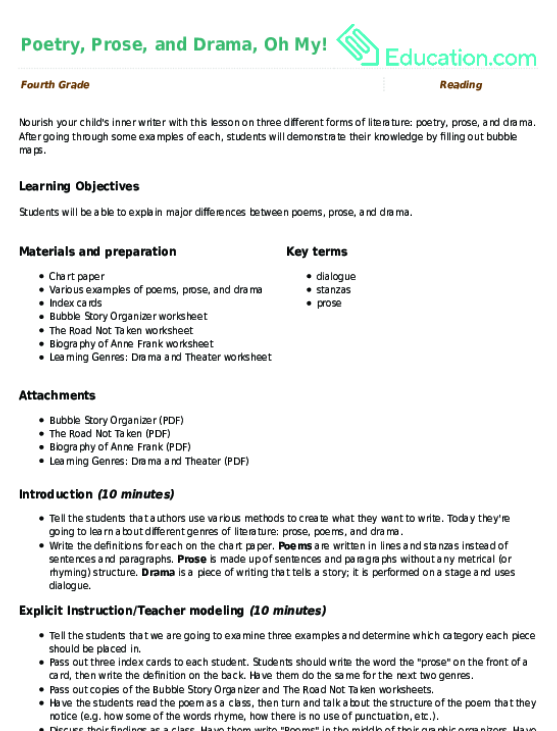
Poetry, Prose, and Drama, Oh My!
Lesson Plan
Poetry, Prose, and Drama, Oh My!
Fourth Grade
Reading
Nourish your child's inner writer with this lesson on three different forms of literature: poetry, prose, and drama. After going through some examples of each, students will demonstrate their knowledge by filling out bubble maps.
Lesson Plan
Poetry, Prose, and Drama, Oh My!
Lesson Plan
Poetry, Prose, and Drama, Oh My!
Nourish your child's inner writer with this lesson on three different forms of literature: poetry, prose, and drama. After going through some examples of each, students will demonstrate their knowledge by filling out bubble maps.
Fourth Grade
Reading
Lesson Plan
Fraction Families
Lesson Plan
Fraction Families
Second Grade
Fractions
Help your students find their fraction families with this lesson that sends them searching for their equal fraction pieces!
Lesson Plan
Fraction Families
Lesson Plan
Fraction Families
Help your students find their fraction families with this lesson that sends them searching for their equal fraction pieces!
Second Grade
Fractions
Lesson Plan
EL
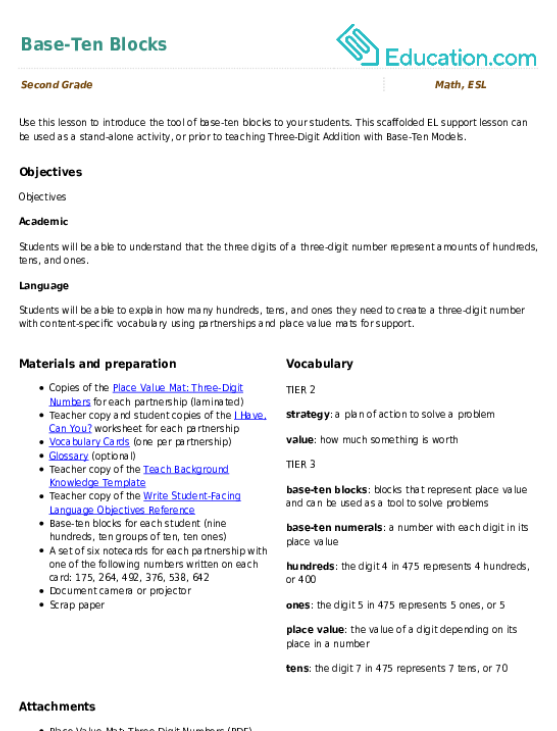
Base-Ten Blocks
Lesson Plan
Base-Ten Blocks
Second Grade
Place Value
Use this lesson to introduce the tool of base-ten blocks to your students. This scaffolded EL support lesson can be used as a stand-alone activity, or prior to teaching Three-Digit Addition with Base-Ten Models.
Lesson Plan
EL
Base-Ten Blocks
Lesson Plan
Base-Ten Blocks
Use this lesson to introduce the tool of base-ten blocks to your students. This scaffolded EL support lesson can be used as a stand-alone activity, or prior to teaching Three-Digit Addition with Base-Ten Models.
Second Grade
Place Value
Lesson Plan
EL
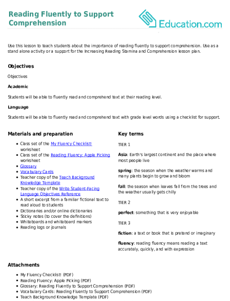
Reading Fluently to Support Comprehension
Lesson Plan
Reading Fluently to Support Comprehension
Second Grade
Reading
Use this lesson to teach students about the importance of reading fluently to support comprehension. Use as a stand alone activity or a support for the Increasing Reading Stamina and Comprehension lesson plan.
Lesson Plan
EL
Reading Fluently to Support Comprehension
Lesson Plan
Reading Fluently to Support Comprehension
Use this lesson to teach students about the importance of reading fluently to support comprehension. Use as a stand alone activity or a support for the Increasing Reading Stamina and Comprehension lesson plan.
Second Grade
Reading
Lesson Plan
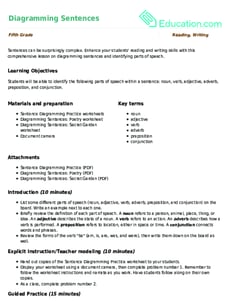
Diagramming Sentences
Lesson Plan
Diagramming Sentences
Fifth Grade
Sentences can be surprisingly complex. Enhance your students' reading and writing skills with this comprehensive lesson on diagramming sentences and identifying parts of speech.
Lesson Plan
Diagramming Sentences
Lesson Plan
Diagramming Sentences
Sentences can be surprisingly complex. Enhance your students' reading and writing skills with this comprehensive lesson on diagramming sentences and identifying parts of speech.
Fifth Grade
Lesson Plan
EL
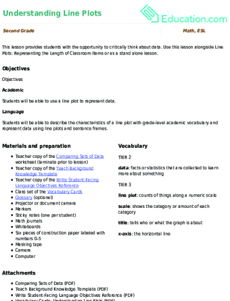
Understanding Line Plots
Lesson Plan
Understanding Line Plots
Second Grade
Writing
This lesson provides students with the opportunity to critically think about data. Use this lesson alongside Line Plots: Representing the Length of Classroom Items or as a stand alone lesson.
Lesson Plan
EL
Understanding Line Plots
Lesson Plan
Understanding Line Plots
This lesson provides students with the opportunity to critically think about data. Use this lesson alongside Line Plots: Representing the Length of Classroom Items or as a stand alone lesson.
Second Grade
Writing
Lesson Plan
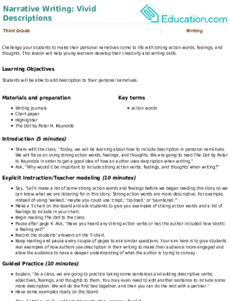
Narrative Writing: Vivid Descriptions
Lesson Plan
Narrative Writing: Vivid Descriptions
Third Grade
Challenge your students to make their personal narratives come to life with strong action words, feelings, and thoughts. This lesson will help young learners develop their creativity and writing skills.
Lesson Plan
Narrative Writing: Vivid Descriptions
Lesson Plan
Narrative Writing: Vivid Descriptions
Challenge your students to make their personal narratives come to life with strong action words, feelings, and thoughts. This lesson will help young learners develop their creativity and writing skills.
Third Grade
Lesson Plan
EL
Using Picture Walks to Examine Purpose
Lesson Plan
Using Picture Walks to Examine Purpose
Second Grade
Reading
Teach your students about picture walks as a strategy to understand the author's purpose in a fictional text. This lesson can be used as a stand-alone lesson or as support for the Examining Author's Purpose in a Fictional Text lesson.
Lesson Plan
EL
Using Picture Walks to Examine Purpose
Lesson Plan
Using Picture Walks to Examine Purpose
Teach your students about picture walks as a strategy to understand the author's purpose in a fictional text. This lesson can be used as a stand-alone lesson or as support for the Examining Author's Purpose in a Fictional Text lesson.
Second Grade
Reading
Lesson Plan
Parts of Speech: Sticky Note Ad-Libs
Lesson Plan
Parts of Speech: Sticky Note Ad-Libs
Fifth Grade
Grammar and Mechanics
In this great grammar lesson, your students will practice using the eight parts of speech to complete sentences.
Lesson Plan
Parts of Speech: Sticky Note Ad-Libs
Lesson Plan
Parts of Speech: Sticky Note Ad-Libs
In this great grammar lesson, your students will practice using the eight parts of speech to complete sentences.
Fifth Grade
Grammar and Mechanics
Lesson Plan
Fact vs. Opinion Sort
Lesson Plan
Fact vs. Opinion Sort
Second Grade
In this lesson, students develop an understand of the difference between facts and opinions. After analyzing different statements, students write their own sentences to sort and analyze.
Lesson Plan
Fact vs. Opinion Sort
Lesson Plan
Fact vs. Opinion Sort
In this lesson, students develop an understand of the difference between facts and opinions. After analyzing different statements, students write their own sentences to sort and analyze.
Second Grade
Lesson Plan
Learn About the Body: Connective Tissues
Lesson Plan
Learn About the Body: Connective Tissues
Fourth Grade
Life Science
Let's learn about the human body. Students will enjoy discovering different connective tissues in this comprehensive science lesson.
Lesson Plan
Learn About the Body: Connective Tissues
Lesson Plan
Learn About the Body: Connective Tissues
Let's learn about the human body. Students will enjoy discovering different connective tissues in this comprehensive science lesson.
Fourth Grade
Life Science
Lesson Plan
Mixed Up Fairy Tales
Lesson Plan
Mixed Up Fairy Tales
Fifth Grade
Reading
Put your students' imaginations to the test with this lesson on storytelling and creative writing. After reading some classic fairy tales, students will create their own using printed figures.
Lesson Plan
Mixed Up Fairy Tales
Lesson Plan
Mixed Up Fairy Tales
Put your students' imaginations to the test with this lesson on storytelling and creative writing. After reading some classic fairy tales, students will create their own using printed figures.
Fifth Grade
Reading
Lesson Plan
Liquid Detectives
Lesson Plan
Liquid Detectives
First Grade
Physical Science
This hands-on lesson will get your students to investigate some mystery liquids, and they will have to use their observational skills to figure out what they are.
Lesson Plan
Liquid Detectives
Lesson Plan
Liquid Detectives
This hands-on lesson will get your students to investigate some mystery liquids, and they will have to use their observational skills to figure out what they are.
First Grade
Physical Science
Lesson Plan
Nonfiction Comprehension: Compare and Contrast
Lesson Plan
Nonfiction Comprehension: Compare and Contrast
Third Grade
Teach your students to compare and contrast to boost their comprehension! Use this lesson to teach your students to compare and contrast information from two nonfiction texts on the same topic.
Lesson Plan
Nonfiction Comprehension: Compare and Contrast
Lesson Plan
Nonfiction Comprehension: Compare and Contrast
Teach your students to compare and contrast to boost their comprehension! Use this lesson to teach your students to compare and contrast information from two nonfiction texts on the same topic.
Third Grade
Lesson Plan
EL
Word Problem Comprehension
Lesson Plan
Word Problem Comprehension
Third Grade
Make sure your students understand the word problem before they begin to solve it! Use this as a stand alone lesson or a pre-lesson for
Two-Step Word Problems with Mixed-Operations - Gamified!
Lesson Plan
EL
Word Problem Comprehension
Lesson Plan
Word Problem Comprehension
Make sure your students understand the word problem before they begin to solve it! Use this as a stand alone lesson or a pre-lesson for
Two-Step Word Problems with Mixed-Operations - Gamified!
Third Grade
Lesson Plan
EL
Strategies to Make Multiplication a Breeze
Lesson Plan
Strategies to Make Multiplication a Breeze
Third Grade
Multiplication
With this lesson, your students will see how the order of the factors does not affect the product in a multiplication expression. Use this on its own or alongside
You're On a Roll! Practicing Multiplication Facts.
Lesson Plan
EL
Strategies to Make Multiplication a Breeze
Lesson Plan
Strategies to Make Multiplication a Breeze
With this lesson, your students will see how the order of the factors does not affect the product in a multiplication expression. Use this on its own or alongside
You're On a Roll! Practicing Multiplication Facts.
Third Grade
Multiplication
Lesson Plan
EL
Who Is Telling the Story?
Lesson Plan
Who Is Telling the Story?
Fourth Grade
Help your ELs see the connection between nouns and pronouns and the author's point of view, or perspective, in fiction and nonfiction texts. This lesson can be taught on its own or used as support for the lesson Two Points of View.
Lesson Plan
EL
Who Is Telling the Story?
Lesson Plan
Who Is Telling the Story?
Help your ELs see the connection between nouns and pronouns and the author's point of view, or perspective, in fiction and nonfiction texts. This lesson can be taught on its own or used as support for the lesson Two Points of View.
Fourth Grade
Lesson Plan
Who Has More?: Comparing Decimals
Lesson Plan
Who Has More?: Comparing Decimals
Fifth Grade
Place Value
Get your little mathematicians excited with this fun lesson about comparing decimals. It features helpful review activities and a game that's sure to keep students engaged.
Lesson Plan
Who Has More?: Comparing Decimals
Lesson Plan
Who Has More?: Comparing Decimals
Get your little mathematicians excited with this fun lesson about comparing decimals. It features helpful review activities and a game that's sure to keep students engaged.
Fifth Grade
Place Value
Lesson Plan
EL
Which Unit of Measurement?
Lesson Plan
Which Unit of Measurement?
Third Grade
Get your students explaining estimations and measurements of liquid volumes and masses of objects! Use this lesson independently or alongside
Estimating Measurements of Mass and Volume Using Metric Units.
Lesson Plan
EL
Which Unit of Measurement?
Lesson Plan
Which Unit of Measurement?
Get your students explaining estimations and measurements of liquid volumes and masses of objects! Use this lesson independently or alongside
Estimating Measurements of Mass and Volume Using Metric Units.
Third Grade
Lesson Plan
The Same or Different? You Decide!
Lesson Plan
The Same or Different? You Decide!
Third Grade
Reading
Are the stories the same or different? You decide! Use this lesson with your students to practice comparing the story elements in two fictional stories written by the same author.
Lesson Plan
The Same or Different? You Decide!
Lesson Plan
The Same or Different? You Decide!
Are the stories the same or different? You decide! Use this lesson with your students to practice comparing the story elements in two fictional stories written by the same author.
Third Grade
Reading
Lesson Plan
Haiku Syllables
Lesson Plan
Haiku Syllables
First Grade
Writing
Have your students stretch their creativity with this lesson that teaches them about haikus and has them practice their syllable counting.
Lesson Plan
Haiku Syllables
Lesson Plan
Haiku Syllables
Have your students stretch their creativity with this lesson that teaches them about haikus and has them practice their syllable counting.
First Grade
Writing
Lesson Plan
Borrowing Center
Lesson Plan
Borrowing Center
Second Grade
Using base ten blocks, cards, and clear cups, your students will practice the concept of borrowing for subtraction problems in this lesson.
Lesson Plan
Borrowing Center
Lesson Plan
Borrowing Center
Using base ten blocks, cards, and clear cups, your students will practice the concept of borrowing for subtraction problems in this lesson.
Second Grade
Lesson Plan
What is a Region?
Lesson Plan
What is a Region?
Fourth Grade
Geography
Through examples and non-examples, students will learn what qualifies as a region. Creativity and problem solving skills will be put to the test as students determine the necessary elements that make up a region.
Lesson Plan
What is a Region?
Lesson Plan
What is a Region?
Through examples and non-examples, students will learn what qualifies as a region. Creativity and problem solving skills will be put to the test as students determine the necessary elements that make up a region.
Fourth Grade
Geography
Lesson Plan
EL
Strategies to Identify What's Missing
Lesson Plan
Strategies to Identify What's Missing
Third Grade
Let your students explore different strategies to figure out the missing number in an equation. Use this lesson on its own or as a support lesson for
Missing Numbers: Math Review
.
Lesson Plan
EL
Strategies to Identify What's Missing
Lesson Plan
Strategies to Identify What's Missing
Let your students explore different strategies to figure out the missing number in an equation. Use this lesson on its own or as a support lesson for
Missing Numbers: Math Review
.
Third Grade
Lesson Plan
Are You a Producer or a Consumer?
Lesson Plan
Are You a Producer or a Consumer?
Second Grade
Economics
In this lesson, your students will learn about their roles as consumers and producers in a community through engaging activities and discussion.
Lesson Plan
Are You a Producer or a Consumer?
Lesson Plan
Are You a Producer or a Consumer?
In this lesson, your students will learn about their roles as consumers and producers in a community through engaging activities and discussion.
Second Grade
Economics
Lesson Plan
EL
Exploring Sequence with Signal Words
Lesson Plan
Exploring Sequence with Signal Words
Third Grade
Use this lesson to teach your students how to retell the beginning, middle, and end of a story using sequencing words and phrases. This lesson can stand alone or be used as a pre-lesson for the
Story Structure Rollercoaster
lesson.
Lesson Plan
EL
Exploring Sequence with Signal Words
Lesson Plan
Exploring Sequence with Signal Words
Use this lesson to teach your students how to retell the beginning, middle, and end of a story using sequencing words and phrases. This lesson can stand alone or be used as a pre-lesson for the
Story Structure Rollercoaster
lesson.
Third Grade
Lesson Plan
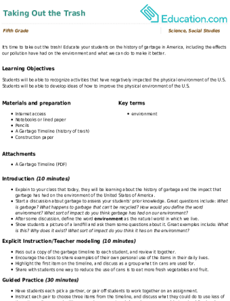
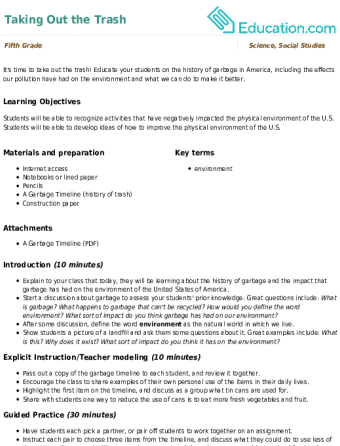
Taking Out the Trash
Lesson Plan
Taking Out the Trash
Fifth Grade
It's time to take out the trash! Educate your students on the history of garbage in America, including the effects our pollution have had on the environment and what we can do to make it better.
Lesson Plan
Taking Out the Trash
Lesson Plan
Taking Out the Trash
It's time to take out the trash! Educate your students on the history of garbage in America, including the effects our pollution have had on the environment and what we can do to make it better.
Fifth Grade
Lesson Plan
1
…
51
52
53
54