SKIP TO CONTENT
Worksheet Generator
Subjects
Grades
Worksheets
Games
Build a Worksheet
More Resources
Roly Recommends
Subjects
Grades
Worksheets
Games
Build a Worksheet
More Resources
Roly Recommends
All Subjects
English Language Arts
Reading
Subtopics:
Reading Comprehension
Reading Passages
Show Less
Filters
Search for: decoding, regular, words
✕
English Language Arts
✕
Lesson Plans
✕
4th Grade
✕
Subjects
Math
English Language Arts
Social Studies
Grade Level
Pre-K
K
1st
2nd
3rd
4th
5th
6th
7th
8th
Early Childhood
Elementary School
Middle School
Resource Type
Worksheets
Lesson Plans
Interactive Worksheets
Activities
Offline Games
Common Core
Yes
English Language Support
Yes
See More
Clear All
View 41 results
Showing Results for decoding regular words
41 results
Search for: decoding, regular, words
✕
English Language Arts
✕
Lesson Plans
✕
4th Grade
✕
Clear All
Sort by:
Relevance
Most recent
Most popular
Alphabetical A-Z
Alphabetical Z-A
All filters
41 results
Sort by:
Relevance
Most recent
Most popular
Alphabetical A-Z
Alphabetical Z-A
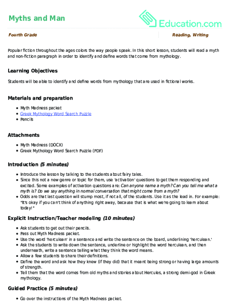
Myths and Man
Lesson Plan
Myths and Man
Fourth Grade
Reading
Popular fiction throughout the ages colors the way people speak. In this short lesson, students will read a myth and non-fiction paragraph in order to identify and define words that come from mythology.
Lesson Plan
Myths and Man
Lesson Plan
Myths and Man
Popular fiction throughout the ages colors the way people speak. In this short lesson, students will read a myth and non-fiction paragraph in order to identify and define words that come from mythology.
Fourth Grade
Reading
Lesson Plan
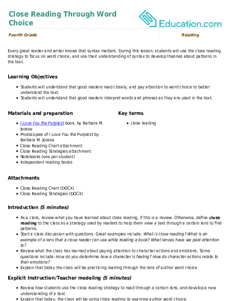
Close Reading Through Word Choice
Lesson Plan
Close Reading Through Word Choice
Fourth Grade
Reading
Every great reader and writer knows that syntax matters. During this lesson, students will use the close reading strategy to focus on word choice, and use their understanding of syntax to develop theories about patterns in the text.
Lesson Plan
Close Reading Through Word Choice
Lesson Plan
Close Reading Through Word Choice
Every great reader and writer knows that syntax matters. During this lesson, students will use the close reading strategy to focus on word choice, and use their understanding of syntax to develop theories about patterns in the text.
Fourth Grade
Reading
Lesson Plan
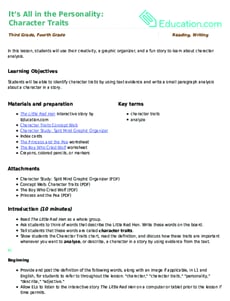
It’s All in the Personality: Character Traits
Lesson Plan
It’s All in the Personality: Character Traits
Third Grade
Reading
In this lesson, students will use their creativity, a graphic organizer, and a fun story to learn about character analysis.
Lesson Plan
It’s All in the Personality: Character Traits
Lesson Plan
It’s All in the Personality: Character Traits
In this lesson, students will use their creativity, a graphic organizer, and a fun story to learn about character analysis.
Third Grade
Reading
Lesson Plan
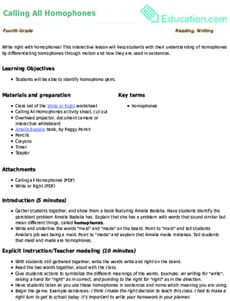
Calling All Homophones
Lesson Plan
Calling All Homophones
Fourth Grade
Reading
Write right with homophones! This interactive lesson will help students with their understanding of homophones by differentiating homophones through motion and how they are used in sentences.
Lesson Plan
Calling All Homophones
Lesson Plan
Calling All Homophones
Write right with homophones! This interactive lesson will help students with their understanding of homophones by differentiating homophones through motion and how they are used in sentences.
Fourth Grade
Reading
Lesson Plan
Pun Visuals
Lesson Plan
Pun Visuals
Fourth Grade
Reading
Strengthen your students' understanding of figurative language by helping them interpret visual puns! Students will use a webpage to help them understand puns in their future reading and writing endeavors.
Lesson Plan
Pun Visuals
Lesson Plan
Pun Visuals
Strengthen your students' understanding of figurative language by helping them interpret visual puns! Students will use a webpage to help them understand puns in their future reading and writing endeavors.
Fourth Grade
Reading
Lesson Plan
What's For Breakfast?
Lesson Plan
What's For Breakfast?
Fourth Grade
Reading
Teach your class to develop strong inferencing skills by focusing on clues and hard evidence. In this lesson, students will play a game of “What’s for Breakfast?” to help them link context clues with word meaning.
Lesson Plan
What's For Breakfast?
Lesson Plan
What's For Breakfast?
Teach your class to develop strong inferencing skills by focusing on clues and hard evidence. In this lesson, students will play a game of “What’s for Breakfast?” to help them link context clues with word meaning.
Fourth Grade
Reading
Lesson Plan
Journey on the Underground Railroad
Lesson Plan
Journey on the Underground Railroad
Fourth Grade
Reading
This lesson combines historical facts and creative writing to engage students in exercises that enhance both vocabulary and social studies knowledge.
Lesson Plan
Journey on the Underground Railroad
Lesson Plan
Journey on the Underground Railroad
This lesson combines historical facts and creative writing to engage students in exercises that enhance both vocabulary and social studies knowledge.
Fourth Grade
Reading
Lesson Plan
Character Comparisons
Lesson Plan
Character Comparisons
Fourth Grade
Reading
Use this lesson to help your ELs compare and contrast supporting characters from excerpted texts. It can be a stand-alone lesson or support the lesson Understanding Character Traits, Understanding Plot Lesson Part III.
Lesson Plan
Character Comparisons
Lesson Plan
Character Comparisons
Use this lesson to help your ELs compare and contrast supporting characters from excerpted texts. It can be a stand-alone lesson or support the lesson Understanding Character Traits, Understanding Plot Lesson Part III.
Fourth Grade
Reading
Lesson Plan
Author's Purpose: Easy as PIE
Lesson Plan
Author's Purpose: Easy as PIE
Fourth Grade
Reading
Give your class the "write" tools they need to become excellent authors. In this literary lesson, students use their knowledge of author's purpose to successfully write pieces that persuade, inform, and entertain.
Lesson Plan
Author's Purpose: Easy as PIE
Lesson Plan
Author's Purpose: Easy as PIE
Give your class the "write" tools they need to become excellent authors. In this literary lesson, students use their knowledge of author's purpose to successfully write pieces that persuade, inform, and entertain.
Fourth Grade
Reading
Lesson Plan
Scary Story Elements
Lesson Plan
Scary Story Elements
Fourth Grade
Reading
In this lesson, students will use conjunctions to compare and contrast scary stories. It can be taught independently or used as a pre-lesson to Using Story Elements to Compare and Contrast Fiction Texts.
Lesson Plan
Scary Story Elements
Lesson Plan
Scary Story Elements
In this lesson, students will use conjunctions to compare and contrast scary stories. It can be taught independently or used as a pre-lesson to Using Story Elements to Compare and Contrast Fiction Texts.
Fourth Grade
Reading
Lesson Plan
A Script with Adverbs
Lesson Plan
A Script with Adverbs
Fourth Grade
Reading
Describe what's happening in the script! Use this lesson to help your ELs describe events in a drama. It can be a stand-alone lesson or used as support to the lesson Summer Drama.
Lesson Plan
A Script with Adverbs
Lesson Plan
A Script with Adverbs
Describe what's happening in the script! Use this lesson to help your ELs describe events in a drama. It can be a stand-alone lesson or used as support to the lesson Summer Drama.
Fourth Grade
Reading
Lesson Plan
Nonfiction Main Idea
Lesson Plan
Nonfiction Main Idea
Fourth Grade
Reading
Let's get reading! In this lesson, students will identify the main idea and details of a nonfiction text. Use this on its own or as support for the lesson Connecting the Coasts: Effects of the Transcontinental Railroad.
Lesson Plan
Nonfiction Main Idea
Lesson Plan
Nonfiction Main Idea
Let's get reading! In this lesson, students will identify the main idea and details of a nonfiction text. Use this on its own or as support for the lesson Connecting the Coasts: Effects of the Transcontinental Railroad.
Fourth Grade
Reading
Lesson Plan
Shifting Points of View
Lesson Plan
Shifting Points of View
Fourth Grade
Reading
This lesson gives students practice identifying first person and third person narration in fiction and nonfiction texts. It could be taught as a stand-alone lesson or as a precursor to the lesson Fiction vs. Nonfiction.
Lesson Plan
Shifting Points of View
Lesson Plan
Shifting Points of View
This lesson gives students practice identifying first person and third person narration in fiction and nonfiction texts. It could be taught as a stand-alone lesson or as a precursor to the lesson Fiction vs. Nonfiction.
Fourth Grade
Reading
Lesson Plan
Traditional Literature: Story Mapping
Lesson Plan
Traditional Literature: Story Mapping
Second Grade
Reading
Students will learn how to identify story elements and create a short and sweet summary. They will fill out a graphic organizer and solidify their understanding by creating illustrations to show major plot points that they find themselves!
Lesson Plan
Traditional Literature: Story Mapping
Lesson Plan
Traditional Literature: Story Mapping
Students will learn how to identify story elements and create a short and sweet summary. They will fill out a graphic organizer and solidify their understanding by creating illustrations to show major plot points that they find themselves!
Second Grade
Reading
Lesson Plan
Simple Summaries
Lesson Plan
Simple Summaries
Third Grade
Reading
Keep it simple! Teach your students to write a summary using the Somebody-Wanted-But-So-Then frame for analyzing a story.
Lesson Plan
Simple Summaries
Lesson Plan
Simple Summaries
Keep it simple! Teach your students to write a summary using the Somebody-Wanted-But-So-Then frame for analyzing a story.
Third Grade
Reading
Lesson Plan
Main Idea and Details in Nonfiction
Lesson Plan
Main Idea and Details in Nonfiction
Fourth Grade
Reading
In this lesson, students will identify nouns and pronouns as they distinguish between the main idea and supporting details. It may be taught on its own or used as support for the lesson Compare and Contrast Texts on the Same Topic.
Lesson Plan
Main Idea and Details in Nonfiction
Lesson Plan
Main Idea and Details in Nonfiction
In this lesson, students will identify nouns and pronouns as they distinguish between the main idea and supporting details. It may be taught on its own or used as support for the lesson Compare and Contrast Texts on the Same Topic.
Fourth Grade
Reading
Lesson Plan
Using Story Elements to Compare and Contrast Fiction Texts
Lesson Plan
Using Story Elements to Compare and Contrast Fiction Texts
Fourth Grade
Reading
All fictional stories have story elements but they sure can differ between stories. In this lesson, students will compare and contrast the story elements of two fictional stories and document their findings in a graphic organizer.
Lesson Plan
Using Story Elements to Compare and Contrast Fiction Texts
Lesson Plan
Using Story Elements to Compare and Contrast Fiction Texts
All fictional stories have story elements but they sure can differ between stories. In this lesson, students will compare and contrast the story elements of two fictional stories and document their findings in a graphic organizer.
Fourth Grade
Reading
Lesson Plan
Similes and Metaphors: Comparisons Done Right
Lesson Plan
Similes and Metaphors: Comparisons Done Right
Fourth Grade
Reading
Your little poets will love how their creative writing abilities will grow with this lesson about similes and metaphors. Students engage in fun activities to learn about similes and metaphors and write comparisons as directed.
Lesson Plan
Similes and Metaphors: Comparisons Done Right
Lesson Plan
Similes and Metaphors: Comparisons Done Right
Your little poets will love how their creative writing abilities will grow with this lesson about similes and metaphors. Students engage in fun activities to learn about similes and metaphors and write comparisons as directed.
Fourth Grade
Reading
Lesson Plan
Poetry, Prose, and Drama, Oh My!
Lesson Plan
Poetry, Prose, and Drama, Oh My!
Fourth Grade
Reading
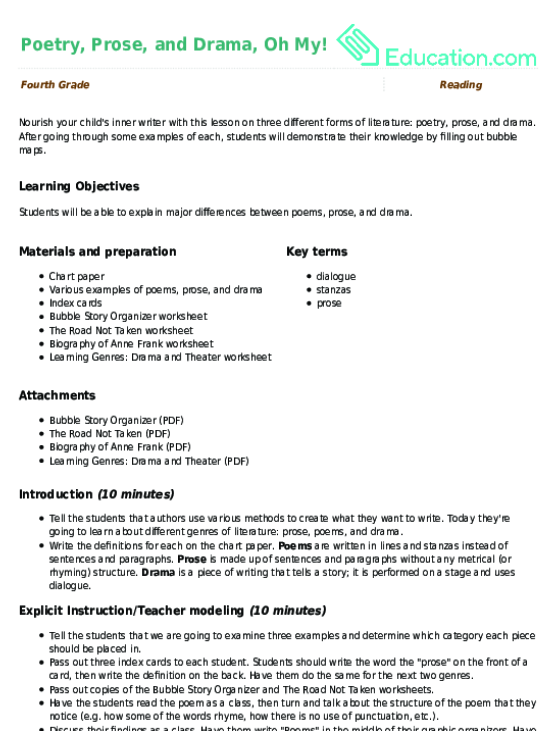
Nourish your child's inner writer with this lesson on three different forms of literature: poetry, prose, and drama. After going through some examples of each, students will demonstrate their knowledge by filling out bubble maps.
Lesson Plan
Poetry, Prose, and Drama, Oh My!
Lesson Plan
Poetry, Prose, and Drama, Oh My!
Nourish your child's inner writer with this lesson on three different forms of literature: poetry, prose, and drama. After going through some examples of each, students will demonstrate their knowledge by filling out bubble maps.
Fourth Grade
Reading
Lesson Plan
Spark Post Pun
Lesson Plan
Spark Post Pun
Fourth Grade
Reading
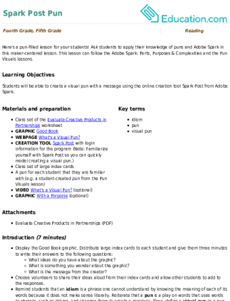
Here's a pun-filled lesson for your students! Ask students to apply their knowledge of puns and Adobe Spark in this maker-centered lesson. This lesson can follow the Adobe Spark: Parts, Purposes & Complexities and the Pun Visuals lessons.
Lesson Plan
Spark Post Pun
Lesson Plan
Spark Post Pun
Here's a pun-filled lesson for your students! Ask students to apply their knowledge of puns and Adobe Spark in this maker-centered lesson. This lesson can follow the Adobe Spark: Parts, Purposes & Complexities and the Pun Visuals lessons.
Fourth Grade
Reading
Lesson Plan
Significance of "Let Freedom Ring" in MLK, Jr.'s Speech
Lesson Plan
Significance of "Let Freedom Ring" in MLK, Jr.'s Speech
Fourth Grade
Reading
In this lesson, Significance of "Let Freedom Ring" in MLK, Jr.'s Speech, students will be able to understand the allusion Martin Luther King, Jr. makes to the song "My Country 'Tis of Thee." Have students discuss allusions in this speech.
Lesson Plan
Significance of "Let Freedom Ring" in MLK, Jr.'s Speech
Lesson Plan
Significance of "Let Freedom Ring" in MLK, Jr.'s Speech
In this lesson, Significance of "Let Freedom Ring" in MLK, Jr.'s Speech, students will be able to understand the allusion Martin Luther King, Jr. makes to the song "My Country 'Tis of Thee." Have students discuss allusions in this speech.
Fourth Grade
Reading
Lesson Plan
Interesting Introductions
Lesson Plan
Interesting Introductions
Third Grade
Reading
Teach young authors how to "hook" readers with this hands-on lesson. By examining novels and developing their own introductions, students will be able to hone their writing skills.
Lesson Plan
Interesting Introductions
Lesson Plan
Interesting Introductions
Teach young authors how to "hook" readers with this hands-on lesson. By examining novels and developing their own introductions, students will be able to hone their writing skills.
Third Grade
Reading
Lesson Plan
Immigration: Ellis Island
Lesson Plan
Immigration: Ellis Island
Fourth Grade
Reading
This is a lesson about the immigration procedures at Ellis Island. Students will learn about the process and creatively write about what it was like for immigrants to pass through Ellis Island.
Lesson Plan
Immigration: Ellis Island
Lesson Plan
Immigration: Ellis Island
This is a lesson about the immigration procedures at Ellis Island. Students will learn about the process and creatively write about what it was like for immigrants to pass through Ellis Island.
Fourth Grade
Reading
Lesson Plan
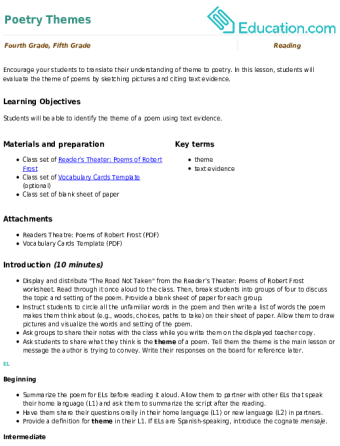
Poetry Themes
Lesson Plan
Poetry Themes
Fourth Grade
Reading
Encourage your students to translate their understanding of theme to poetry. In this lesson, students will evaluate the theme of poems by sketching pictures and citing text evidence.
Lesson Plan
Poetry Themes
Lesson Plan
Poetry Themes
Encourage your students to translate their understanding of theme to poetry. In this lesson, students will evaluate the theme of poems by sketching pictures and citing text evidence.
Fourth Grade
Reading
Lesson Plan
Connecting the Coasts: Effects of the Transcontinental Railroad
Lesson Plan
Connecting the Coasts: Effects of the Transcontinental Railroad
Fourth Grade
Reading
Look at history! In this lesson, guide students through an exploration of the context, causes, and effects of the Transcontinental Railroad, and help them practice identifying the main idea and supporting details in a nonfiction text.
Lesson Plan
Connecting the Coasts: Effects of the Transcontinental Railroad
Lesson Plan
Connecting the Coasts: Effects of the Transcontinental Railroad
Look at history! In this lesson, guide students through an exploration of the context, causes, and effects of the Transcontinental Railroad, and help them practice identifying the main idea and supporting details in a nonfiction text.
Fourth Grade
Reading
Lesson Plan
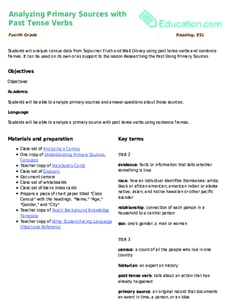
Analyzing Primary Sources with Past Tense Verbs
Lesson Plan
Analyzing Primary Sources with Past Tense Verbs
Fourth Grade
Reading
Students will analyze census data from Sojourner Truth and Walt Disney using past tense verbs and sentence frames. It can be used on its own or as support to the lesson Researching the Past Using Primary Sources.
Lesson Plan
Analyzing Primary Sources with Past Tense Verbs
Lesson Plan
Analyzing Primary Sources with Past Tense Verbs
Students will analyze census data from Sojourner Truth and Walt Disney using past tense verbs and sentence frames. It can be used on its own or as support to the lesson Researching the Past Using Primary Sources.
Fourth Grade
Reading
Lesson Plan
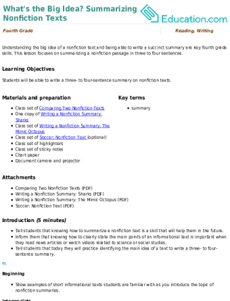
What's the Big Idea? Summarizing Nonfiction Texts
Lesson Plan
What's the Big Idea? Summarizing Nonfiction Texts
Fourth Grade
Reading
Understanding the big idea of a nonfiction text and being able to write a succinct summary are key fourth grade skills. This lesson focuses on summarizing a nonfiction passage in three to four sentences.
Lesson Plan
What's the Big Idea? Summarizing Nonfiction Texts
Lesson Plan
What's the Big Idea? Summarizing Nonfiction Texts
Understanding the big idea of a nonfiction text and being able to write a succinct summary are key fourth grade skills. This lesson focuses on summarizing a nonfiction passage in three to four sentences.
Fourth Grade
Reading
Lesson Plan
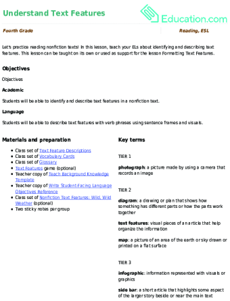
Understand Text Features
Lesson Plan
Understand Text Features
Fourth Grade
Reading
Let's practice reading nonfiction texts! In this lesson, teach your ELs about identifying and describing text features. This lesson can be taught on its own or used as support for the lesson Formatting Text Features.
Lesson Plan
Understand Text Features
Lesson Plan
Understand Text Features
Let's practice reading nonfiction texts! In this lesson, teach your ELs about identifying and describing text features. This lesson can be taught on its own or used as support for the lesson Formatting Text Features.
Fourth Grade
Reading
Lesson Plan
Detective Reading
Lesson Plan
Detective Reading
Fourth Grade
Reading
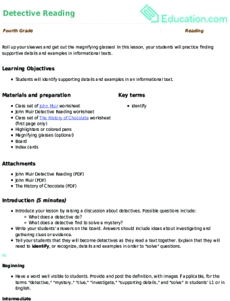
Roll up your sleeves and get out the magnifying glasses! In this lesson, your students will practice finding supportive details and examples in informational texts.
Lesson Plan
Detective Reading
Lesson Plan
Detective Reading
Roll up your sleeves and get out the magnifying glasses! In this lesson, your students will practice finding supportive details and examples in informational texts.
Fourth Grade
Reading
Lesson Plan
Fiction vs. Nonfiction
Lesson Plan
Fiction vs. Nonfiction
Fourth Grade
Reading
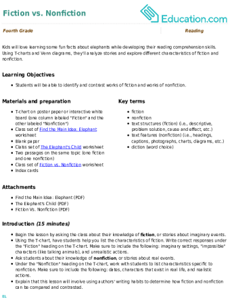
Kids will love learning some fun facts about elephants while developing their reading comprehension skills. Using T-charts and Venn diagrams, they'll analyze stories and explore different characteristics of fiction and nonfiction.
Lesson Plan
Fiction vs. Nonfiction
Lesson Plan
Fiction vs. Nonfiction
Kids will love learning some fun facts about elephants while developing their reading comprehension skills. Using T-charts and Venn diagrams, they'll analyze stories and explore different characteristics of fiction and nonfiction.
Fourth Grade
Reading
Lesson Plan
1
2