SKIP TO CONTENT
Worksheet Generator
Subjects
Grades
Worksheets
Games
Build a Worksheet
More Resources
Roly Recommends
Subjects
Grades
Worksheets
Games
Build a Worksheet
More Resources
Roly Recommends
1st - 4th Grade Lesson Plans for 'what'
Filters
1,423 results
Search for: what
✕
Lesson Plans
✕
1st - 4th Grade
✕
Clear all
1,423 results
Filters
Search for: what
✕
Lesson Plans
✕
1st - 4th Grade
✕
Subjects
Math
English Language Arts
Science
Social Studies
Technology
Grade Level
Pre-K
K
1st
2nd
3rd
4th
5th
6th
7th
8th
Early Childhood
Elementary School
Middle School
Resource Type
Worksheets
Games
Lesson Plans
Interactive Worksheets
Workbooks
Activities
Exercises
Stories
Songs
Offline Games
Guided Lessons
Teacher Resources
Occasion
Back to School
Common Core
Yes
Roly Recommends
Social Emotional Learning
English Language Support
Yes
Clear all
View 1,423 results
1st - 4th Grade Lesson Plans for 'what'
Filters
1,423 results
Search for: what
✕
Lesson Plans
✕
1st - 4th Grade
✕
Clear all
1,423 results
What is Recycling?
Lesson Plan
What is Recycling?
Second Grade
Life Science
What is recycling all about? What can and can't be recycled? What can I do to help others understand the importance of recycling? This activity helps students answer all of these questions as they learn about saving planet Earth.
Lesson Plan
What is Recycling?
Lesson Plan
What is Recycling?
What is recycling all about? What can and can't be recycled? What can I do to help others understand the importance of recycling? This activity helps students answer all of these questions as they learn about saving planet Earth.
Second Grade
Life Science
Lesson Plan
What Happened?
Lesson Plan
What Happened?
First Grade
Reading
Help your students' story telling abilities grow with this lesson that helps them recount what happened in a story and has them point out key details.
Lesson Plan
What Happened?
Lesson Plan
What Happened?
Help your students' story telling abilities grow with this lesson that helps them recount what happened in a story and has them point out key details.
First Grade
Reading
Lesson Plan
What Makes an Awesome Leader?
Lesson Plan
What Makes an Awesome Leader?
Second Grade
What makes an excellent leader? In this lesson, students will discuss leadership and design a video that informs others of what it means to be a positive leader.
Lesson Plan
What Makes an Awesome Leader?
Lesson Plan
What Makes an Awesome Leader?
What makes an excellent leader? In this lesson, students will discuss leadership and design a video that informs others of what it means to be a positive leader.
Second Grade
Lesson Plan
What Does the Author Think?
Lesson Plan
What Does the Author Think?
Third Grade
Can you tell what the author thinks about this subject? What do
you
think about it? Use this resource to help your students recognize the author's point of view and establish their own.
Lesson Plan
What Does the Author Think?
Lesson Plan
What Does the Author Think?
Can you tell what the author thinks about this subject? What do
you
think about it? Use this resource to help your students recognize the author's point of view and establish their own.
Third Grade
Lesson Plan
What is a Region?
Lesson Plan
What is a Region?
Fourth Grade
Geography
Through examples and non-examples, students will learn what qualifies as a region. Creativity and problem solving skills will be put to the test as students determine the necessary elements that make up a region.
Lesson Plan
What is a Region?
Lesson Plan
What is a Region?
Through examples and non-examples, students will learn what qualifies as a region. Creativity and problem solving skills will be put to the test as students determine the necessary elements that make up a region.
Fourth Grade
Geography
Lesson Plan
What is a Good Citizen?
Lesson Plan
What is a Good Citizen?
Kindergarten
Community and Culture
Aid your students in becoming the best citizens they can be with this lesson that teaches students how to be, and what makes, a good citizen.
Lesson Plan
What is a Good Citizen?
Lesson Plan
What is a Good Citizen?
Aid your students in becoming the best citizens they can be with this lesson that teaches students how to be, and what makes, a good citizen.
Kindergarten
Community and Culture
Lesson Plan
What Were They Thinking?
Lesson Plan
What Were They Thinking?
Fourth Grade
What do Malala Yousafzai, Al Gore, and Michelle Obama all have in common? They are all nonfiction authors with a purpose. In this interactive lesson, students will gain practice looking at details in text to identify the author’s purpose.
Lesson Plan
What Were They Thinking?
Lesson Plan
What Were They Thinking?
What do Malala Yousafzai, Al Gore, and Michelle Obama all have in common? They are all nonfiction authors with a purpose. In this interactive lesson, students will gain practice looking at details in text to identify the author’s purpose.
Fourth Grade
Lesson Plan
EL
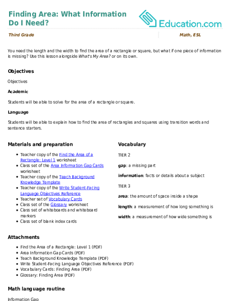
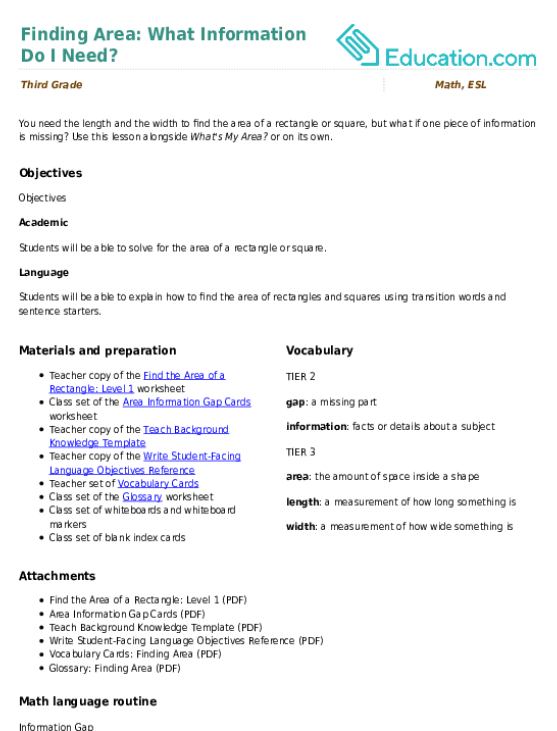
Finding Area: What Information Do I Need?
Lesson Plan
Finding Area: What Information Do I Need?
Third Grade
You need the length and the width to find the area of a rectangle or square, but what if one piece of information is missing? Use this lesson alongside
What's My Area?
or on its own.
Lesson Plan
EL
Finding Area: What Information Do I Need?
Lesson Plan
Finding Area: What Information Do I Need?
You need the length and the width to find the area of a rectangle or square, but what if one piece of information is missing? Use this lesson alongside
What's My Area?
or on its own.
Third Grade
Lesson Plan
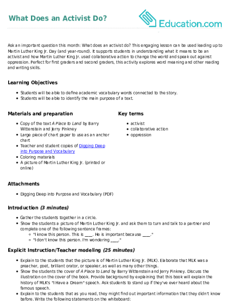
What Does an Activist Do?
Lesson Plan
What Does an Activist Do?
First Grade
Reading
Ask an important question this month: What does an activist do? This engaging lesson can be used leading up to Martin Luther King Jr. Day (and year-round). It supports students in understanding what it means to be an activist and how Martin Luther King Jr. used collaborative action to change the world and speak out against oppression. Perfect for first graders and second graders, this activity explores word meaning and other reading and writing skills.
Lesson Plan
What Does an Activist Do?
Lesson Plan
What Does an Activist Do?
Ask an important question this month: What does an activist do? This engaging lesson can be used leading up to Martin Luther King Jr. Day (and year-round). It supports students in understanding what it means to be an activist and how Martin Luther King Jr. used collaborative action to change the world and speak out against oppression. Perfect for first graders and second graders, this activity explores word meaning and other reading and writing skills.
First Grade
Reading
Lesson Plan
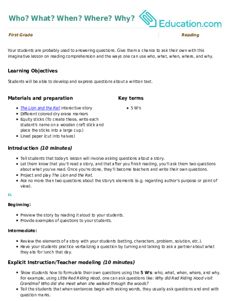
Who? What? When? Where? Why?
Lesson Plan
Who? What? When? Where? Why?
First Grade
Your students are probably used to answering questions. Give them a chance to ask their own with this imaginative lesson on reading comprehension and the ways one can use who, what, when, where, and why.
Lesson Plan
Who? What? When? Where? Why?
Lesson Plan
Who? What? When? Where? Why?
Your students are probably used to answering questions. Give them a chance to ask their own with this imaginative lesson on reading comprehension and the ways one can use who, what, when, where, and why.
First Grade
Lesson Plan
Exploring Probability: What Are The Chances?
Lesson Plan
Exploring Probability: What Are The Chances?
Third Grade
Probability
What is the likelihood that a polar bear will walk into the classroom? Students will consider this and other events using the concept of probability and the terms: Impossible, unlikely, likely, and certain.
Lesson Plan
Exploring Probability: What Are The Chances?
Lesson Plan
Exploring Probability: What Are The Chances?
What is the likelihood that a polar bear will walk into the classroom? Students will consider this and other events using the concept of probability and the terms: Impossible, unlikely, likely, and certain.
Third Grade
Probability
Lesson Plan
Who, When, What, Where, Why, and How?
Lesson Plan
Who, When, What, Where, Why, and How?
First Grade
Reading
Do you have students who are constantly asking what, who, where, why, how, and when? It's your turn to ask now! Have them read various stories and ask them to answer these questions in this lesson.
Lesson Plan
Who, When, What, Where, Why, and How?
Lesson Plan
Who, When, What, Where, Why, and How?
Do you have students who are constantly asking what, who, where, why, how, and when? It's your turn to ask now! Have them read various stories and ask them to answer these questions in this lesson.
First Grade
Reading
Lesson Plan
What is Culture?
Lesson Plan
What is Culture?
First Grade
Community and Culture
Help your students become global citizens with this lesson that teaches the about culture. Students will explore their culture and the cultures of their classmates in this engaging, hands-on activity.
Lesson Plan
What is Culture?
Lesson Plan
What is Culture?
Help your students become global citizens with this lesson that teaches the about culture. Students will explore their culture and the cultures of their classmates in this engaging, hands-on activity.
First Grade
Community and Culture
Lesson Plan
What Is Animation?
Lesson Plan
What Is Animation?
Fourth Grade
Engineering and Science Inquiry
In this lesson, students will learn to program an animated figure using ScratchJr.
Lesson Plan
What Is Animation?
Lesson Plan
What Is Animation?
In this lesson, students will learn to program an animated figure using ScratchJr.
Fourth Grade
Engineering and Science Inquiry
Lesson Plan
EL
What Are Arrays?
Lesson Plan
What Are Arrays?
Second Grade
In this lesson, students will explore the characteristics of arrays and find out why they are important. Use this lesson independently or alongside Come Array With Us!
Lesson Plan
EL
What Are Arrays?
Lesson Plan
What Are Arrays?
In this lesson, students will explore the characteristics of arrays and find out why they are important. Use this lesson independently or alongside Come Array With Us!
Second Grade
Lesson Plan
What Happens Next?
Lesson Plan
What Happens Next?
First Grade
Writing
Featuring Stephanie's Ponytail by Robert Munsch, this creative writing lesson gives students the chance to turn themselves into the main characters of emotion-packed short stories.
Lesson Plan
What Happens Next?
Lesson Plan
What Happens Next?
Featuring Stephanie's Ponytail by Robert Munsch, this creative writing lesson gives students the chance to turn themselves into the main characters of emotion-packed short stories.
First Grade
Writing
Lesson Plan
What Is an Algorithm?
Lesson Plan
What Is an Algorithm?
Second Grade
Engineering and Science Inquiry
In this lesson, students will learn to create a simple algorithm using block code. The platform used for this activity is a website created by Google that provides free educational games that teach students to program using block code.
Lesson Plan
What Is an Algorithm?
Lesson Plan
What Is an Algorithm?
In this lesson, students will learn to create a simple algorithm using block code. The platform used for this activity is a website created by Google that provides free educational games that teach students to program using block code.
Second Grade
Engineering and Science Inquiry
Lesson Plan
EL
What Was the Problem?
Lesson Plan
What Was the Problem?
Third Grade
Use this lesson to teach your students to use the correct past tense language when speaking about a story they have read. This lesson can stand alone or be used as a pre-lesson for the
Fiction Comprehension: Problem and Solution
lesson.
Lesson Plan
EL
What Was the Problem?
Lesson Plan
What Was the Problem?
Use this lesson to teach your students to use the correct past tense language when speaking about a story they have read. This lesson can stand alone or be used as a pre-lesson for the
Fiction Comprehension: Problem and Solution
lesson.
Third Grade
Lesson Plan
What is Subject-Verb Agreement?
Lesson Plan
What is Subject-Verb Agreement?
Fourth Grade
What's the grammar rule? In this subject-verb agreement lesson plan, you will introduce your students to the basics of subject-verb agreement with one simple rule.
Lesson Plan
What is Subject-Verb Agreement?
Lesson Plan
What is Subject-Verb Agreement?
What's the grammar rule? In this subject-verb agreement lesson plan, you will introduce your students to the basics of subject-verb agreement with one simple rule.
Fourth Grade
Lesson Plan
Listening to What Matters
Lesson Plan
Listening to What Matters
Second Grade
In this lesson, students will learn the importance of nonviolent communication and listening to others in order to have a more supportive community.
Lesson Plan
Listening to What Matters
Lesson Plan
Listening to What Matters
In this lesson, students will learn the importance of nonviolent communication and listening to others in order to have a more supportive community.
Second Grade
Lesson Plan
EL
What Are Equivalent Fractions?
Lesson Plan
What Are Equivalent Fractions?
Third Grade
Get your students to think deeply about fractions as they discuss which pictures show equivalence. Use this as a stand alone lesson or a pre-lesson for the
Equivalent Fractions: Are They Equal?
lesson.
Lesson Plan
EL
What Are Equivalent Fractions?
Lesson Plan
What Are Equivalent Fractions?
Get your students to think deeply about fractions as they discuss which pictures show equivalence. Use this as a stand alone lesson or a pre-lesson for the
Equivalent Fractions: Are They Equal?
lesson.
Third Grade
Lesson Plan
What is the Question?
Lesson Plan
What is the Question?
Third Grade
This lesson introduces students to the punctuation mark at the end of the sentence, the question mark. Your students will study sentences to determine whether or not to use a question mark.
Lesson Plan
What is the Question?
Lesson Plan
What is the Question?
This lesson introduces students to the punctuation mark at the end of the sentence, the question mark. Your students will study sentences to determine whether or not to use a question mark.
Third Grade
Lesson Plan
The Clock Struck What?
Lesson Plan
The Clock Struck What?
First Grade
It's time-telling time with this fun lesson featuring Trudy Harris' 'The Clock Struck One.' Students will learning about time with a short story and hands-on practice with analog clocks.
Lesson Plan
The Clock Struck What?
Lesson Plan
The Clock Struck What?
It's time-telling time with this fun lesson featuring Trudy Harris' 'The Clock Struck One.' Students will learning about time with a short story and hands-on practice with analog clocks.
First Grade
Lesson Plan
What’s Next?
Lesson Plan
What’s Next?
Fourth Grade
Guess what comes next! Teach your students to make a prediction based on textual evidence.
Lesson Plan
What’s Next?
Lesson Plan
What’s Next?
Guess what comes next! Teach your students to make a prediction based on textual evidence.
Fourth Grade
Lesson Plan
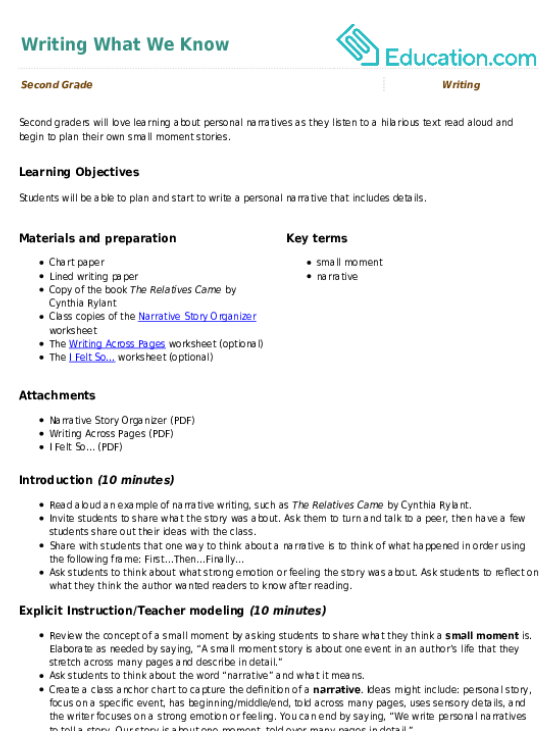
Writing What We Know
Lesson Plan
Writing What We Know
Second Grade
Second graders will love learning about personal narratives as they listen to a hilarious text read aloud and begin to plan their own small moment stories.
Lesson Plan
Writing What We Know
Lesson Plan
Writing What We Know
Second graders will love learning about personal narratives as they listen to a hilarious text read aloud and begin to plan their own small moment stories.
Second Grade
Lesson Plan
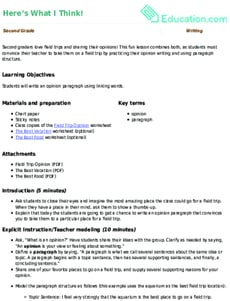
Here’s What I Think!
Lesson Plan
Here’s What I Think!
Second Grade
Writing
Second graders love field trips and sharing their opinions! This fun lesson combines both, as students must convince their teacher to take them on a field trip by practicing their opinion writing and using paragraph structure.
Lesson Plan
Here’s What I Think!
Lesson Plan
Here’s What I Think!
Second graders love field trips and sharing their opinions! This fun lesson combines both, as students must convince their teacher to take them on a field trip by practicing their opinion writing and using paragraph structure.
Second Grade
Writing
Lesson Plan
What Kind of Sentence Is That?
Lesson Plan
What Kind of Sentence Is That?
Fourth Grade
How much fun can you have reviewing the four kinds of sentences? You’re about to find out! This lesson culminates with a classroom game that doubles as a group review of declarative, exclamatory, interrogative, and imperative sentences.
Lesson Plan
What Kind of Sentence Is That?
Lesson Plan
What Kind of Sentence Is That?
How much fun can you have reviewing the four kinds of sentences? You’re about to find out! This lesson culminates with a classroom game that doubles as a group review of declarative, exclamatory, interrogative, and imperative sentences.
Fourth Grade
Lesson Plan
What are Checks and Balances?
Lesson Plan
What are Checks and Balances?
Third Grade
Life is about balance, and that applies to government too! Use this civics lesson with your students to teach them about the system of checks and balances, and why these are an important part of American government.
Lesson Plan
What are Checks and Balances?
Lesson Plan
What are Checks and Balances?
Life is about balance, and that applies to government too! Use this civics lesson with your students to teach them about the system of checks and balances, and why these are an important part of American government.
Third Grade
Lesson Plan
EL
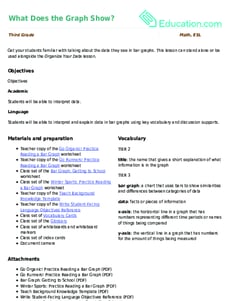
What Does the Graph Show?
Lesson Plan
What Does the Graph Show?
Third Grade
Get your students familiar with talking about the data they see in bar graphs. This lesson can stand alone or be used alongside the
Organize Your Data
lesson.
Lesson Plan
EL
What Does the Graph Show?
Lesson Plan
What Does the Graph Show?
Get your students familiar with talking about the data they see in bar graphs. This lesson can stand alone or be used alongside the
Organize Your Data
lesson.
Third Grade
Lesson Plan
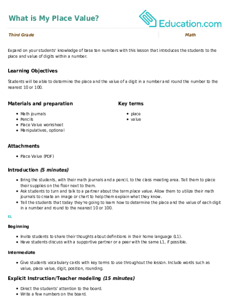
What is My Place Value?
Lesson Plan
What is My Place Value?
Third Grade
Expand on your students' knowledge of base ten numbers with this lesson that introduces the students to the place and value of digits within a number.
Lesson Plan
What is My Place Value?
Lesson Plan
What is My Place Value?
Expand on your students' knowledge of base ten numbers with this lesson that introduces the students to the place and value of digits within a number.
Third Grade
Lesson Plan
1
2
3
4
…
48